


Twelve Illinois scientists rank among world's most influential

Share
Twelve scientists at the University of Illinois Urbana-Champaign have been named to the 2025 Clarivate Analytics Highly Cited Researchers list, with 7 from the IGB. The list recognizes researchers and social scientists who have demonstrated exceptional influence, as reflected through their publication of multiple papers frequently cited by their peers during the last decade.
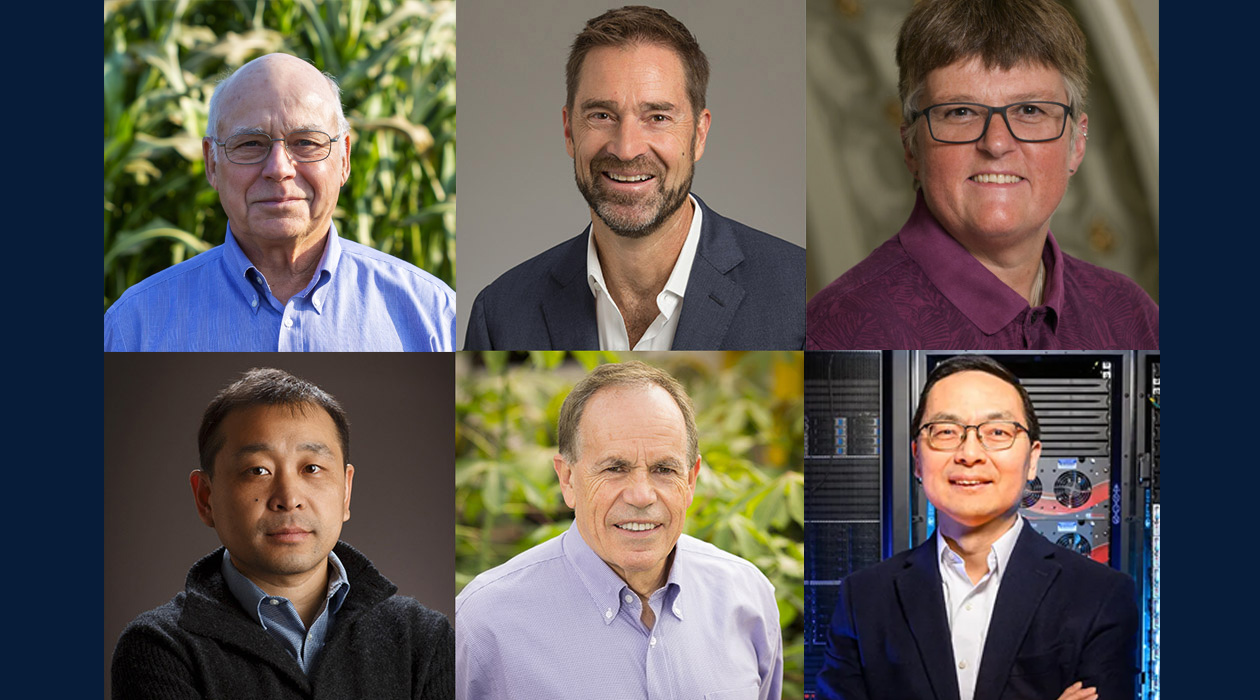
The highly cited Illinois researchers from the IGB this year are: natural resources and environmental sciences professor Kaiyu Guan (CAMBERS); plant biology professor Tracy Lawson (CAMBERS/PFS); plant biology and crop sciences professor emeritus Donald Ort (PFS leader/BSD/CAMBERS); psychology professor Brent Roberts (GNDP); cell and developmental biology professor Boxuan Zhao (GNDP); and chemical and biomolecular engineering professor Huimin Zhao (BSD leader/CAMBERS/CGD/MMG). The remaining researchers are materials science and engineering professor Axel Hoffmann; climate, meteorology and atmospheric sciences professor Atul Jain; Siebel School of Computing and Data Science professor Jimeng Sun; and civil and environmental engineering professor Lei Zhao.
This year’s list also includes psychology professor emeritus Ed Diener and plant biology and crop sciences professor Stephen P. Long (BSD/CAMBERS/PFS), both of whom are deceased.
“Highly Cited Researchers demonstrate significant and broad influence in their field(s) of research,” Clarivate Analytics reports. “Each researcher selected has authored multiple highly cited papers, which rank in the top 1% by citations for their field(s) and publication year in the Web of Science Core Collection over the past eleven years.” Other metrics and qualitative analyses are also used to compile the list. This year, 7,131 researchers are on the list.
Guan works to ensure sustainable food production and develop solutions to address environmental challenges in agriculture, focusing on agroecosystem modeling, remote sensing, environmental forecasting and agricultural adaptation to climate change. He is the founding director of the Agroecosystem Sustainability Center; a professor of computing and data science; a professor in the Institute for Sustainability, Energy, and Environment; and a Blue Waters professor at the National Center for Supercomputing Applications.
Lawson studies the influence of stomatal behavior on plant productivity and water-use efficiency, manipulating stomatal anatomy and function to produce crops that are more resilient to environmental changes, including higher temperatures and drought. She also focuses on developing new phenotyping tools to optimize plant growth in controlled environments, including vertical farms.
Ort’s research focuses on improving photosynthesis and addresses crop responses to global change including rising carbon dioxide levels, temperature stress and drought. He directed the open-air agricultural laboratory SoyFACE, led the Genomic Ecology of Global Change theme (now PFS), served as a research director of the Center for Advanced Bioenergy and Bioproducts Innovation and was deputy director of the international research project Realizing Increased Photosynthetic Efficiency.
Roberts specializes in the field of personality psychology and studies continuity and change in personality throughout adulthood, with an emphasis on understanding the factors that influence change. His recent research focuses on assessing and building social, emotional and behavioral skills. He also is a professor of biomedical and translational sciences in the Carle Illinois College of Medicine, a Center for Advanced Study professor, and an affiliate of the Center for Social and Behavioral Science.
Boxuan Zhao’s laboratory develops and applies new sequencing technologies to map how the mammalian brain is wired, exploring the underlying principles of how neurons form connections and identifying connectivity changes induced by experiences, behaviors and brain disorders. He incorporates transcriptomics and proteomics data into the structural map to clarify the underlying molecular mechanisms causing these changes. He also is a professor in the Neuroscience Program.
Huimin Zhao develops and applies synthetic biology, artificial intelligence and laboratory automation tools to address challenges in human health, sustainability and energy. His main research focuses on the development of an AI-powered self-driving biofoundry for protein engineering and cellular engineering. He is the director of three concurrent National Science Foundation research centers at the U. of I, including the Molecule Maker Lab Institute, the iBioFoundry and the Global Center for Biofoundry Applications. He also is an affiliate of the chemistry, biochemistry and bioengineering departments and the Center for Biophysics and Quantitative Biology.
Long, who passed away in September, used computational and bioengineering approaches to improve photosynthetic efficiency in crop plants and to address the effects of climate change on crop physiology and yields. He founded RIPE, a multinational project to increase crop production. He was the founding editor of the journal Global Change Biology, and was invited to give a TED Talk about his work in 2023. He was an affiliate of the NCSA and the Center for Advanced Study at the U. of I.