


Stephen P. Long: Visionary, teacher, and doer
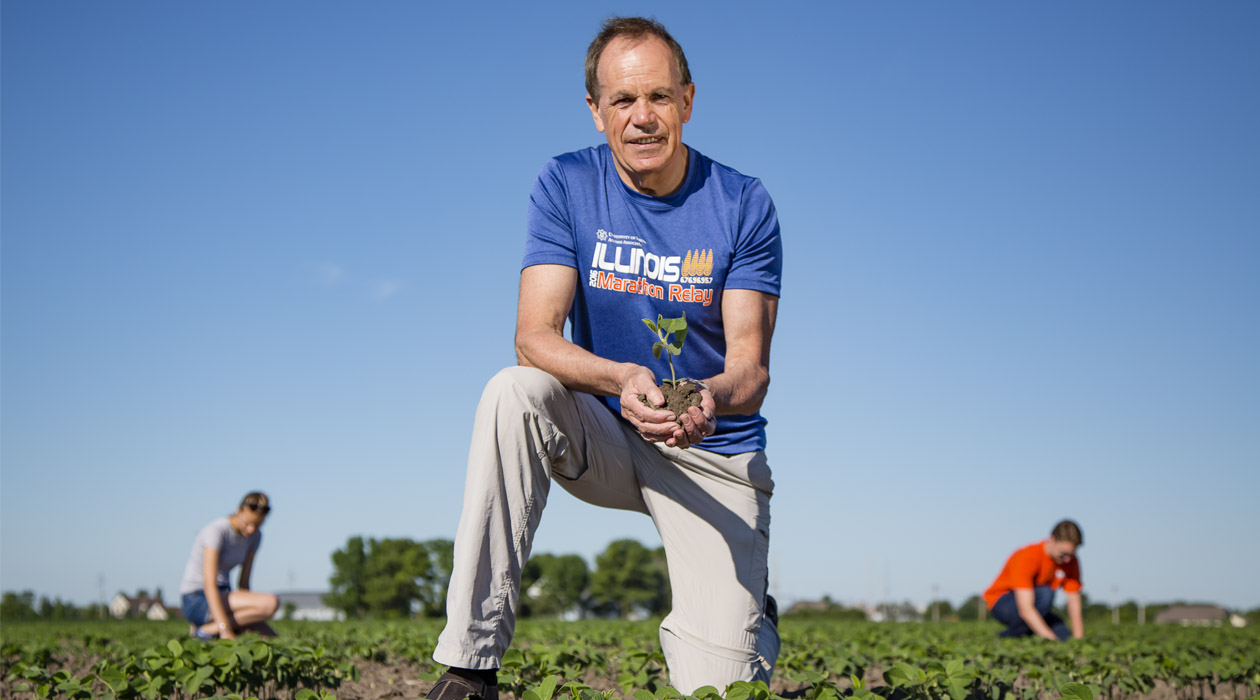
Stephen Long, the Ikenberry Endowed Chair of Crop Sciences and Plant Biology at Illinois, devoted his career to how changes in the atmosphere affected photosynthesis and influenced crop productivity, and what could be done to adapt food and bioenergy crops to global change.

Share
Stephen Long pioneered a multidisciplinary approach to advance our knowledge of photosynthesis, by integrating research at the molecular, cellular, organismal, and ecological levels along with a pragmatic understanding of the implications for agriculture. This involved development of new mathematical models, patented equipment for analyzing photosynthetic efficiency, and the world’s largest open-air laboratory for understanding crop responses to atmospheric change.
Long fundamentally changed our understanding of how crops respond to rising CO2 and ozone. He inspired and led efforts to engineer photosynthesis to increase yield and respond maximally to rising CO2. He discovered that C4 plants, that have highly efficient photosynthesis due to a CO2 concentrating mechanism, could thrive in cold climates, which was a true paradigm shift as previously C4 photosynthesis had been considered limited to tropical and subtropical climates. He provided a theoretical explanation, and his research led to the discovery that Miscanthus x giganteus could achieve the high yields in cool northern climate achieved by other C4 plants in the tropics. This seminal finding led Long to experiment on the closely related and much more widely used maize plant, and he showed how it could be adapted to cooler conditions and achieve a significant yield jump in the Corn Belt. At a time when society critically needed new ways to achieve increases in productivity in ecologically sustainable ways, Long’s research and leadership changed the way we think about choices of plants and cropping systems.
Read the full retrospective, authored by IGB Interim Director and C.A. Ewing Chair of Crop Physiology Lisa Ainsworth (PFS co-leader/CAMBERS), and Robert Emerson Professor of Plant Biology and Crop Sciences Don Ort (PFS co-leader/BSD/CAMBERS), published in PNAS: https://doi.org/10.1073/pnas.2536888123