


New "Stomata in-sight" system allows scientists to watch plants breathe in real-time
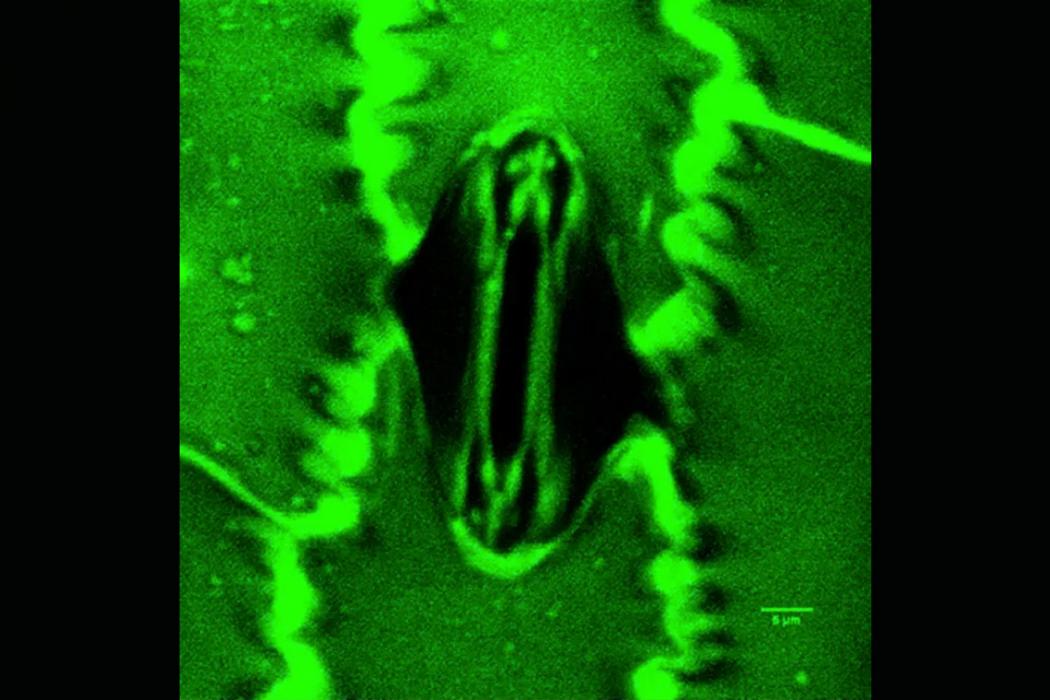
Representative 16-bit confocal microscope image of an open Zea mays stoma.

Share
For centuries, scientists have known that plants "breathe" through microscopic pores on their leaves called stomata. These tiny valves balance the intake of carbon dioxide to supply photosynthesis against the evaporation of water from the leaf into the air. Researchers at the University of Illinois Urbana-Champaign have developed a groundbreaking new tool that allows them to watch and quantify this process in real time and under strictly controlled environmental conditions.
The study, published in the journal Plant Physiology, introduced a system dubbed "Stomata In-Sight." It solves a long-standing technical challenge in plant biology: how to observe the microscopic movements of stomatal pores while simultaneously measuring how much gas they are exchanging with the atmosphere, a feat that requires high-powered microscopy within a tightly controlled environment.
The research team was led by plant biology professor Andrew Leakey (CAMBERS leader/PFS) and postdoctoral researcher Joseph Crawford (PFS) and colleagues, in close collaboration with Carl R. Woese Institute for Genomic Biology Core Facilities Director Glenn Fried. Leakey is also the director of the US Department of Energy-funded Center for Advanced Bioenergy and Bioproducts Innovation, which provided support for the work.
The ability of crop plants to regulate water loss is critical to global agriculture. Plants must open their stomata to get the carbon dioxide they use in converting the energy of sunlight into sugar during photosynthesis. Each time stomata open, water is lost from the leaves in the form of vapor, dehydrating the plant.
Because of the need to balance the need for carbon dioxide against water loss, stomata respond quickly to changes in light, humidity, and other environmental and internal factors. Understanding how the movements and distribution of stomata impact photosynthesis is key to developing crops that need less water to grow and can reliably produce food, biofuel and bioproducts even during drought stress.
In the past, researchers often examined stomata by making impressions of leaves (like taking a dental mold), which only captures a static snapshot. To capture carbon dioxide intake and stomata function simultaneously, they turned to measuring changes in water vapor surrounding a leaf, but this method gives an indirect and averaged idea of stomata activity.
"Traditionally, we've had to choose between seeing the stomata or measuring their function," Leakey said.
The "Stomata In-Sight" system integrates three complex technologies into one: live, three-dimensional microscopy of the living cells on the surface of the leaf; high-precision sensors within a carefully designed environmental chamber to measure exactly how much carbon dioxide and water are being exchanged through open stomata; and image analysis powered by machine learning to identify, track, and correlate stomata function with the changing conditions. The machine learning tool accelerated the speed with which the aperture of many stomatal pores could be assessed.
Over the course of the study, the research team successfully demonstrated that they could successfully combine these three technologies. They showed that across multiple environmental conditions, the system could detect and quantify stomata movement. Using these metrics, they were able to make predictions about carbon dioxide and water exchange across the leaf and verify the predictions using real-time data.
This high-definition view of plant physiology has the potential to revolutionize how crops are developed. By understanding how stomatal opening and closing is coordinated across the leaf surface and in response to plant growth conditions, scientists can identify genetic traits associated with "smarter" plants—crops that use water most efficiently while still producing high yield. That is crucial because water is a primary factor limiting agricultural production.
In addition to the DOE, this work was supported by two additional funding sources. The National Science Foundation is funding the team to assess how stomata and photosynthesis are regulated to respond to rapid fluctuations in light. A generous philanthropic gift from Tito’s Handmade Vodka is supporting the team as they broadly investigate how artificial intelligence can be used to accelerate measurement of key crop traits, as part of broader efforts to breed crops that can be highly productive while requiring less water.