


Microbial assembly line makes plastic upcycling programmable
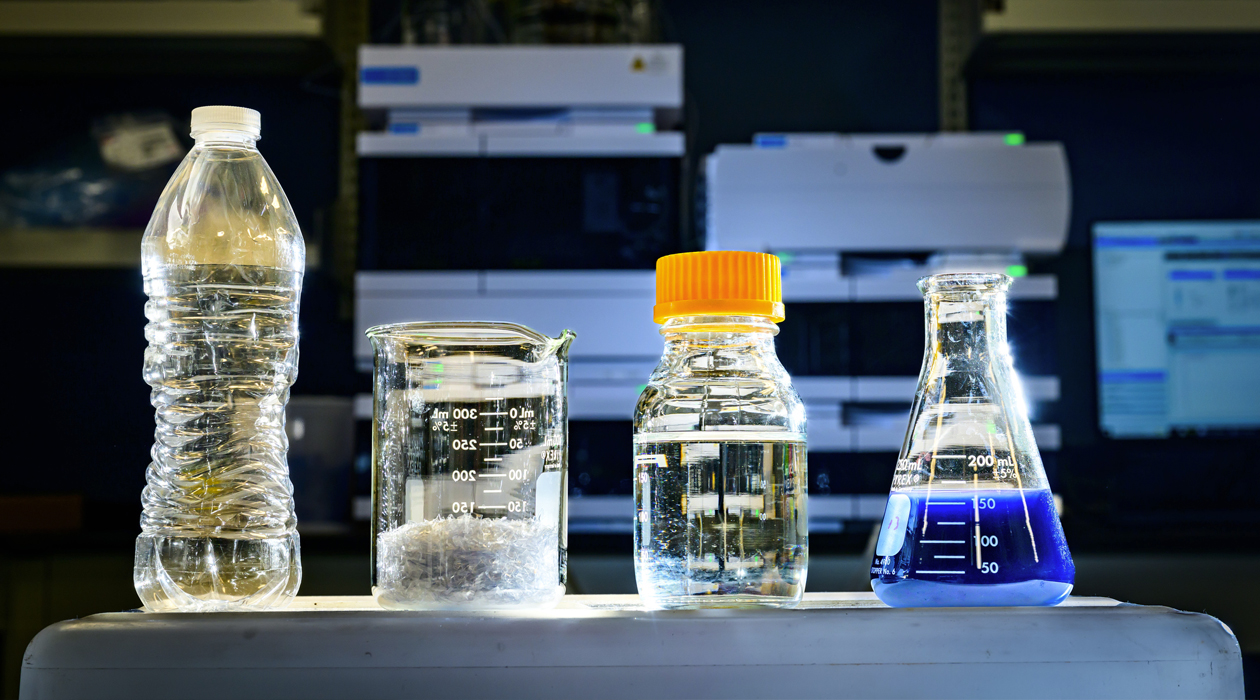
Researchers used microbes to convert plastic waste into pyruvate, an essential energy source for microbes that use it to generate other useful products. As a proof-of-concept experiment, they converted polyethylene terephthalate, or PET, from plastic bottles into the blue dye indigoidine. / Fred Zwicky

Share
By converting plastic waste into a microbe-friendly food source, scientists have built an upcycling pipeline that turns the waste into a variety of useful products.
The findings are detailed in the journal Nature Sustainability.
The team engineered the bacterium Pseudomonas putida to convert polyethylene terephthalate, a main class of single-use plastics found in containers like water bottles, into pyruvate, a molecule that most organisms rely on to generate the cellular energy and biomass that sustain them. The researchers also developed a series of specialist microbes, each of which consumes pyruvate to produce a unique end-product.
Because every arm of their microbial assembly line centers on pyruvate, “it offers an efficient and flexible method for generating a virtually unlimited variety of products,” said University of Illinois Urbana-Champaign bioengineering professor Ting Lu (BSD/CAMBERS/PFS), who led the study with his senior research scientist Yuanchao Qian. Such products include biopolymers and enzymes used in medicine, chemicals and fuels used in engineering, and electricity for powering electronics.
“Plastic pollution is a global challenge, yet most recycling or upcycling approaches today are narrow — they convert plastic into a single, fixed product, regardless of changing or diverse needs,” Lu said. “Our study takes a fundamentally different approach. We show that plastic waste can be treated as a versatile resource, capable of being converted into many different valuable products on demand.”
Each year, the world produces more than 400 million tons of plastic and, “so far, only about 9% of this waste is recycled,” Lu said. Much of the rest is either incinerated, lost to the environment or landfilled.
A key insight of the new study is the use of a universal currency, pyruvate, in conjunction with a community of organisms, each optimized to use pyruvate to generate a specific product. This differs from approaches that try to engineer multiple capabilities into a single microbe, Lu said.
“Plastic is first broken down into a common building block, which can then be routed to different engineered microbes — much like swapping tools on a factory line — to generate a wide range of outputs, including materials, fuels, chemicals, enzymes and even electricity,” he said. “This built-in flexibility is critical if plastic upcycling is to be practical, scalable and responsive to real-world demands.”
In a proof-of-concept demonstration using real-world waste, the researchers fished plastic water and soda bottles from their own recycling bins, shredded and hydrolyzed them into byproducts terephthalic acid and ethylene glycol. Then, they fed the hydrolysates to their engineered P. putida, which had been designed to produce pyruvate without consuming it. The bacterium was not used alone, however. In the same pot, the team grew a strain of Escherichia coli designed to produce a natural dye, indigoidine.
As in other experiments, the engineered E. coli consumed the pyruvate as quickly as it was produced and generated the desired end-product, in this case, a blue pigment.
“Because plastic pollution sits at the intersection of environmental damage, public health and sustainability, we believe this concept — transforming postconsumer plastic into various target products — could change it from a pollution source to a viable resource,” Lu said.
Merck KGaA in Darmstadt, Germany, and the U.S. Defense Advanced Research Projects Agency ReSource program supported this research.
Lu is a professor in the Center for Biophysics and Quantitative Biology and the Carle Illinois College of Medicine, and a research affiliate of physics at the U. of I. Qian is the first author of the new paper. Bioengineering and physics are departments in The Grainger College of Engineering at the U. of I.
***
The paper “A programmable microbial assembly line for plastic upcycling” is available online. DOI: 10.1038/s41893-025-01765-9