


IGB Profile: Lizzie Bello
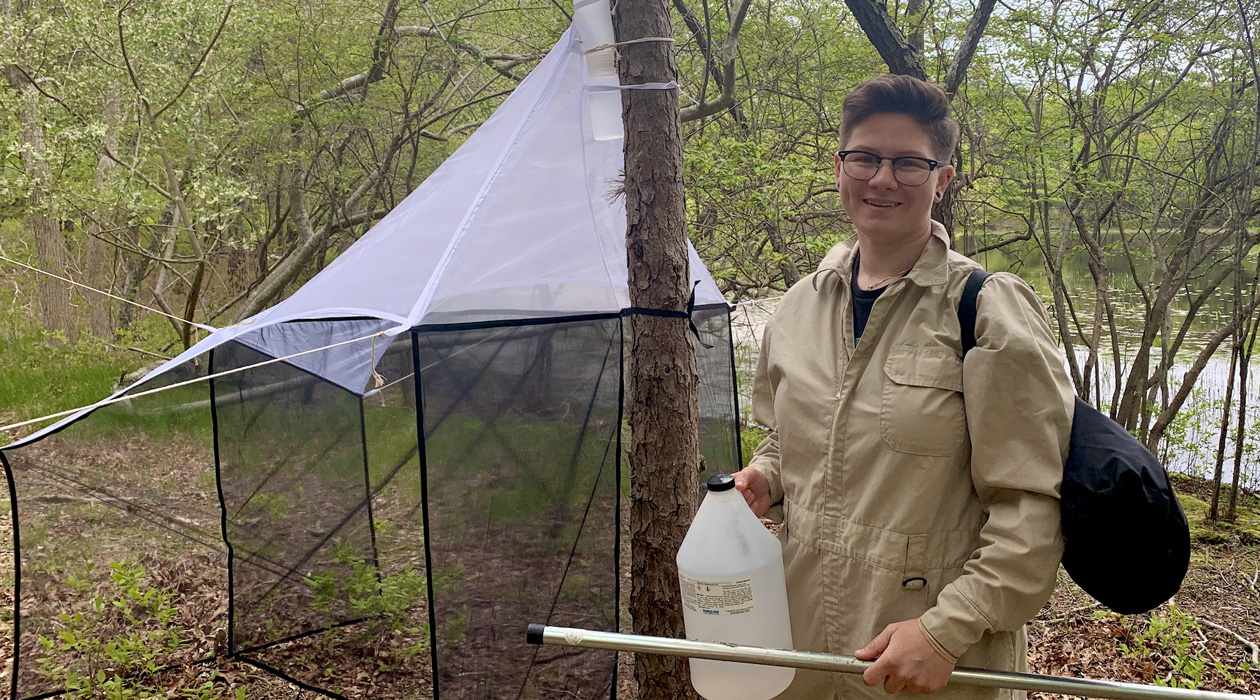
"The idea of 'umwelt', a term coined by biologist Jakob von Uexküll, really expanded my idea of the natural world. Umwelt describes the unique subjective perceptual world that every living organism experiences. What we think a flower smells like or looks like might be totally different from the perspective of a dog or honey bee, for example."

Share
Many kids are inspired by early participation in sports. Lizzie Bello was too, but maybe not in quite the way her coach anticipated. In the outfield during softball games, she was doing what she did every day growing up in Florida—getting lost in the wonder of the natural world.
“Catching lizards was probably my favorite, but I also used to catch snakes, frogs, toads, all sorts of bugs and other critters like roly-polies and millipedes. I played outside, climbed trees, and swam in the ocean,” Bello said. “I think being out in nature all the time is what really got me interested in science in the first place.”
Bello joined the Carl R. Woese Institute for Genomic Biology at the start of September as the institute’s latest science writing fellow. The love of nature that has stayed with her through the years will now fuel her work translating IGB’s research portfolio into engaging and accessible news for the public.
Just as Bello’s interest in living things started early, so too did her identification with science as a pursuit. She attended a STEM magnet school, Poinciana Elementary, and thrived on the culture of science in the school. For her, the school was not incepting an interest in science, but rather affirming what she already felt.
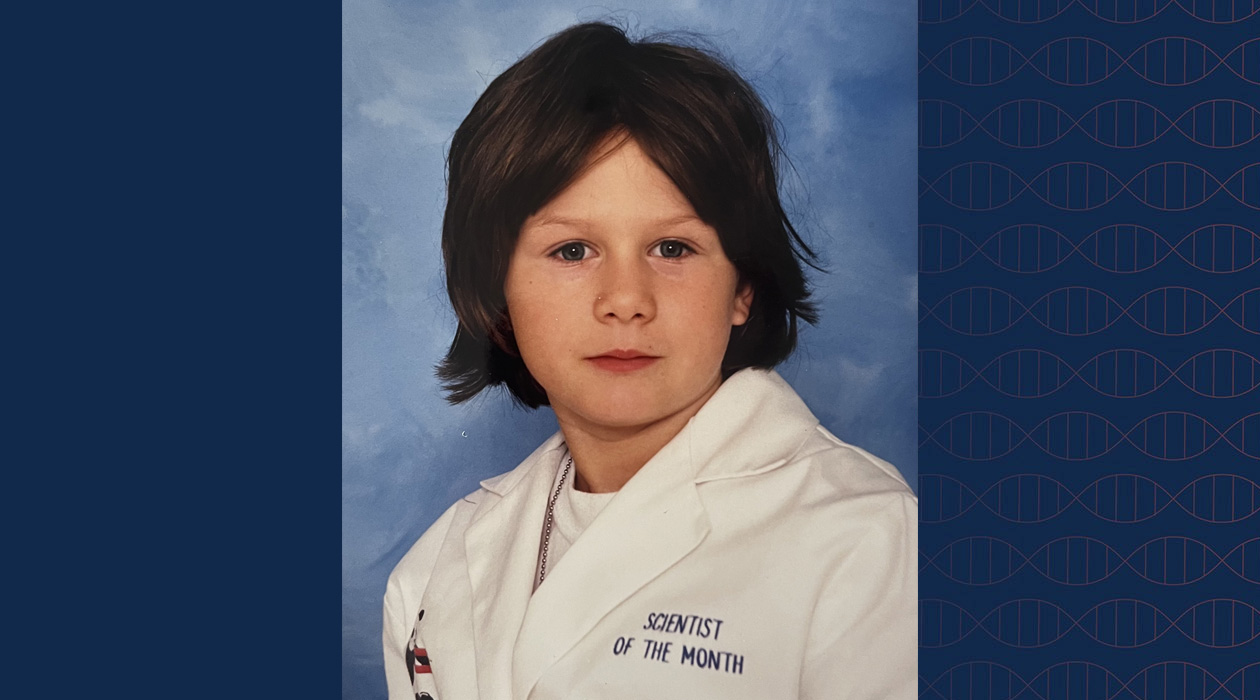
“I loved science class and was actually named ‘Scientist of the Month’ on several occasions,” Bello said. “I knew it was an accomplishment and I was proud, but I think it’s a lot more meaningful now when I think about those early days and the scientist I grew up to be.”
In college, Bello sharpened her focus on one of her early interests: insects.
“I was always fascinated by insects, but it wasn’t until I took an entomology course at Farmingdale State College with Dr. Carly Tribull that I realized I could have a career in entomology,” she said. “Dr. Tribull quickly became my undergraduate advisor and encouraged me to develop an independent research project.”
Bello began research, pursuing an ecological field study of bumble bees. She traveled to St. Louis for the 2019 Entomological Society of America Annual Meeting, where a chance encounter set her on a path toward the University of Illinois Urbana-Champaign.
“We were at a barbeque restaurant one night and Dr. Marianne Alleyne, whose lab I was interested in, just so happened to be there,” she said. “Dr. Tribull introduced me and the rest is history.”
Alleyne, an assistant professor of entomology, and Bello remained in touch after the conference, and Bello was accepted to the Illinois Entomology Department graduate program the following spring. She arrived on campus in the summer of 2020, ready to embark on the next phase of her research career—although doing so amidst the challenges of the COVID-19 pandemic required some creativity.
Bello was set up with a stereomicroscope and a computer in her home and began getting to know Alleyne’s laboratory group via Zoom. Fairly quickly, she was attracted to a developing collaboration with chemical and biomolecular engineering professor Charles Schroeder (BSD/GNDP) to study the unique properties of the cuticle, or outside surface, of small insects called leafhoppers.
“The first time I saw a leafhopper was during one of my entomology classes at Farmingdale. It was a beautiful red-banded leafhopper, Graphocephala coccinea, and I remember thinking ‘Wow, that is the coolest surfboard-looking bug I have ever seen,’” Bello said. “Little did I know they’d take over my life in Illinois a year later . . . the more I learned, the more questions I had.”
Along with colleagues at the University of Texas at Austin and Northwestern University, Bello and her Illinois collaborators investigated the properties of naturally occurring nanoparticles called brochosomes. These particles are found on the leafhopper cuticle and serve multiple functions: contributing to camouflage, reducing glare, and making the exoskeleton water-resistant.
In addition to the satisfaction of reverse-engineering these fascinating adaptations, Bello appreciated the communication skills she gained in collaborating across disciplinary boundaries.
“I think one of the most important lessons I learned was to communicate openly and be humble. Never stop asking questions,” she said. “Biologists and engineers practically speak two different languages, which makes communication challenging. Each collaborator offers a different perspective and sometimes you have to be brave enough to admit when you don’t understand something outside of your expertise and ask for clarification.”
Bello is now excited to put those communication skills to use for the IGB. In the science writing fellowship, she will write press releases, help to edit grant proposals, contribute to online and printed institutional publications, and develop materials for public engagement activities. She is excited to dive in.
“I’m most excited about working with a large, diverse team of creative people all with unique skill sets,” she said. “Being passionate about both science communication and outreach, I’m really excited to continue building my communication skills and to learn from those around me.”