



A gene editing tool designed to precisely rewrite the gene that causes Huntington’s disease reduced toxic protein fragments and symptoms associated with the disease in mice, researchers at the University of Illinois Urbana-Champaign report.
While other gene-based treatments have focused on turning the gene off, the Illinois team took a different approach. The researchers designed a base-editing tool to alter a specific point of the huntingtin gene so the cell’s machinery would skip over a small section prone to generating toxic fragments, while preserving enough huntingtin protein to support its normal functions.
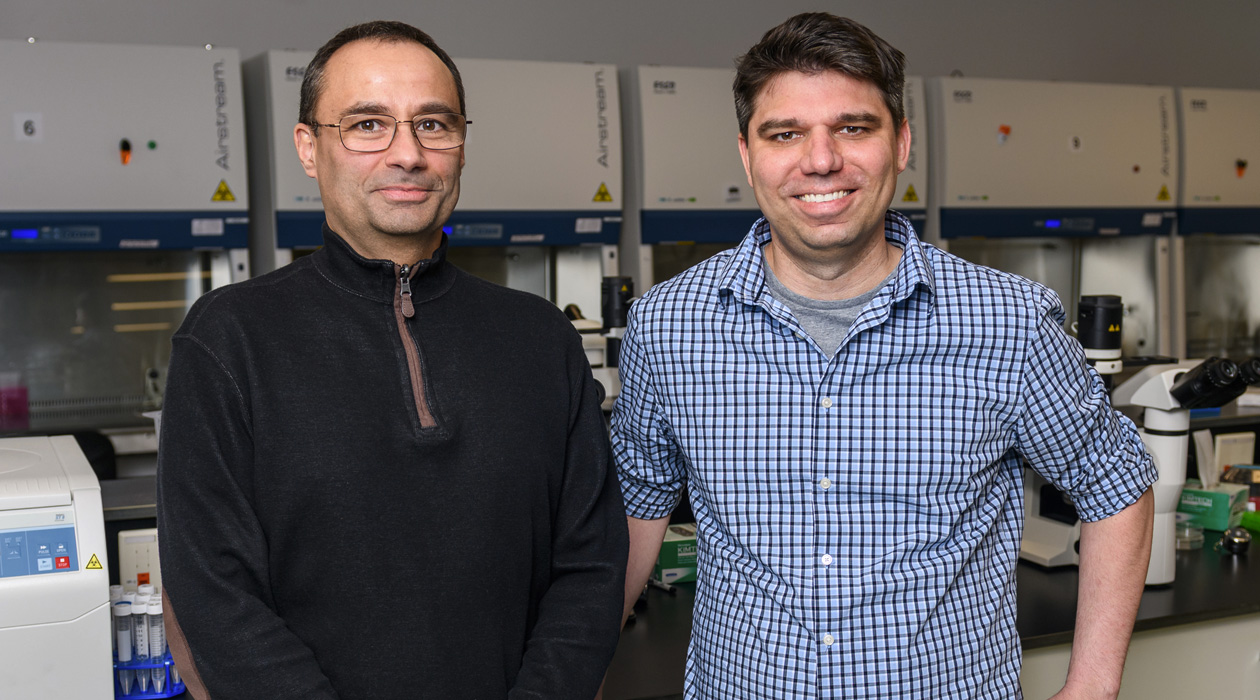
Led by Pablo Perez-Pinera (ACPP/CAIM) and Thomas Gaj (BSD), professors of bioengineering at the U. of I., the researchers published their findings in the journal Nature Biomedical Engineering.
“Our results suggest a new way of thinking about treating Huntington’s disease: Instead of inactivating the protein completely or targeting collateral pathways, we introduce a very small edit in the gene that changes how the protein is processed by the cells. For Huntington’s disease, this is an exciting development because there is no cure and having multiple possible treatments in the pipeline provides a reason for hope,” Perez-Pinera said.
Huntington’s disease is an inherited condition that causes progressive loss of control over movement and cognitive decline. It is caused by a mutation in the HTT gene, which makes the huntingtin protein prone to being cleaved into toxic fragments that gradually kill brain cells. Because symptoms typically manifest in middle age, patients may not know they have the condition until they have already passed it to their children.
“Our base editors were developed to target the region of HTT that, when cleaved, can initiate the chain of events that leads to the toxic fragments. The result is that instead of turning the protein off completely, we alter how the gene is read so that the most damaging protein fragments are not produced,” Gaj said.
The team screened more than 140 base editors, a gene editing technology that chemically converts one DNA base to another without cutting both strands of DNA. They found the editors that were the most effective with the fewest unintended effects and injected them into the brains of mice with mutant HTT genes.
The mice that received the base-editing treatment had less accumulation of toxic protein fragments, reduced symptoms and less degeneration within the brain than untreated mice.
“This approach not only shows that base editors have the potential to be used for Huntington’s disease, it also opens the door to a new kind of potential treatment for other genetic conditions,” Gaj said. “This study helps to show that treating genetic diseases can be done without inactivating a gene or directly correcting a mutation. Sometimes, it is possible to implement modifications to change how proteins function and that could be sufficient to protect the body from further damage.”
Next, the researchers are working to refine delivery of the base editors to the brain, hoping to make it less invasive and not rely on viruses for transport, said Illinois graduate student Kyrollos Shenouda. “We’re also interested in adapting this approach to target other regions of the HTT gene to decrease other toxic aspects of the protein,” Shenouda said.
Perez-Pinera is affiliated with the department of Molecular and Integrative Physiology, the Carle Illinois College of Medicine and the Cancer Center at Illinois. Bioengineering professor Sergei Maslov (CAIM) was a co-author of the paper. The CHDI Foundation was the primary sponsor of this work, with additional support from the National Institutes of Health, the Muscular Dystrophy Association, the American Heart Association, the Parkinson’s Disease Foundation and the Simons Foundation.