


AI model offers a faster way to explore how proteins move, study finds
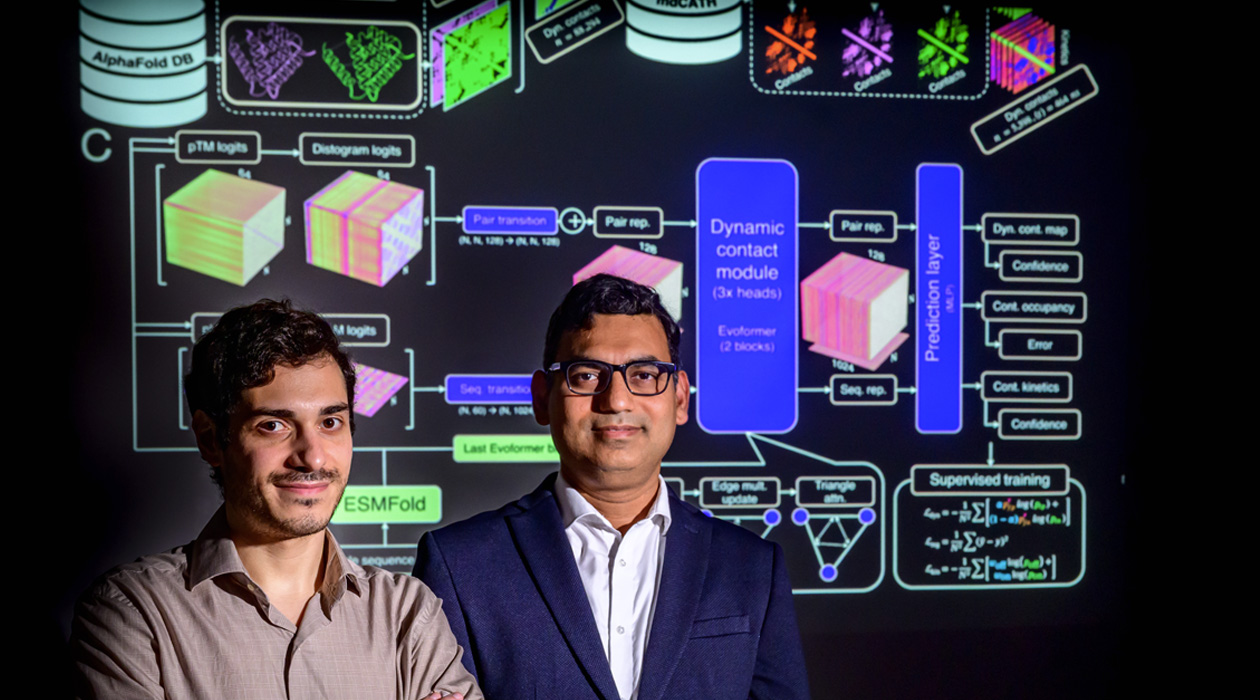
Diwakar Shukla, right, and graduate student Diego E. Kleiman worked together to map the moving parts of more than 18,000 proteins in the human body in less than two days, a feat that used to take months on a supercomputer. / Fred Zwicky

Share
The proteins that keep the cells in all living things working don’t stay still. They bend and shift between shapes as they perform their jobs, but many tools for studying proteins reveal only a snapshot of how they really work.
Historically, capturing protein movement for molecular biology studies required massive supercomputing clusters running molecular dynamics simulations. These “MD” simulations can track thousands of individual atoms over time and can take weeks or months to produce results.
In a new study, researchers at the University of Illinois Urbana-Champaign are using AI to predict protein motion—a capability that could help them study disease-related mutations and drug-binding possibilities that may appear only when a protein shifts into a particular shape.
“Because the new AI model is so incredibly fast, we did something previously impossible,” said Diwakar Shukla (CAMBERS/MMG), a professor of chemical and biomolecular engineering at Illinois. “We mapped the moving parts of more than 18,000 proteins in the human body in less than two days.”
In the study, Shukla and his team, including first author and U. of I. graduate student Diego E. Kleiman, introduce ESMDynamic, a deep learning model that predicts residue-to-residue contact dynamics—or what happens when two amino acids in a protein are spatially close to each other in a folded 3D protein structure but are far apart in the linear amino acid sequence—to mimic the dynamics and accuracy of the expensive, time-consuming simulations in milliseconds. The model can predict whether a contact is likely to change, how often it appears and roughly how quickly it forms or breaks, on short nanosecond timescales.
The study’s findings are published in the journal Nature Communications.
The new model can help researchers identify flexible regions that may be important for protein function, choose sites for experiments and focus molecular dynamics simulations on the most informative movements. Shukla said this improves on static AI models that suffer from what researchers call “mode collapse,” meaning they show only one protein shape and block researchers from visualizing alternatives.
The study found that ESMDynamic performed as well as or better than several leading methods at finding changing protein contacts, while running much faster. It also detected movements in several challenging examples, including human amino-acid transporters, which have important clinical implications for treating cancer and genetic disorders.
“The tool is best at predicting relatively fast, local movements like small contact changes,” Shukla said. “It is less reliable for highly disordered proteins and very slow or large-scale shape changes. Its results are a useful guide for deeper experiments and simulations, rather than a complete picture of every way a protein can move.”
Meanwhile, this massive open-access catalog offers an unprecedented look at human biology, letting scientists worldwide see exactly how genetic mutations might paralyze a protein’s necessary movements and trigger disease.
The National Science Foundation, the National Institute of General Medical Sciences, the National Institutes of Health and the Molecular Sciences Software Institute supported this research. Shukla is also affiliated with plant biology, chemistry, bioengineering, the National Center for Supercomputing Applications, and the Center for Digital Agriculture.
***
The paper “ESMDynamic: Fast and accurate prediction of protein dynamic contact maps from single sequences” is available online. DOI: 10.1038/s41467-026-76361-2. Bioengineering is part of The Grainger College of Engineering at Illinois.