


Helen Nguyen receives Wellcome Leap Award to study antimicrobial resistance networks
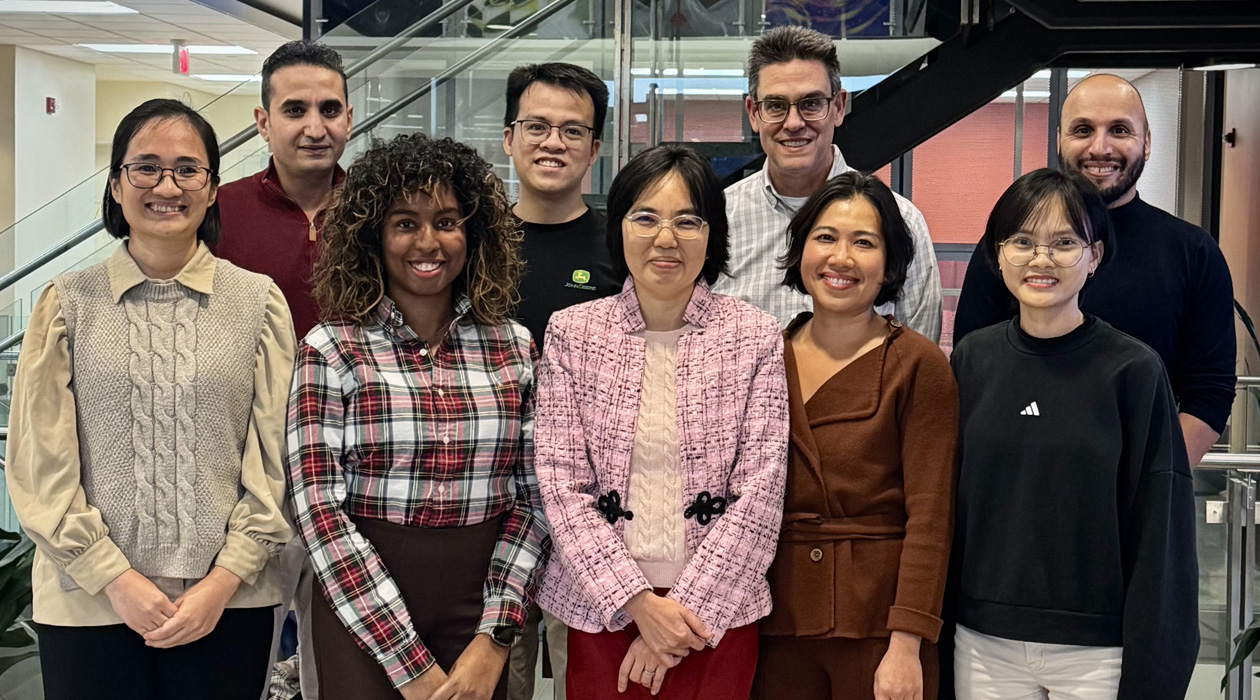
Front row (left to right): Hien Ngo, Nidia Trovao, Helen Nguyen, Mai Hoang, Nhung Do
Back row (left to right): Mohamed Zeineldin, Kien Dang, Tony Yannarell, Mohammed El-Kebir / Elizabeth Bello

Share
In rising economies, an increasing demand for animal protein drives industrial livestock production, which relies heavily on antibiotics. This use has a hidden cost; when bacteria in livestock animals are exposed to consistent, low-level antibiotic treatments, the antibiotics eliminate susceptible bacterial strains but allow resistant bacteria to survive and multiply, enabling the spread of those more pernicious strains.
Antibiotics are recognized as powerful infection-fighting tools, but misuse and overuse of antibiotics can quickly accelerate antibiotic resistance. Researchers at the Carl R. Woese Institute for Genomic Biology have received new funding from Wellcome Leap to investigate and understand the transfer of plasmids that carry antibiotic resistance genes, or ARGs, from one bacterium to another in human populations.
Ivan Racheff Professor of Environmental Engineering Helen Nguyen (IGOH) will lead a three-year research project which falls under the Wellcome Leap Resistance Networks program with collaborators from the University of Illinois Urbana-Champaign and VinUniversity in Vietnam. Vietnam is a developing country with a nascent need for animal protein sources. Due to growing livestock densities and limited regulations on antibiotic use, Vietnam has been recognized as a high burden country in terms of antimicrobial resistance.
The research project, titled Plasmid Resistance Outbreak Multiscale Prediction and Transmission in Vietnamese Household Cohorts or PROMPT, aims to evaluate and predict the spread of plasmids carrying antibiotic resistance in human cohorts with different exposure profiles across urban-occupational and agricultural-zoonotic areas in Vietnam.
“The goal of the project is to understand the transmission of plasmids that carry antibiotic resistant genes, which are also called pARGs,” said Nguyen. “Once we understand the transmission process, we can begin to think about interventions to reduce those transmission events.”
Plasmids are small circular pieces of DNA, separate from chromosomal DNA, within bacterial cells. Plasmids can replicate independently from the chromosomal DNA and can be transferred between bacteria through a process called conjugation. This means that the genetic material they contain, including ARGs, can be rapidly spread among bacteria, making plasmids a driver of antimicrobial resistance.
Antimicrobial resistance in livestock can rapidly spread to humans in a variety of ways. Contamination in the food chain and consuming raw or undercooked meat can introduce resistant bacteria into the human gut. Environmental runoff from livestock manure can also present issues. Manure is a massive reservoir for AMR bacteria transfer as these microbes leach into local soils, groundwater and drinking water supplies. Farmers and other agricultural workers are also at higher risk for transmission because they are typically in direct contact with animals carrying AMR genes and often accumulate resistant bacterial strains. Contamination, environmental exposure and direct exposure threaten and compromise the efficacy of critical human medicines and contribute to the global burden of drug-resistant infections.
Nguyen and her collaborators will run a cohort study—a longitudinal, observational research study that is designed to track exposure and other risk factors—for a group of people, or a cohort, who share a common characteristic. The researchers will investigate pARG transmission in cohorts living in urban environments compared to cohorts living in agricultural regions in Vietnam.
In a prior research study, the team developed a way to detect very low abundant genes, like antibiotic resistant genes, in wastewater samples. One issue with collecting wastewater samples is that you get many, many genomes. “The antibiotic-resistant genes are needles in a haystack,” Nguyen said.
To overcome this challenge, Nguyen’s lab developed a way to use CRISPR-Cas9 technology to detect pARGs in environmental and other samples. CRISPR-Cas9 is a gene-editing tool adapted from bacterial immune systems that can be used to cut and modify DNA. The tool can be packaged into conjugation plasmids that will readily spread among bacteria and will be used to target, identify, or destroy AMR genes, or even to eliminate entire pARGs.
The research study will run over the course of three years and includes multiple collaborators with expertise in civil engineering, computer science, microbiology, statistical modelling, pathology and phylodynamics. Illinois collaborators include molecular epidemiology professor Nidia Sequeira Trovao (IGOH), natural resources and environmental sciences professor Anthony Yannarell (IGOH), computer science professor Mohammed El-Kebir (CAIM/IGOH), and social work professor Mai Hoang. VinUniversity researchers include Hien Ngo, Minh Do and KokSeng Wong.
The study will help researchers understand the transmission of ARG-carrying plasmids and provide insight to develop new interventions and clinical treatments to prevent the spread and transmission of antimicrobial resistance associated with increasing livestock demands in emergent nations.