


Stephen P. Long: Celebrating a career of innovation and impact

Share
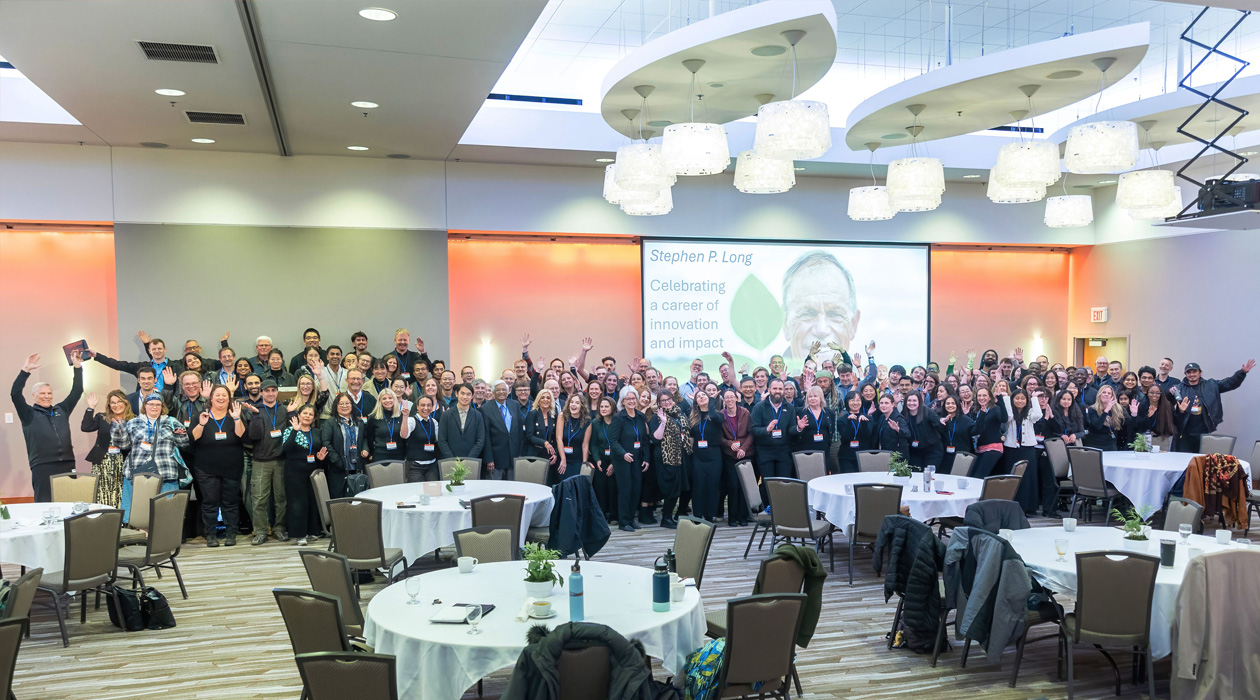
Stephen P. Long (1950–2025) was a leader in photosynthesis and global change biology, fueled by his passion to improve food security by modifying plants to better harness the energy of the sun. On November 3, colleagues, collaborators, mentees, and friends of Long gathered to celebrate his impactful career.
At the scientific symposium, which was held at the I Hotel and Conference Center, attendees from across the world dressed in Long’s signature all black conference attire and reflected on his lasting research legacy.
“Steve's career and academic accomplishments are widely known, and his influence on plant research has been huge. We all know he was a giant,” said Gene Robinson, Director of the Carl R. Woese Institute for Genomic Biology, during his opening remarks. “Steve chose to pursue some of the most difficult and complex challenges in plant biology and in many instances, achieved remarkable success.”
Long, the Ikenberry Endowed Chair of Crop Sciences and Plant Biology, came to the University of Illinois Urbana-Champaign in 1999. His research focused on using computational and bioengineering approaches to improve crop photosynthesis—the process that all plants use to convert energy from sunlight into biomass—so as to boost production of food, biofuels, and biobased products.
In 2012, Long founded the Realizing Increased Photosynthetic Efficiency project, an international effort that continues to bring scientists together to engineer crops to be more productive by improving photosynthesis. Photosynthesis is highly complex, consisting of over 100 steps and involving many different genes and proteins. Many parts of this process of photosynthesis have the potential to be more efficient, allowing a plant to produce more food.
“He liked to remind us often that photosynthesis is the most important biological process, and that studying it is more exciting, challenging and impactful than rocket science,” said Professor of Plant Biology Andrew Leakey (CAMBERS leader/PFS) during his remarks. Leakey began working with Long as a postdoctoral researcher before establishing his own lab at Illinois. “His research increased our understanding of global climate change, its effects on plants, and helped to inform approaches to improve crop yields by improving the efficiency of the photosynthesis . . . He was in the vanguard of people doing this from the molecular level, all the way up to the field.”
Throughout his career, Long was a visionary in his field. His work is published in over 400 research journals, and he is consistently listed as one of the most highly cited scientists in plant and animal sciences. Long was elected as a Fellow of the Royal Society in Great Britain and a member of the National Academy of Sciences of the United States of America, and he was the founding editor of the journals Global Change Biology, Global Change Biology Bioenergy, and Plants in Silico.
But Long’s impact extends far beyond citations and accolades, and his legacy lives on in the people he has impacted. Many will always remember Long’s ability to inspire those around him, whether by catalyzing scientists to solve grand challenges like food security, getting everyone to dress up for Halloween, or sharing his love of running.
In reflecting on working with Long, Leakey referred to the concept of a reality distortion field, which was first developed by people at Apple in the 1980s to describe how Steve Jobs inspired teams. Leakey said, “The reality distortion field Steve Long created was something that I had been living through for multiple years but didn't realize it until I read Steve Jobs’ biography. It describes the charismatic ability of individuals to inspire others to adopt their beliefs, goals, and vision, and as a result, achieve seemingly unattainable objectives. This was something that Steve Long did to those of us in his group quite routinely.”
Long’s influence can also be seen across the Illinois campus; he transformed the landscape of plant research in Champaign-Urbana. Research facilities like the Crop Transformation Facility, Energy Farm, High-Throughput Phenotyping Greenhouses, SoyFACE, and Spidercam Aerial Plant Phenotyping System all have Long’s fingerprint on them. This has enabled new research capabilities and has cemented Illinois as a world leader in plant biology and crop sciences.
Recently, a team of researchers, including Long and RIPE Director and Professor of Crop Sciences Lisa Ainsworth (CAMBERS/PFS), published a review article reflecting on RIPE’s work and their future goals.
Ainsworth said, “Steve's legacy and reach is truly global. The review paper in Cell is one of the last he wrote, in collaboration with experts from around the world. The review shows that we're not just close to enhancing photosynthesis, we are achieving it. Our co-authors on the review are just a small list of the large community of people that will carry on Steve’s torch.”
Stephen Long passed away in September 2025. His official obituary can be found at https://www.renner-wikoffchapel.com/obituary/Stephen-Long and memories from colleagues, collaborators, and mentees can be found at https://www.kudoboard.com/boards/yPnmvKro.