


Early Innovator Program announces 2026 pitch contest winners
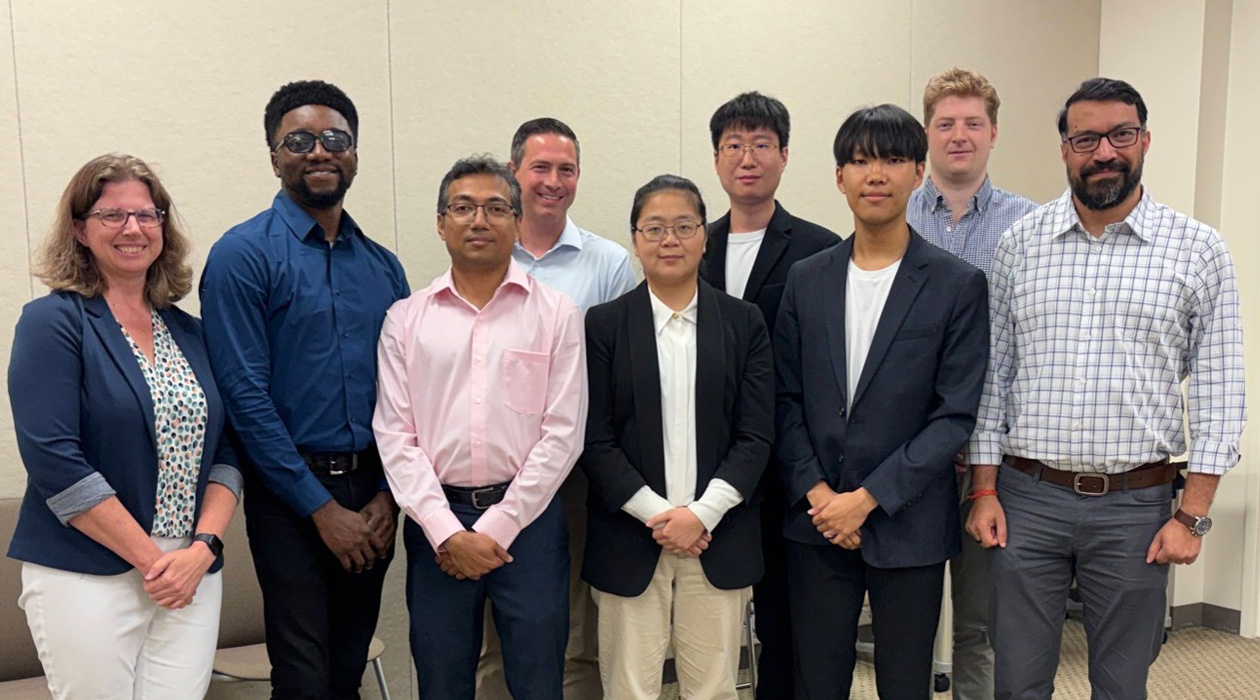
From left to right: Sarah Schwartz, Iyke Nnaji, Shah-Al Emran, Jacob Kinsey, Cindy Yang, Zhengyi Zhang, Siun Lee, Frithjof Gressmann, and Abhishek Pandey / Kelly Darr

Share
On July 28, aspiring entrepreneurs from the Carl R. Woese Institute for Genomic Biology wrapped up another successful summer of the Early Innovator Program. After 10 weeks of innovation, training, and mentorship, the group of graduate student and postdoctoral researchers presented their final pitches to a panel of judges. Three participants were awarded tiered funds ranging from $2,000 to $5,000 to continue advancing their novel innovations.
EIP is designed to prepare participants to become innovative entrepreneurs and leaders in their fields and to find creative ways to address societal challenges with their scientific research.
“I had ideas but was missing the crucial link needed to turn them into a business. The EIP program was the essential piece that filled this gap,” said Siun Lee, a graduate student in Brian Cunningham’s (CGD leader) research group.
Throughout the summer, EIP trainees learn practical skills from subject matter experts, discussing topics ranging from intellectual property and regulatory considerations to personal branding and networking. While developing their start-up ideas, participants also began to conduct their own customer discovery and market analysis.
“The program taught me just how important customer discovery is. By stepping out of the lab environment and speaking with real potential customers, I discovered what the truly unmet needs were, which allowed me to solidify my business plan,” Lee said.
Each trainee was also connected to a mentor with relevant experience. These industry leaders met with their EIP mentees to answer their questions and provide guidance as they prepared their pitch decks. The program culminated in a final pitch contest and a luncheon to recognize the hard work of all the trainees.
EIP is led by IGB’s external relations coordinator Sarah Schwartz. During her remarks at the lunch, Schwartz said, “We are exposing our participants to the entrepreneurial ecosystem here on campus, to highlight the range of careers that exist within the entrepreneurial space, to provide professional development as it applies to innovative scientific applications, and to invest funds to advance up to three novel innovations that show further development potential.”
Siun Lee won first place ($5000) for his pitch of IDiS, a diagnostic tool to help farmers quickly screen for pigs infected with swine viruses. This rapid and low-cost diagnostic technology aims to minimize the economic losses associated with the spread of viral diseases on farms.
Frithjof Gressmann received second prize ($3000) for his pitch of Captur[re]. A graduate student in Mattia Gazzola’s (M-CELS) research group, Gressmann’s artificial intelligence for neuroscience platform aims to train a foundational model that laboratories can use to better read and control neural activity—eventually enabling the development of psychiatric diagnostics and therapies.
Cindy Yang earned third place ($2000) for her startup focused on engineering yeast to produce an active ingredient in skincare products called ceramides. Yang, who is a graduate student in Christopher Rao’s (BSD/CAMBERS/CGD) group, aims to reduce the production costs of ceramides while also using sustainable raw materials.
This year’s EIP judges included Jacob Kinsey, senior director at Illinois Ventures, and Abhishek Pandey, interim CEO/CTO of ASERTI Pharma. After evaluating and providing individualized feedback on the pitches, the judges shared that they were impressed by all the trainees’ innovations, noting that the competition was close and many great ideas were pitched.
Other participants in the program included Iyke Nnaji, a graduate student in Lisa Ainsworth’s (CAMBERS/PFS) lab who pitched Soy-RISE, an agricultural biotechnology startup that develops new soybean varieties for tropical environments; Shah-Al Emran, a research scientist from Emily Heaton’s (CAMBERS) group, developed Verdatum, a mobile and web platform that integrates satellite and cost data to provide farmers with reliable field-scale yield forecasts; and Zhengyi Zhang, a postdoctoral fellow in Huimin Zhao’s (BSD/CAMBERS/CGD/MMG) lab who started EnzyFoundry, a platform for engineering enzymes to expand biology’s catalytic toolbox and sustainably manufacture industrial chemicals.
“A scientifically exciting technology only becomes commercially valuable when it addresses a real customer need,” Zhang said. “EIP encouraged me to evaluate research ideas not only by scientific novelty, but also by their potential applications and customer value. I now think more about whether a project can solve practical problems, reduce costs, or improve existing processes.”