


Meeting the moment with team science training: IGB’s professional development opportunities
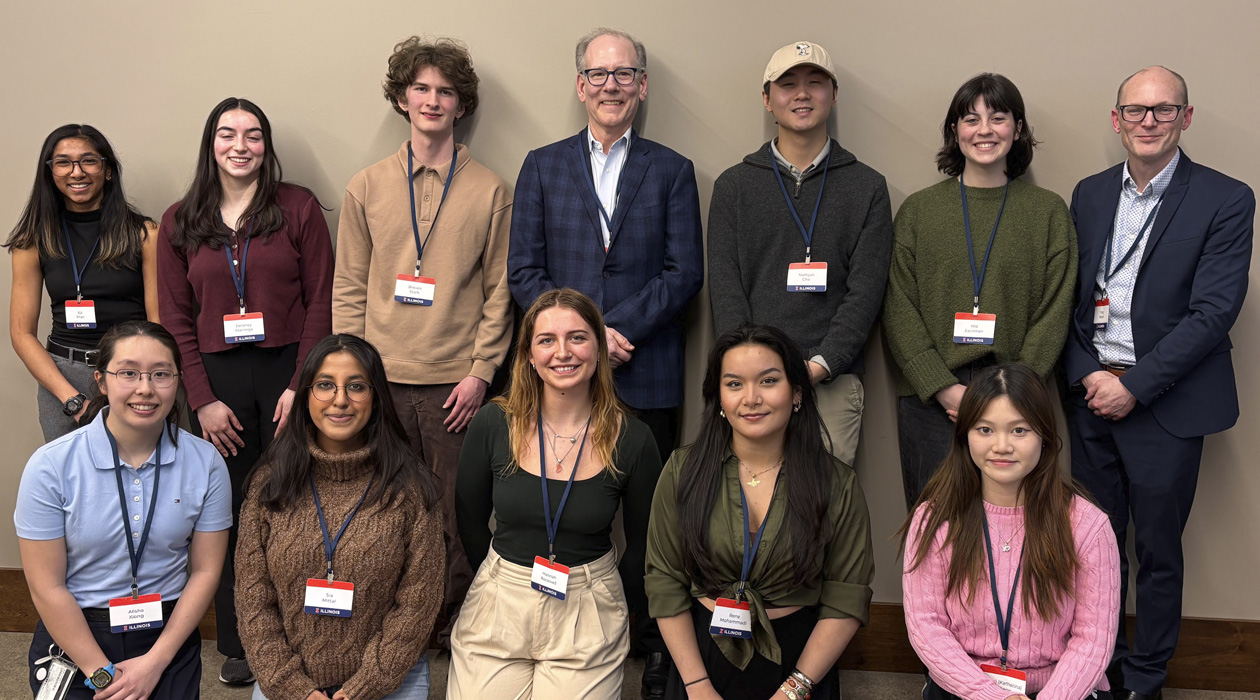
The 2024-2025 Tracy Undergraduate Team Science Training Program cohort, with founder and president of Tracy BioConsulting, LLC Mark Tracy (back, center) and IGB director of external relations and strategic partnerships Tracy Parish (back, right). / Sarah Schwartz

Share
Almost from its inception, genomics has been a team-based science, anchored by intercontinental collaborative efforts to sequence, analyze, and understand whole genomes. Similarly, the Carl R. Woese Institute for Genomic Biology was built from the ground up as a home for team science. That means more than providing the facilities and staffing that make collaborative and interdisciplinary work possible; the IGB also offers a portfolio of professional development programming to support its members to become proficient in the skills of good team science, from early research involvement through established careers.
Students of team science
Secondary school is a formative time for shaping students’ scientific confidence and interests. IGB’s goal in creating team science opportunities for students this age is to foster curiosity and confidence. Our STEAM TRAIN program invites teams of middle school students at Franklin STEAM Academy in Champaign to choose their own research projects and provides them with materials, equipment, and expertise not readily available within the school. Projects range from designing seed-planting robots to observing the regenerative capabilities of flatworms to characterizing the microbial populations of the school building.
STEAM TRAIN pairs these middle school groups with high schooler mentors, ensuring that students have someone close to them in age and experience to talk to about their ideas. Each group is also mentored by an undergraduate or postgraduate researcher who can help refine and implement their plans. Participating high school students gain experience through this central communicating role, while middle school students thrive on the freedom to translate their enthusiasms into genuine science projects.
Opportunities to participate in laboratory research typically expand for undergraduate students, but pathways to building team science skills are harder to find. For the last decade, IGB has offered summer research scholarships for undergraduate students in an effort to expand access to interdisciplinary research experiences at this level. Woese Undergraduate Research Scholars are funded to complete a summer of full-time research in an IGB-affiliated lab group, and their projects reflect the collaborative nature of IGB’s work.
Through a newer program, supported by founder and president of Tracy BioConsulting, LLC Mark Tracy, undergraduate students are able to further expand their team science skill set as well as their professional network. The Tracy Undergraduate Team Science Training Program encourages students to work across traditional boundaries in academia and help prepare them for careers in industry. Participants engage in a variety of training activities throughout the year, including seminars, participatory workshops, and industry site visits, as well as working through case studies and discussions on topics including effective communication, team problem-solving, and establishing collaborative research projects.
Team science in career development
Graduate students and postdoctoral researchers at the IGB benefit from broadened professional training and opportunities that position them for career trajectories inside academia and out. Although graduate students, like undergraduates, have primary affiliations with their home departments, the IGB provides complementary research training opportunities that are able to focus more heavily on team science skills. One such program is the Professional Skills for Careers in Biosciences course, a year-long series of seminars on professional communication skills, entrepreneurship, science policy, and related topics. Participants earn a certificate after completing a capstone project that emphasizes knowledge gained throughout the course.
Trainees with a particular interest in entrepreneurship and industry can learn more about how to translate their research interests into innovation in the IGB’s Early Innovator Program, which is offered each summer and focuses more intensively on translating research to the marketplace. Participants are paired with mentors in industry and attend weekly workshops on entrepreneurial skills and practices. The program culminates in a product pitch competition for proof-of-concept funding.
Rounding out IGB’s team science professional development offerings are its social supports for faculty members. A long tradition of academia is for senior faculty members to find ways to support their more recently hired colleagues. Two groups at IGB complement these informal social supports with programs designed to support connections within cohorts of faculty members and with institute and campus resources. The New PIs group invites affiliated and interested assistant professors to meet regularly with the IGB director, support staff, and partners across campus and beyond to discuss challenges and approaches in establishing an interdisciplinary research career. Associate professors can find similar networking opportunities and support through the Team Science Leadership Program, which supports mid-career faculty as they navigate the world of team science research.
Just as it did for the Human Genome Project over two decades ago, team science makes grand research challenges possible. By investing in the ideas that makes team science work, the IGB aims to strengthen genomics research now and for generations to come.