


Researchers collaborate to develop red blood cell tagging technology
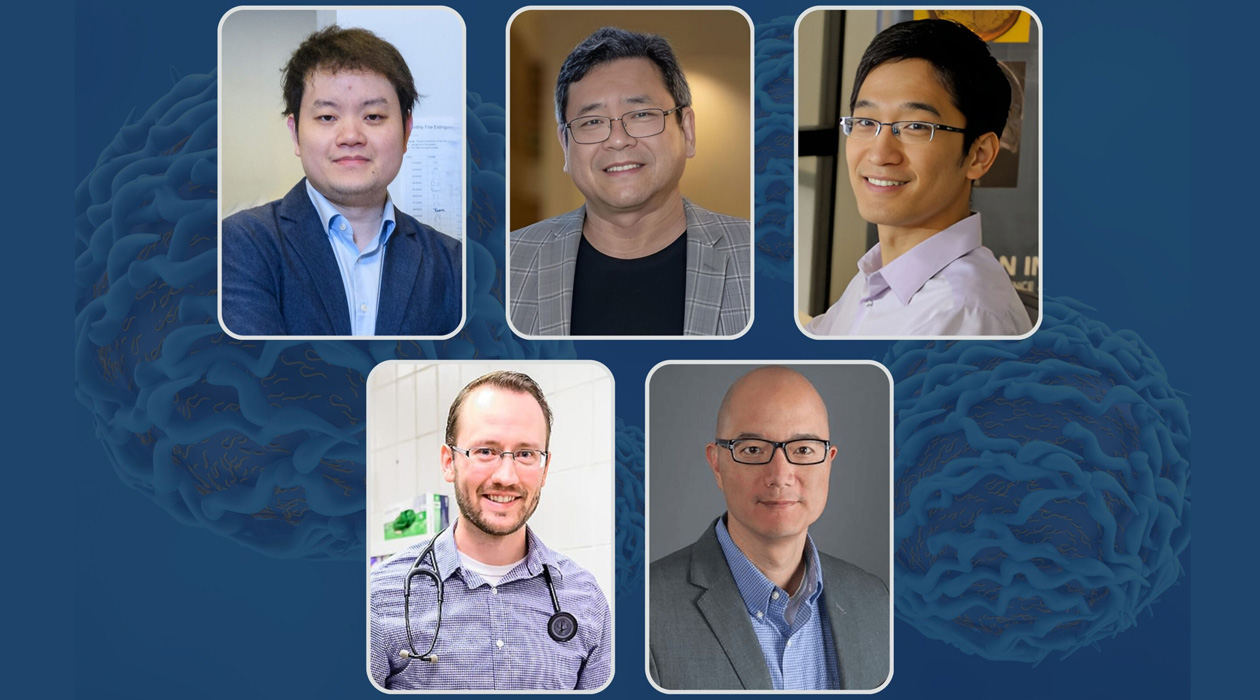
Research members, clockwise from top left: Hua Wang, Shuming Nie, Fan Lam, Timothy Fan, Matthew Berry.

Share
Hua Wang (RBTE) is leading a collaborative research project to develop a technology that will target and tag red blood cells in the human body. Wang, a professor of materials science and engineering, has established a strong laboratory presence in the cancer immunotherapy research space. A Cancer Center of Illinois member, while this current project isn’t singularly focused on cancer, the derivative implications of the research are broad and dramatic.
“This technology has various foreseeable applications. The first is drug delivery. This technology could significantly extend the blood circulation of drugs, such as anti-cancer therapeutics, from hours to days or even weeks. As well, this new technology could greatly influence blood vessel imaging, by enabling the circulation of contrast agents for weeks, which could be broadly applied to various types of imaging agents,” reported Wang.
Ideally, this red blood cell technology will enable higher drug efficacy alongside reduced drug dose and dosing frequency. For the latter, this technology could enable MRI, fluorescence imaging, and other types of biomedical imaging methods with just one dose of a contrast agent.
Wang is joined by four other members: Fan Lam (GNDP) and Shuming Nie from the Department of Bioengineering and Matthew Berry (ACPP) and Timothy Fan (ACPP/CGD) from the College of Veterinary Medicine.
The team’s research initiative, “In Vivo Metabolic Tagging and Targeting of Long-Circulating Biomembranes,” recently earned a significant merit-based R01 award from the National Institutes of Health. “This is an amazing team effort. I feel fortunate to have many incredible collaborators on campus, who share the same passion and vision to develop innovative and impactful technologies to the scientific community—ultimately for the benefit of human health,” said Wang. Clinician-scientists Berry and Fan will contribute their expertise in veterinary clinical medicine and translational research with companion animals.
Berry noted, “A key strength of this work is its commitment to translational science. By advancing this red blood cell labeling technology into dogs, we will demonstrate effective labeling in a clinically meaningful setting. This approach will open new possibilities for diagnosing and treating disease in canine patients while also generating critical insights to accelerate therapeutic applications in human medicine.”
Lam, a professor of bioengineering, highlighted the research team’s focus on in vivo biomembranes. “Being able to tag specific biomembranes in vivo will offer exciting opportunities to create a new class of contrast probes for imaging. For example, blood is an endogenous contrast agent for MRI and being able to tag red blood cells’ membranes will enable us to design new imaging methods to study vascular abnormalities in tumor,” said Lam.
“Under Hua’s leadership, this is a wonderful example of interdisciplinary team science to develop cutting-edge technologies for broad biomedical applications. Once developed, I believe that this new type of molecularly tagged and long-circulating membranes could be widely used for in-vivo tumor imaging, image-guided surgery, and cancer drug delivery,” concluded Nie, the Interim Department Head of Bioengineering.
***
Dr. Matthew Berry is an Assistant Professor in the Department of Veterinary Clinical Medicine.
Dr. Timothy Fan is the Associate Director for Translational Research and Development at the Cancer Center at Illinois and the Khan Family Chair and Professor in the Department of Veterinary Clinical Medicine.
Fan Lam is an Associate Professor in the Department of Bioengineering.
Shuming Nie is the W. W. Grainger Distinguished Chair and Interim Department Head of Bioengineering.
Hua Wang is an Associate Professor in the Department of Materials Science & Engineering.