


IGB Profile: Carson O’Connell
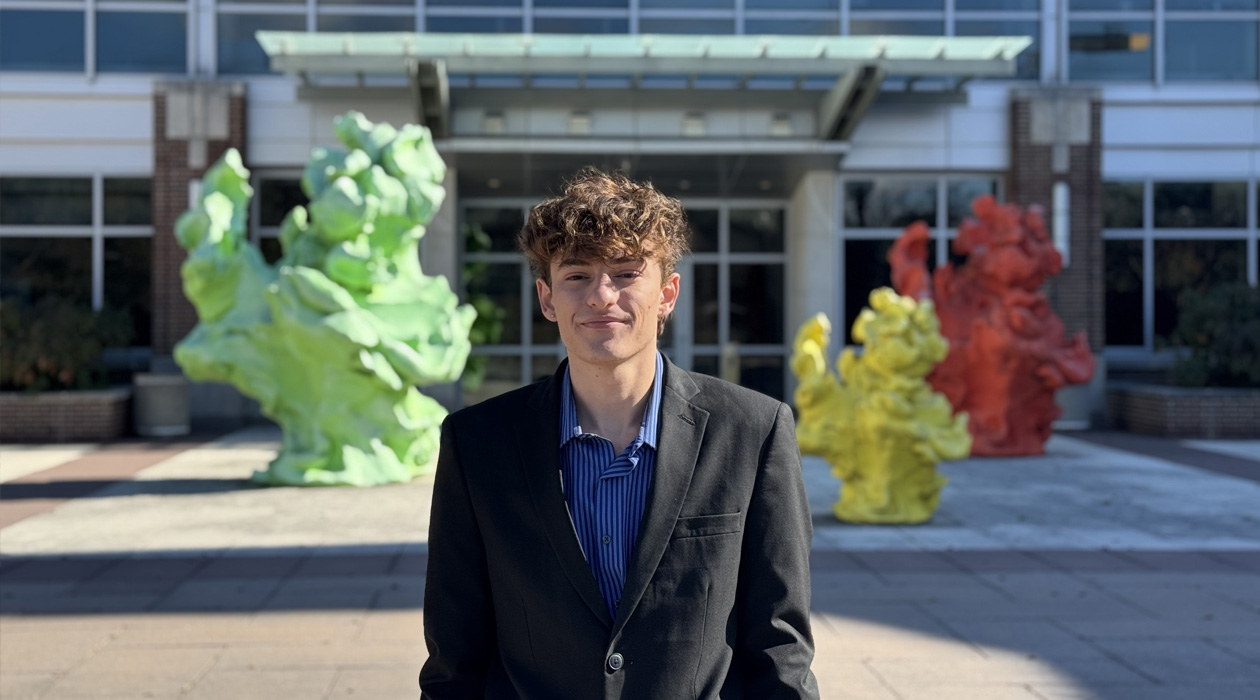
Woese Undergraduate Research Scholar Carson O’Connell joined the Hergenrother lab to study a molecule derivative that may serve as a potential cancer therapeutic. / Elizabeth Bello

Share
Why? This is the quintessential question asked by young children. For some children, asking why is simply their attempt at understanding the world around them. For others, asking why might be a characteristic of a budding young scientist. For Woese Undergraduate Research Scholar Carson O’Connell, asking why at a young age marked his curiosity and eventually his passion for scientific investigation.
“I was always a very curious kid, that was probably one of my most significant traits,” O’Connell said. “I loved spending time outside and being out in nature. I was always asking why, why, why, you know, the early makings of a scientist. I never really accepted simple answers when given them … I wanted every detail.”
O’Connell, who spent nights with his grandfather looking up at the sky through a telescope, was interested in astrobiology at an early age. He wasn’t driven by finding life on other planets but rather was intrigued by the biological and chemical conditions that are required for life to emerge. O’Connell’s interest led him to pursue a bachelor’s degree in biochemistry with minors in both chemistry and astronomy at the University of Illinois Urbana-Champaign.
“I was always wondering ‘Why are we here? How did we get here?’ and I think those types of questions connected me to biochemistry,” O’Connell said. “I started taking biochemistry classes and fell in love with it. I recognized that this might be my path because I found so many answers to my questions through biology and chemistry.”
Biochemistry gave O’Connell the answers he had been searching for on a deeper, molecular level and in excruciating detail. A perfect match to satisfy his ever-curious inner child. During his sophomore year, O’Connell wanted to gain hands-on research experience and joined the Hergenrother (ACPP) lab.
“Dr. Hergenrother’s work was especially interesting to me because of their novel approach to develop and use small molecule treatments for cancer interventions,” O’Connell said.
O’Connell’s mother was diagnosed with lung cancer during his junior year of high school, and the re-emergence of her disease during his sophomore year of college drove his interest in joining a cancer research lab. Noticing the limitations of current standard treatments that involve immunotherapy, chemotherapy and radiation, O’Connell wanted to be a part of a lab that pushed the boundaries of modern medicine to develop something new.
O’Connell joined the Hergenrother lab in February 2026 and immersed himself in graduate-level research. This spring, he applied for the Carl R. Woese Undergraduate Research Scholar Program to continue his research during the summer months.
Mentored by Illinois graduate student Brooke Bouwens, O’Connell got a unique opportunity to experience true independence over the summer. Through virtual meetings and outside guidance from Bouwens, O’Connell worked independently to study a molecule called ErSO-TFPy. The original molecule, ErSO, was discovered through a collaboration between the Shapiro and Hergenrother labs at Illinois. The small molecule, ErSO-TFPy, is a derivative developed by the Hergenrother group and is being investigated as a potential cancer therapeutic.
“We believe that ErSO-TFPy targets an ion channel called TRPM4 and results in its hyperactivation, which opens the cell channel, allowing large influxes of sodium to pass through the channel resulting in necrotic cell death,” O’Connell said. “My research focused on understanding the mechanism of action and how we can increase the selectivity and potency of ErSO-TFPy.”
O’Connell worked with two cell lines; one breast cancer cell line with TRPM4 ion channels and one TRPM4-deficient cell line where CRISPR gene editing technology was used to knock out the TRPM4 gene. O’Connell added ErSO-TFPy to each line, adjusted various cell parameters and used cell viability assays following the treatment to examine cell death.
“The broader goal was to see how different parameters influence ErSO-TFPy-induced cell death,” O’Connell said.
His aim was to investigate how TRPM4 contributes to ErSO-TFPy-mediated cell death by examining different factors such as temperature, calcium and sodium levels, and PIP-2 TRPM4 dependence that are necessary for TRPM4-ErSO-TFPy hyperactivation.
“I think one of the most satisfying parts of my research experience was the freedom and creativity,” said O’Connell. “I think a lot of people think science is just procedures that we follow, but there’s an emphasis on creativity in the way we design experiments and test different methods.”
The first few weeks of O’Connell’s summer endeavor were spent optimizing the experiment. “It hit me like a ton of bricks,” said O’Connell. “I didn’t realize how much time and energy and research goes into just troubleshooting an experiment. It really expanded my view and taught me a lot about what goes into research.”
O’Connell made an important realization. The science we do in laboratory class isn’t exactly how research happens in the real world. In the classroom there is a procedure that you follow and you get results.
“In the real world, you spend a large amount of time reading literature, learning more about the subject, and optimizing and troubleshooting your experiments,” explained O’Connell. “I gained a lot of confidence, especially through failures too. The experience taught me that there is no true failure in science. Every finding, even if it isn’t exciting or positive, gives you important information.”
O’Connell is continuing his research in the Hergenrother lab and plans to start using confocal microscopy to visual his experiments. After graduation he wants to stay in drug discovery and development research and plans to pursue a PhD in biochemistry or pharmacology.
“I’m incredibly grateful to Dr. Hergenrother, my mentor Brooke, and the summer scholars program for this opportunity,” O’Connell said.