Infection Genomics for One Health

The Infection Genomics for One Health theme works to describe microbial communities and their genes across different natural and man-made environments.

Read More About IGOH

Featured Stories

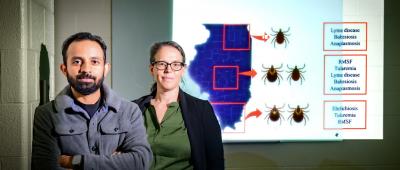
Abrar Hussain, left, Rebecca Smith and their colleagues mapped the distribution of three tick species across the state of Illinois. They compared this distribution to the incidence of tick-borne diseases in the state. Photo by Fred Zwicky
Terence Crofts’ research group, including paper co-authors Ezabelle Frank (far left), Terence Crofts (behind the group), Elizabeth Bernate (center, in purple), and Hayden Allman (far right).
Graduate student Owen Ouyang, left, and professor Nicholas Wu found common features among antibodies that bind to the influenza antigen hemagglutinin, a key target for vaccine development. Photo by Michelle Hassel
Illinois Ph.D. student Ivan Sosa Marquez, left, plant biology professor Katy Heath and their colleagues identified clusters of genes in soil bacteria that enhance plant growth. Photo by Michelle Hassel. Study co-lead Amy Marshall-Colón, pictured, and postdoctoral researcher Rizwan Riaz conducted detailed statistical analyses and gene network modeling to identify which rhizobial genes correlated with more robust plant growth. Photo by Della Perrone
Illinois pathobiology professor Csaba Varga and his colleagues tracked antibiotic-resistant infections with Campylobacter jejuni, a primary cause of foodborne illness in the U.S. The study found regional and age-related differences, and an upward trend in resistance to a class of antibiotics known as quinolones. Photo by Craig Pessman
Civil and Environmental Engineering graduate student Yuqing Mao and Professor Helen Nguyen developed a new method for detecting antibiotic resistance genes in wastewater.