


New IGB theme aims to boost the bioeconomy through the revitalization of an ancient biological partnership
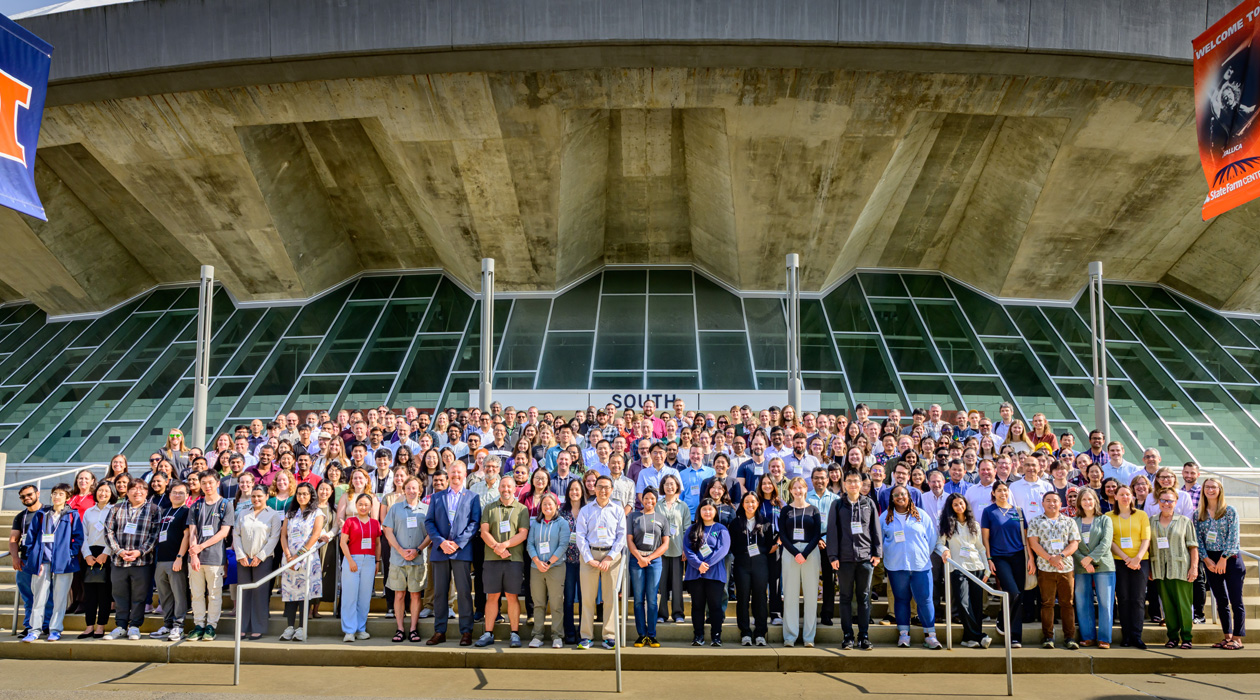
Members of the new CAMBERS theme

Share
Since the dawn of agriculture, our societies have been powered by the sunlight captured by plants and supplied by the chemical toolbox of microbes that tap into the resources of those plants that we cannot. A new research theme at the IGB pulls together cutting-edge methods across an array of fields— genomics, biotechnology, remote sensing, automation, biogeochemistry, technoeconomic analysis and artificial intelligence—to leverage our modern bioeconomic partnership with plants and microbes to the fullest.
The research theme, Crops And Microbes for BioEconomy Resilience and Sustainability, will be led by Michael Aiken Chair of Plant Biology Andrew Leakey. CAMBERS, which has 29 faculty members and affiliates, expands upon the ongoing activities of the Center for Advanced Bioenergy and Bioproducts Innovation, which has received ~$200M in funding from the Department of Energy since 2017. Leakey also directs CABBI and is a member of the Photosynthesis and Food Security research theme.
The basic premise behind the work of CAMBERS is likely more familiar than it seems at first glance. Through photosynthesis, plants convert carbon from CO2 into carbohydrates, including both sugars and structural fiber. People have long used microbes to ferment those carbohydrates into ethanol; microbes with different metabolic genes can digest carbohydrates into a wide range of other useful fuels and products.
“I am very excited about establishing CAMBERS,” Leakey said. “It provides a pathway and meeting point for a transdisciplinary team of scientists from across campus to accelerate progress on developing the scientific understanding and technological innovations needed for the agricultural bioeconomy to be more profitable, while also delivering net environmental benefits.”
Since its establishment, CABBI has focused on three major areas of research. It has made major breakthroughs in developing crops that produce significant amounts of oil and other high value chemicals, that have greater rates of photosynthesis and biomass production, that require less water to grow, and that are more tolerant of temperature extremes. It has developed custom microbial strains that can convert crop-derived sugars and lipids into high value chemicals that can be used to make a wide array of industrial and domestic products. Finally, CABBI researchers have translated data from these cellular-level innovations into predictions about system-scale impacts to pave the way for technology adoption. This has all been achieved while developing new genomic, synthetic biology and AI-enabled tools that can accelerate biotechnological advances related to plants, microbes, and ecosystems.
CAMBERS is supporting investment and innovation in new cutting-edge methods upstream of the work performed within CABBI. For example, this year saw the start of a new $10M National Science Foundation-funded Global Center on Actionable and Socially-Acceptable Plants (ASAP). The project, led by Professor of Plant Biology Tracy Lawson (CAMBERS/PFS), is developing and testing new approaches to find valuable gene variants from across all plant species. It also aims to more rapidly test gene edits in plants, aided by cell-culture-free methods, while also exploring the societal acceptance of clean fuels and products made from gene edited crops. This work is being conducted in collaboration with researchers in the UK, Finland and Japan.
Another key effort of CAMBERS is to expand campus access to cutting-edge research facilities. Leakey and Professor of Plant Biology Wendy Yang (CAMBERS/PFS) have established facilities for high-throughput crop phenotyping and stable isotope tracing experiments, respectively, in the Plant Biology Innovation Greenhouse that was opened last year. The greenhouse was developed with investment from the Provost’s Office; the Department of Plant Biology; the College of Liberal Arts and Sciences; the College of Agricultural, Consumer and Environmental Sciences; the School of Integrative Biology; and the Department of Crop Sciences.
To be most impactful, discovery in bioproduct research must be supported to implementation. CAMBERS is building partnerships to make sure innovations from its fundamental science projects are refined and scaled up so that they will be adopted at farms and biorefineries. CAMBERS members are involved in a new campus-wide Biomass Innovation Hub led by Professor of Crop Sciences Emily Heaton (CAMBERS) that is working to de-risk adoption of new crops through engagement with a diverse set of industry partners. In addition, the Integrated Bioprocessing Research Laboratory, led by Founder Professor of Agricultural and Biological Engineering Vijay Singh (CAMBERS/PFS), and the Illinois Fermentation and Biomanufacturing Hub provide nationally unique opportunities for at-scale testing of novel bioprocessing and fermentation technologies.
“I believe CAMBERS will help our faculty and students bring, integrate, and leverage the unique strengths in agricultural biotechnology research found across the Urbana-Champaign campus to enable major breakthroughs needed to grow the bioeconomy and train the next generation of scientists,” Leakey said. “The coming years hold incredible promise!”
CAMBERS faculty members and affiliates:
Theme leader: Andrew Leakey (Department of Plant Biology)
Lisa Ainsworth (Department of Crop Sciences)
Carl Bernacchi (Department of Crop Sciences)
Steven Burgess (Department of Plant Biology)
Li-Qing Chen (Department of Plant Biology)
Evan DeLucia (Department of Plant Biology)
Kaiyu Guan (Department of Natural Resources & Environmental Sciences)
Jeremy Guest (Department of Civil & Environmental Engineering)
Emily Heaton (Department of Crop Sciences)
Matthew Hudson (Department of Crop Sciences)
Heng Ji (Department of Computer Science)
Yong-Su Jin (Department of Food Science & Human Nutrition)
Madhu Khanna (Department of Agricultural & Consumer Economics)
Tracy Lawson (Department of Plant Biology)
DoKyoung Lee (Department of Crop Sciences)
Ge Liu (Department of Computer Science)
Stephen Long (Department of Crop Sciences)
Ting Lu (Department of Bioengineering)
Megan Matthews (Department of Civil & Environmental Engineering)
Donald Ort (Department of Plant Biology)
Bin Peng (Department of Crop Sciences)
Christopher Rao (Department of Chemical & Biomolecular Engineering)
Erik Sacks (Department of Crop Sciences)
Diwakar Shukla (Department of Chemical & Biomolecular Engineering)
Vijay Singh (Department of Agricultural & Biological Engineering)
Jonathan Sweedler (Department of Chemistry)
Hong Yang (Department of Chemical & Biomolecular Engineering)
Wendy Yang (Department of Plant Biology)
Huimin Zhao (Department of Chemical & Biomolecular Engineering)