


IGB hosted third summer cohort of undergraduate researchers
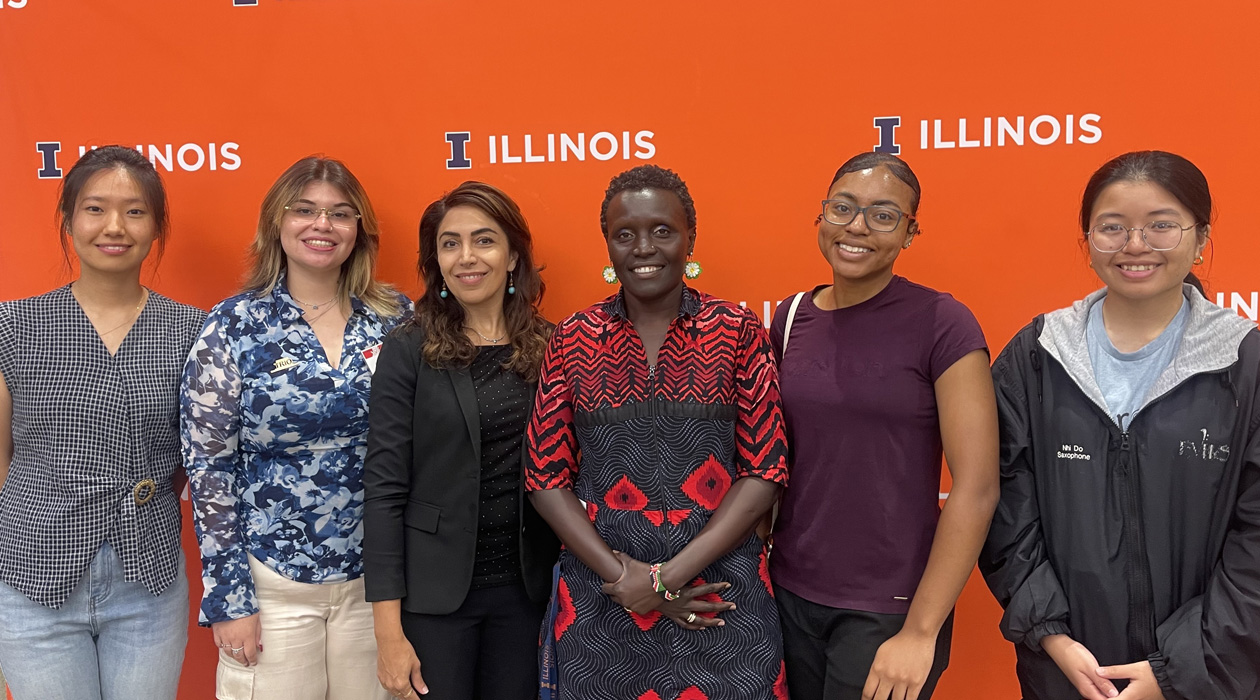
From left to right: Minxing Zhu, Frania Amaya, Zohreh Golshani, Dr. Esther Ngumbi, Lakiyah Smith, & Nhi Do at the research symposium.

Share
For undergraduate students seeking to advance their education or career in STEM fields, gaining hands-on experience in a research laboratory can be a valuable and transformative experience.
The Carl R. Woese Institute for Genomic Biology has partnered with AREES, the Alliance for Research Enterprise Excellence in STEM program, at the University of Illinois Urbana-Champaign to provide undergraduate students with real life genomic research opportunities.
"Mentoring undergraduate researchers brings me a lot of joy. Providing the space for undergraduates to experience the joy of research – from an idea, a testable hypothesis, and all through to doing the experiments, collecting and synthesizing data, and creating presentations is important and as such, partnerships such as the IGB/AREES makes that possible,” said Esther Ngumbi (CIS/MMG/PFS), a professor of entomology and African American studies. "I wholly believe that today’s undergraduate students become tomorrow’s graduate students and if we train them well and invest in building an unshakable foundation, we set them off for success wherever they go.”
The AREES program began in 2022 and is supported by the Office of Public Engagement which sponsors an annual cohort of undergraduate researchers during the summer months. The program pairs students with faculty, graduate mentors and labs across various Illinois research labs, providing a pathway for undergraduates to immerse themselves in graduate-level research.
Four undergraduate students from this year’s cohort joined IGB labs to work on a variety of topics including honey bee behavior and genetics, plant stress responses, and antimicrobial resistance. IGB host laboratories included those led by Ngumbi, Swanlund Professor of Entomology Gene Robinson (GNDP), and Professor of Microbiology Rachel Whitaker (IGOH).
“The chance to get students excited about science is my favorite part of being a scientist,” Melissa Flores said, a fifth-year neuroscience graduate student and AREES mentor in the Robinson Lab. “As the first person in my family to graduate high school and then college, I had no idea what it meant to be a scientist nor what a PhD even was.”
Flores mentored Kimber Dickson, an undergraduate biology student from Spelman College. Flores and Dickson worked together in the Robinson Lab to examine the effect of early life isolation on honey bee social behavior. Three additional students were paired with two other labs. Zohreh Golshani, an undergraduate from Parkland College, and Frania Amaya, a student at Morgan State University, were both paired with graduate mentor Minxing Zhu from the Ngumbi lab, where they worked to understand plant responses to insect pests and flooding. Isabella Navarrete, visited from Chicago State University and joined mentor Saralexis Torres in the Whitaker Lab to study the emergence and potential spread of spectinomycin antimicrobial resistance in piglet gut microbiomes.
Kimber Dickson: Learning to study honey bee behavior and physiology
In the Robinson Lab, Flores studies how chronic and acute stressors affect the brain and social behavior of honey bees.
“I use honey bees to explore how environmental cues like isolation, heat stress, or exposure to social stimuli affect gene expression in the brain, in addition to individual behavior,” Flores said.
Honey bees live in complex societies, called colonies, and are organized in a way that individual bees can address needs of the overall colony. As they age, worker bees have different behaviors based on the role they play within their colony. How quickly bees mature and shift from role to role is affected by complicated interactions between several factors including the social inputs of bee larva, the queen, older worker bees and environmental changes.
Experimentally, when honey bees are caged in small groups of eight, their behavior can be assessed a week later to identify which bees have developed what behaviors to address specific needs. Some bees will focus on wax-building, some will tend to larvae, and some will act as a guard when exposed to an intruder bee. Presenting a queen-destined larva to a developing group of workers provides an opportunity for worker bees to take on the role of nurse and care for the future queen by either feeding her or closing her honey comb cell so she can undergo metamorphosis.
Dickson focused on quantifying the response of grouped worker bees and isolated worker bees when presented with a queen larva. Dickson observed and determined whether bees who had experienced the partially isolated environment differed in their response to the presence of a queen larva when compared to those that had lived in groups for the entire week instead.
“The purpose of this study was to determine how placing newly emerged honey bees in isolation would impact their hormonal response to the pheromones secreted by hungry larvae, and to determine if reunification could be a restorative treatment for responsiveness in those bees,” Dickson said.
Flores wanted Dickson to learn not only about honey bee behavior and the ways in which social environments can change the physiology of bees, but also to show her what graduate school is like.
“Given Kimber’s interest in pursuing a PhD and this being her first research experience, I wanted her to get a taste of the main responsibilities that graduate students juggle in addition to experiencing the many tasks that go into developing ambitious research projects like this one,” Flores said.
While Flores values showing her mentees the rewarding nature of generating new knowledge, she’s careful not to sugarcoat the process or downplay the hard work and resilience that’s necessary to overcome the inevitable challenges to make research endeavors successful.
“In particular, I try to emphasize the importance of curiosity, self-advocacy, and self-reflection to predict when and where a researcher will need to ask for support or seek resources that will help them do their best work,” said Flores.
Dickson plans to apply to graduate school with the goal of obtaining a PhD in molecular biology and genetics to combat genetic predispositions within the African American community.
“I think this research experience further affirmed my dreams of advocating for others and that it’s possible to combine that with my love for science,” Dickson said.
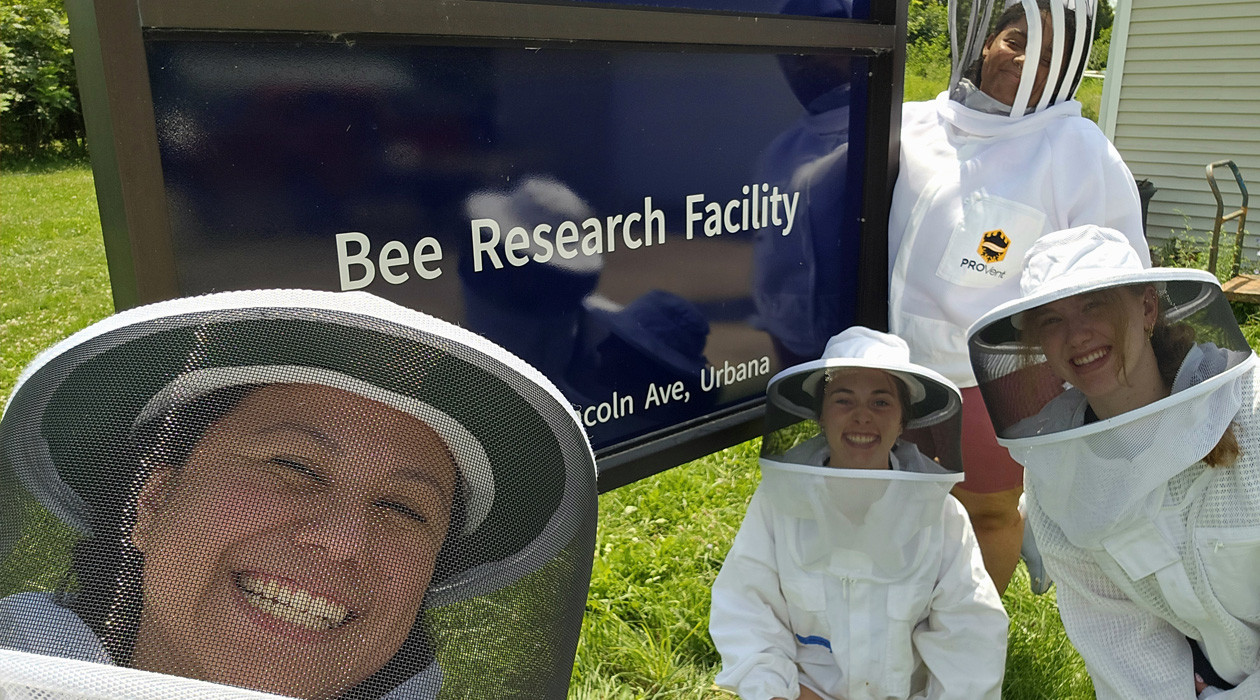
Zohreh Golshani: Investigating the stress response of cherry tomato plants to aphid infestations
Zohreh Golshani joined the Ngumbi lab and worked with entomology graduate student Minxing Zhu (MZ) who studies plant-insect interactions between flood-stressed tomato plants and tomato pests like aphids and beet armyworms.
“One of the most memorable parts of my summer research experience was learning the importance of persistence and not giving up when things didn’t go as planned,” Golshani said. “Instead of giving up, I learned to be patient, stay motivated, and keep trying different approaches. This experience taught me that progress doesn’t always happen quickly, and sometimes the most valuable lessons come from overcoming challenges.”
Ngumbi lab members typically work as a team on large lab projects. As a mentor, Zhu wanted Golshani to understand and be involved in the lab’s main project but also encouraged her to develop her own research question that would reflect her interests. Golshani wanted to understand how cherry tomato varieties respond to aphid infestations, by examining their volatile organic compounds.
When plants are faced with stressors like a feeding insect, they emit volatile organic compounds, or VOCs, that act as an airborne chemical signaling system. VOCs are a warning system that cue other nearby plants to activate their defense genes to repel pests or to recruit beneficial pest-eating insects.
Zohreh investigated the emission of VOCs of cherry tomato varieties under aphid infestation. In addition to her individual project, Golshani also worked with other lab members to focus on the larger project which involved characterizing the phenotypes of 23 different tomato accessions under flooding stress and insect herbivory.
“I think mentorship benefits both mentor and mentee, reciprocally. I can share skills and knowledge with undergraduate students because I have more experience in research, and they provide me with new insights that I never thought about before,” said Zhu.
In the future, Golshani intends to pursue a doctorate in veterinary medicine. Working with Zhu, Golshani learned that she doesn’t have to choose between veterinary medicine and research. She can combine both by pursuing a DVM/PhD.
“Being involved in research helped me discover a new passion for scientific investigation and problem-solving. This was one of the most exciting realizations of my summer experience as it opened my eyes to new possibilities for my future career,” Golshani said.
Frania Amaya: Exploring how geographic region-specific plants traits impact flooding tolerance
Zhu mentored a second AREES undergraduate, Frania Amaya, who was interested in comparing the flooding tolerance of two tomato accensions collected from different geographical regions; Mexico and the United States. Amaya hypothesized that the tomato seeds from Mexico would have a higher flooding tolerance. She then observed and measured the physical traits of both tomato accensions under flooding stress.
“I was responsible for measuring the height of the plants and the length and width of the longest leaf on the plants,” Amaya said. “On the last day of the experiment, I measured both the dry and wet weights of the shoot and root mass. MZ helped me develop my hypothesis and experimental design. She also helped me understand data organization and statistical methods like analysis of variance, commonly called ANOVA.”
Amaya organized and analyzed the data she collected and presented her findings at the research symposium at the end of the internship which she remarked was certainly a memorable part of the experience. In addition to her own independent project Amaya enjoyed working in the greenhouse and joining lab meetings in the Ngumbi lab.
“I believe mentorship is a type of guidance that is necessary and helpful in an individual’s academic and professional journey,” Amaya said. Time spent in the Ngumbi lab helped Amaya understand more about the research projects and allowed her to brainstorm with the rest of the lab members.
Amaya explained that the research experience reinforced her prior knowledge about graduate school and showed her different paths she can take in the future. She plans to attend graduate school and pursue a career in environmental science.
Isabella Navarrete: Understanding antimicrobial resistance in the gut microbiome
Isabella Navarrete, a biochemistry student at Chicago State University, was paired with Saralexis Torres, a bioinformatics graduate student who studies the emergence of antibiotic and antimicrobial resistance in the Whitaker Lab.
“My primary focus is understanding the effects of antibiotic selection in the piglet gut microbiome. Specifically, I am interested in uncovering the mechanisms that explain the changes in resistance frequency of the microbial community over time,” Torres said.
Navarrete worked with Torres to investigate how a single dose of spectinomycin treatment impacts the genetic context of antibiotic resistance in the gut microbiome of neonatal piglets.
“My main tasks included growing the representative bacterial isolates from a selected pig in two types of media, lysogeny broth and lysogeny broth mixed with our antibiotic, spectinomycin,” Navarrete explained. “The representative isolates were grown in 96-well plates, and I was responsible for placing them in the plate reader machine and then collecting and saving the data to analyze in RStudio.”
The gut microbiome hosts a diverse reservoir of microbes, some of which facilitate resistance against antimicrobial treatments. Broad spectrum antibiotics, like spectinomycin, can negatively affect beneficial bacteria in the gut microbiome, lower microbial diversity and create environments where resistant bacterial strains thrive.
“Working with Saralexis was a great experience, especially since we have similar backgrounds and it can feel isolating to be a woman in STEM. Saralexis was extremely kind, patient and cultivated a welcoming environment which I appreciated,” Navarrete said.
Based on Torres’ prior experience as a clinical laboratory technologist at Mayo Clinic where coworkers often train one another, she believes in the buddy system. Working in a lab for the first time can be scary but Torres assumes the mentorship role well to ensure her mentees gain the confidence they need to succeed in the lab.
“My goal was to teach Isabella how to work in a microbiology lab, a fundamental skill for any biology undergraduate student. Following protocols is one thing, but knowing why a protocol is written the way it is builds a foundation for understanding how research is designed,” explained Torres. “As I developed new protocols for measuring the phenotypes of hundreds of bacteria, Isabella was learning how to validate and assess their precision.”
As a result of Torres’ compassion and guidance in the lab, Navarrete learned new microbiology techniques, how to dissect research papers, experienced what it’s like to be a graduate student and was supported throughout her experience. After completing her bachelor’s degree, Navarrete will apply to graduate school for medical laboratory sciences.
“This research experience influenced my future as I was initially unsure of what my plans would be after undergrad. Because of this experience, I was able to branch off from chemistry and get experience in a microbiology lab setting,” Navarrete said.