


Art and ideation drive new study on interdisciplinary team science
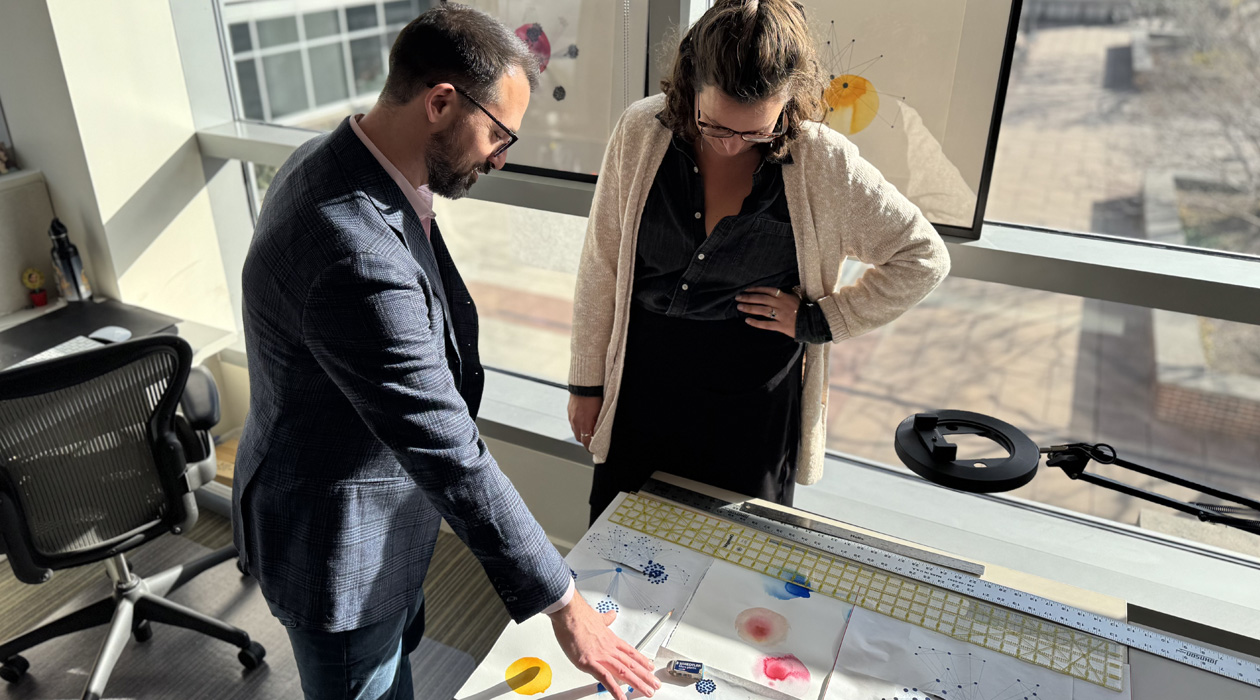
Will Barley (left) and Julia Pollack discussing design ideas for the network sociogram illustrations. / Elizabeth Bello

Share
In some cases, science inspires creative works of art. In other cases, the art itself inspires unique scientific research. Either way, novelty is generated through the interaction and exchange of knowledge from differing perspectives. This underlying concept of interdisciplinary collaboration is at the heart of William Barley’s research on team science at the University of Illinois Urbana-Champaign.
Barley, the director of graduate studies and associate professor of communication, focuses on the dynamics that make teams successful. His research explores the challenges that individuals face as they collaborate across knowledge boundaries and the strategies that interdisciplinary teams use to productively manage their differences. This work informs his role within the Carl R. Woese Institute for Genomic Biology as a faculty advisor to the director in team science.
In a recent Nature Scientific Reports publication titled, “Rare Gems: researchers from unconventional departments provide greater brokerage in interdisciplinary sciences,” Barley and his colleagues examined how scientists who have joined interdisciplinary research institutes compare to those who haven’t.
“This paper is asking, ‘Does joining an interdisciplinary research institute that has resources devoted to facilitating teams and collaboration meaningfully shape researcher’s careers and how?’” said Barley. “The study is looking at not only whether or not joining these types of institutes has an effect, but who it affects and why, compared to other people.”
To answer these questions and explore conventionality and constraint metrics among researchers who are either involved or not involved with an interdisciplinary research institute, Barley collaborated with ecologist Brian Allan (IGOH), Entomology Department Head, and Ly Dinh, a professor of information science at the University of South Florida.
Dinh is a computational social scientist who has been working with Barley for nearly a decade on network theory methods and modeling techniques to examine various research institutes and organizations. Barley started working with Allan when Barley first joined the IGB in 2020. Through conversation, Barley and Allan quickly realized that ecologists have been thinking about measures of diversity and networks within complex systems for a lot longer than social scientists.
“Brian and I had this great collaboration where we asked, ‘What if we tried to use some of these ecological ideas to examine team science?’” said Barley. “It was a brokering experience; it’s exactly the mechanism we’re talking about in this publication.”
The team conducted a 17 year-long longitudinal study, that matched pairs of 256 researchers at one institute referred to in the publication by a pseudonym, the “Nature Institute.” The team wanted to estimate whether researchers’ collaboration networks became more redundant or bridging after joining the institute. A redundant network is one in which there are multiple researchers with similar expertise. A bridging network will tend to have a more diverse array of researchers with differing subject knowledge. Redundant networks are more constrained while bridging networks are less constrained.
The researchers found that departmental conventionality conditions the effect of membership: in less conventional departments, institute membership is associated with decreased network constraint, providing greater access to diverse and non-redundant co-authorship connections.
“Our conventionality measure is essentially a measure of how represented a researcher’s home department is within a particular research institute,” Barley said.
Researchers have less constrained networks if they have a big network, if they act as a broker within their network to bridge different disciplines, or if there is no one in the researcher’s network who is structurally equivalent. Barley is particularly excited about two implications of their findings.
“The conceptual aspect that I’m really proud of is that first, this paper starts to demonstrate the importance of doing large-scale empirical studies of team science,” Barley said.
Prior teams literature has been primarily rooted in business firm studies, but scientific teams work differently and their collaborations are more ephemeral. Joint research efforts can be more fluid with respect to time and topic, starting and ending more frequently, and overlapping or diverging in their aims.
“The second aspect I’m really excited about is that we have a really nice data set from a scientific setting and we’re able to show that looking at those data with nuance can provide actionable insights and policy implications for administrators and leaders in science,” Barley said.
One of Barley’s favorite implications of the study involves the dynamics of the entire system. Every time a researcher is brought into an interdisciplinary institute, that discipline is paradoxically made more conventional within that institute. For example, the addition of an engineer to a biology-focused institute means that engineering is unconventional with respect to the overall composition of researcher expertise at that institute. However, as more engineers join the institute, engineering becomes more conventional and the marginal benefits of including more engineers decreases over time. These types of dynamics influence science policies depending on the structure and goals of a specific institute.
The research suggests that, for example, the director of an interdisciplinary institute will likely need to consider balancing the recruitment and support for both conventional and unconventional researchers. Generally, most researchers who join such an institute receive benefits related to resources, instrumentation, and expertise, but exactly how each researcher will benefit from those resources varies. Benefits can also be dictated by the overall composition of combined research expertise at a given institute or within a team.
“There’s a ton of research that shows that being in unconstrained networks is beneficial for producing novel ideas and these tend to be more interdisciplinary teams,” said Barley. “We show that people from less conventional departments see a greater reduction in their constraint when compared to all the other groups in the study.”
Interestingly, the idea behind the publication was initially driven by the outcome an unconventional partnership; artwork inspired by Barley’s previous research that was designed by IGB’s Creative Program Manager Julia Pollack, who curates the institute’s Art of Science program.
Several years ago, Barley gave a presentation at the IGB about the importance of research institutes, not just in terms of funding or physical resources, but also in terms of staff and expert technicians who are rarely represented in networks associated with interdisciplinary research. Pollack, an audience member, was intrigued by Barley’s research and reached out to him about a potential collaboration. The pair, an interdisciplinary duo themselves, then worked together to create a series of art pieces inspired by Barley’s research for the Art of Science program.
“Working with Will is a joy; he was interested to see my process unfold and then picked up what he could see from our work and transformed those ideas into an entirely different research outcome,” said Pollack. “Interdisciplinary work is my favorite when people with very different skills and backgrounds pull inspiration from each other. I am less interested in perfect synchrony and more curious about what is possible to create in response to each other’s different specialties.”
While at the Art of Science exhibit, inspiration struck again. This time, Pollack’s art inspired a new research direction for Barley to pursue.
“We’re standing together at this show looking specifically at the images Julia created and we’re reflecting and having conversations about what we saw in the images, and it was in those conversations that this idea of using constraint as a dependent variable and thinking about conventionality came to be,” Barley said.
The hypotheses for Barley’s latest publication were therefore drawn from Pollack’s artistic representation of his prior work. It was ideation at its finest and exemplified the creative process of generating, developing, and communicating new ideas to solve problems and drive innovation.
“There’s this oscillation between the type of social scientific research that I do, the artist engaging with it enough to see a connection with their interests, approaching me to make art, and then our conversation about that art that ended up creating inspiration for this new project, now published in Scientific Reports—and now it has Julia’s art in it. I live for that,” Barley said.
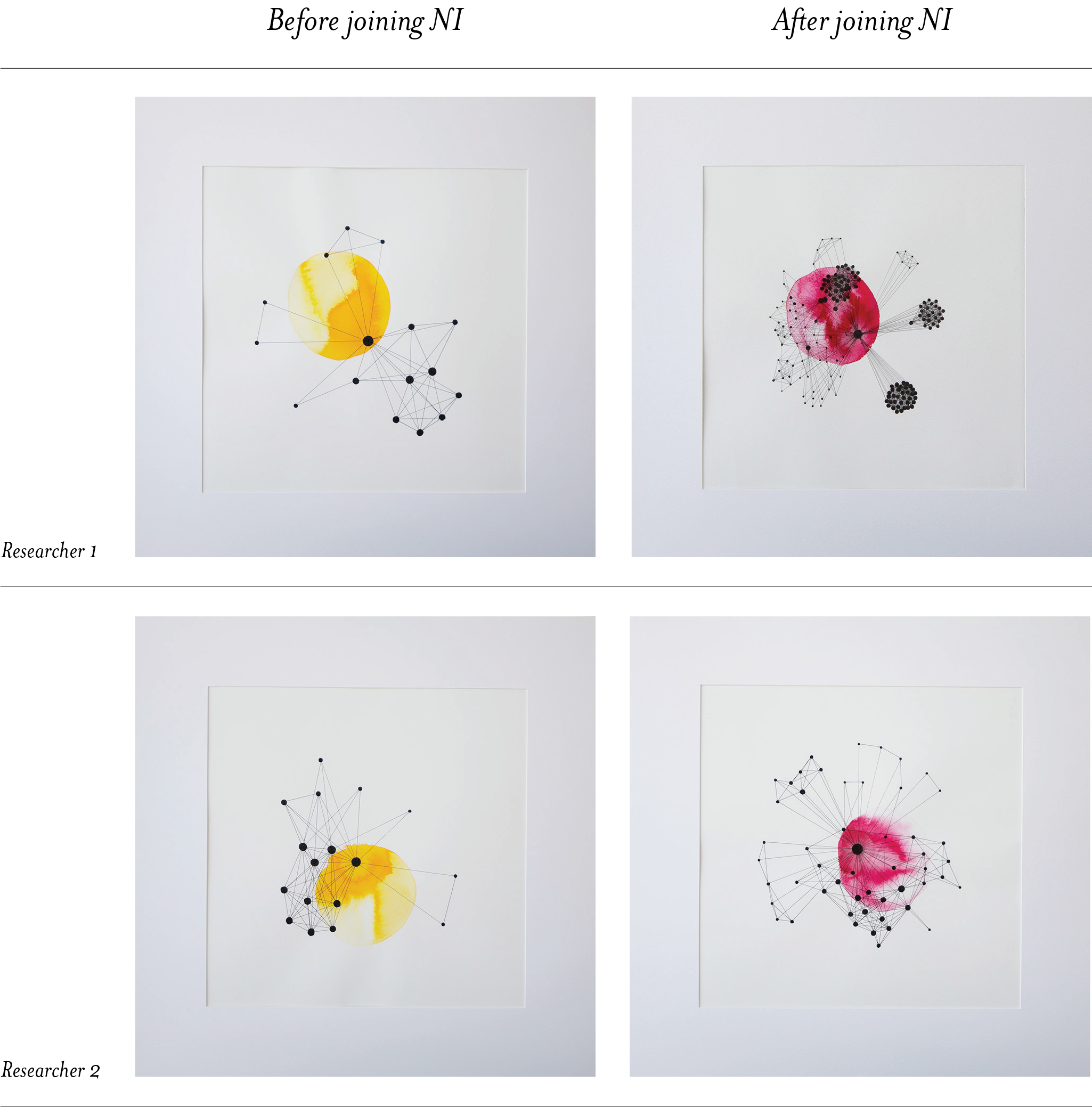
Some of Pollack’s art is featured in Figure 1 of the publication; two hand-rendered sociograms that display real data points from the team’s research. The image is both aesthetically pleasing and a valid representation of the data, demonstrating the unique intersection between art and science.
“One of the common public critiques of science is that it’s hard for members of the public—people who aren’t embedded within the fields that we study—to understand or find meaning in what we do,” said Barley. “Art is a different way of engaging with science. It encourages reflection in ways that many of the methods that we use as scientists just don’t. I think the process of engaging with the visual representation that Julia created was so neat. I want more of that, especially if it’s another way we can increase public engagement.”
In the future, Barley and Pollack intend to continue exploring the relationship between art, science, and the processes that weave these seemingly opposite disciplines together.
Additionally, Barley plans to bolster the findings from this case study by examining scientific teams at other interdisciplinary research institutes. His publication has already enabled conversations with directors from many different institutes and has rallied a lot of support to continue this type of research.
“By looking at multiple institutes we can examine whether the effects found at this particular institute are unique, or if there are features of other interdisciplinary institutes and organizations that create different effects on researchers’ networks,” Barley said.
The full publication, entitled “Rare Gems: researchers from unconventional departments provide greater brokerage in interdisciplinary sciences,” can be accessed here.