


World of Genomics brings biotechnology to life
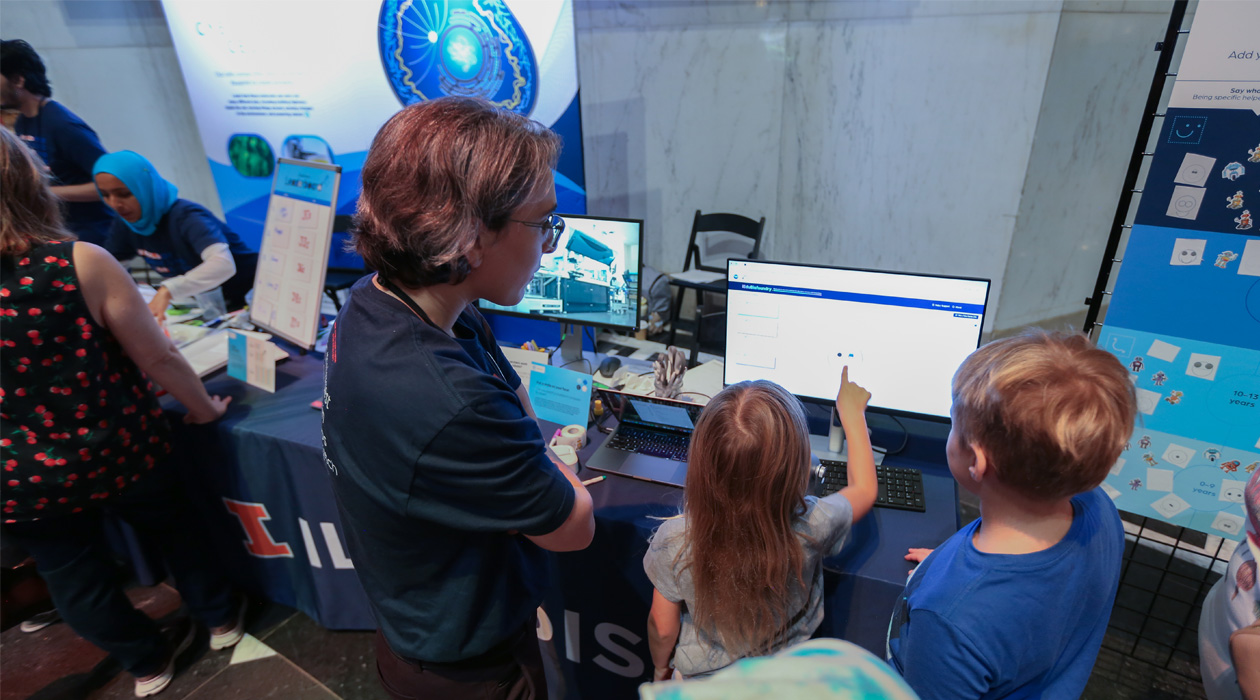
As one of the world’s largest science museums which welcomes thousands of visitors every day, Griffin MSI serves as a premier venue for the IGB's World of Genomics. / Julia Pollack

Share
“We made a slide for a microscope! We saw the leaf's stomata.”
“We didn't know how many seeds bananas used to have!”
“I learned about caterpillars and I LOVED it.”
Visitors to the Griffin Museum of Science and Industry this October 11–12 were excited to encounter a new dimension to its renowned range of interactive exhibits. Over these two days, Griffin MSI and the Carl R. Woese Institute for Genomic Biology at the University of Illinois Urbana-Champaign collaborated to offer the World of Genomics, a public event hosted in the Museum’s main rotunda and featuring interactive learning stations staffed by IGB scientists.
This was the museum’s second time hosting the World of Genomics, this time as part of a broader partnership to offer activities that feature genomics, the study of the structure and function of an organism’s complete set of genetic material. Griffin MSI and the IGB had first worked together to offer a World of Genomics event in the fall of 2024. This year’s event, which was seen by more than 5000 museum guests over the holiday weekend, included a special focus on biotechnology. Each learning station highlighted ways that automation and artificial intelligence are enabling us to study and understand the living world in new ways.
“I especially liked that the biotechnology theme this year,” said IGB’s Assistant Director of Outreach Daniel Urban, who oversaw the scientific content of the event. “It let us delve into some topics we have previously worked with and find creative new ways to significantly improve upon them.”
One of those topics is the exploration of how neurons, the cells that make up our nervous system, process information. To help visitors of all ages understand how neurons work and how engineered neuron-computer interfaces reveal the way they process information, IGB scientists and staff worked together to create an activity in which guests could make their own giant neurons out of conductive clay and connect them with an electrode array to light up LEDs. Alongside this activity, guests viewed microscopic neuron samples, raced a liquid-handling robot to pipette colored water, and observed the motion of a bio-inspired soft robot that crawls like a caterpillar.
Another new activity placed visitors even more directly in the role of scientists, asking them to identify key features on microscopic images of leaf surfaces. In a custom-built browser game dubbed Stomata Spotta, participants searched for and clicked on microscopic pores called stomata that enable a plant to take in carbon dioxide for photosynthesis. Through the game and a related activity that guided participants to make their own microscope slides with a detailed imprint of a leaf’s surface, researchers connected the act of identifying and counting stomata with efforts to develop more water use-efficient crops..
Attendees of the World of Genomics also enjoyed returning favorite activities, including driving a remote-controlled crop-monitoring robot; replicating a model DNA strand; and playing giant plinko for the chance to win a science-themed prize. Children earned additional chances at plinko by visiting each of four learning stations featuring an introduction to genomics, innovations in food and fuel crops, cellular biotechnologies, and therapeutic drug discovery. At each station, the visiting scientists were supported by members of Griffin MSI’s fleet of volunteers.
“It was great to have Griffin MSI as a partner in this endeavor,” Urban said. “We appreciated having their volunteers be at the tables, helping to lead the activities and discuss their impacts. We look forward to their continued involvement and participation as we begin to plan for the next World of Genomics event.”
As in past years, the World of Genomics was made possible with the support of sponsors, this year including Bayer, Biohub, ThermoFisher Scientific, and Zeiss, as well as a generous gift to Griffin MSI from Dr. Pat and Kelly Basu. Countless hours of effort by over 40 IGB professional staff and scientists from 14 different campus units made the event one to remember.
“We couldn’t have asked for a better start to the formal partnership with the Griffin Museum of Science and Industry,” said IGB Interim Director Lisa Ainsworth. “The museum started because Julius Rosenwald was inspired by a child’s fascination with an interactive exhibit. Nearly 100 years later, we helped to fulfill that mission to spark curiosity and innovation through an immersive science experience.”