


IGB celebrates opening of iBioFoundry, National Institute for Biofoundry Applications
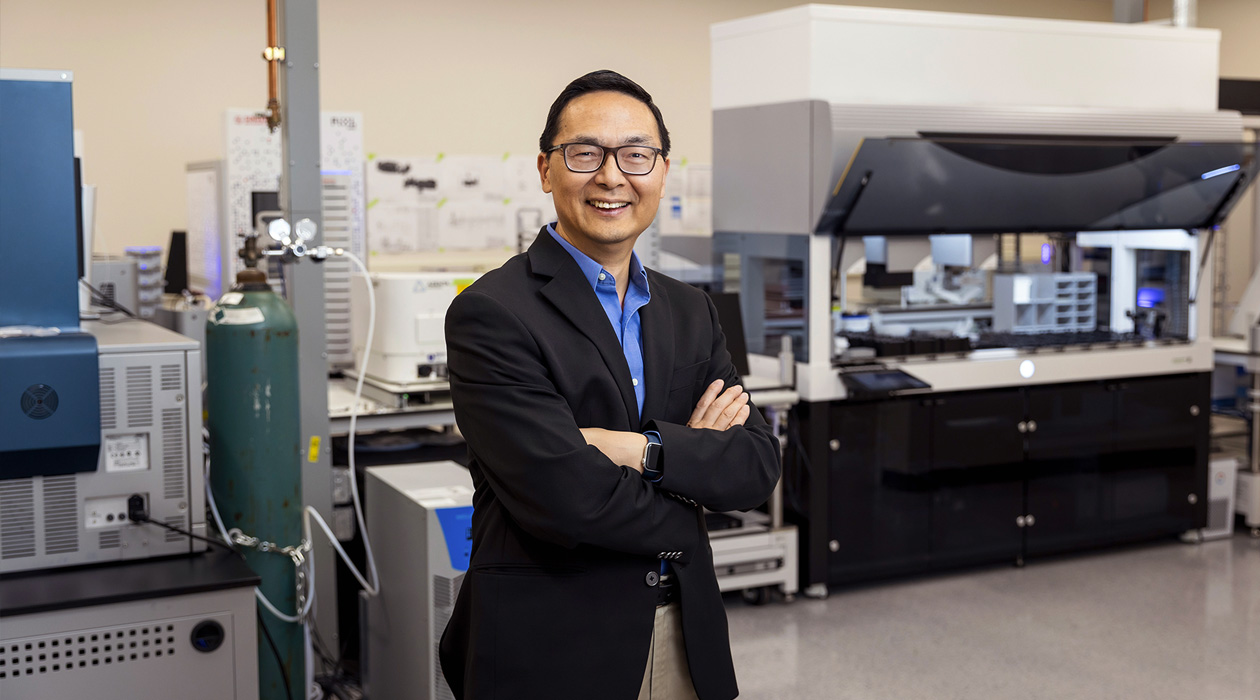
Chemical and biomolecular engineering professor Huimin Zhao leads the new National Science Foundation iBioFoundry at the IGB. / Michelle Hassel

Share
Scientists, government officials and participants from around the world gathered on the University of Illinois Urbana-Champaign campus for the grand opening of the National Science Foundation’s Illinois BioFoundry, or iBioFoundry, and the National Institute for Biofoundry Applications at the U. of I.
The ribbon-cutting ceremony took place Sept. 18 at the IGB on the U. of I. campus in Urbana, where the new facilities are housed.
The iBioFoundry builds on more than a decade of research at the U. of I. to integrate synthetic biology, laboratory automation and artificial intelligence to advance protein and cellular engineering. It is one of several biofoundries established in the U.S., each of which has its own focus and mission.
“The NSF iBioFoundry serves as a hub for innovation, bringing together researchers, industry experts and policymakers to foster collaboration and accelerate the development of sustainable biomanufacturing processes,” said iBioFoundry director Huimin Zhao (BSD leader/CAMBERS/CGD/MMG), a professor of chemical and biomolecular engineering at Illinois. “By centralizing resources and expertise, it will streamline the creation of new bio-based products and technologies, ranging from renewable chemicals to advanced medical treatments.”
See Prof. Zhao's interview on WAND News.
The National Institute for Biofoundry Applications complements the mission of the Illinois Fermentation and Agriculture Biomanufacturing Tech Hub — an initiative backed by nearly $680 million in commitments from public and private partners. NIBA and iFAB are expected to create high-tech jobs, stimulate regional economic growth and bolster the U.S. position in the global bioeconomy, officials said.
The grand opening coincided with the Global Biofoundry Alliance annual meeting, which welcomed approximately 150 participants from more than 30 biofoundries in 14 countries. Attendees included leaders from academia, industry, national laboratories, nonprofit organizations and U.S. government agencies such as NSF and the Department of Energy.