


IGB Profile: Yingjie Lei
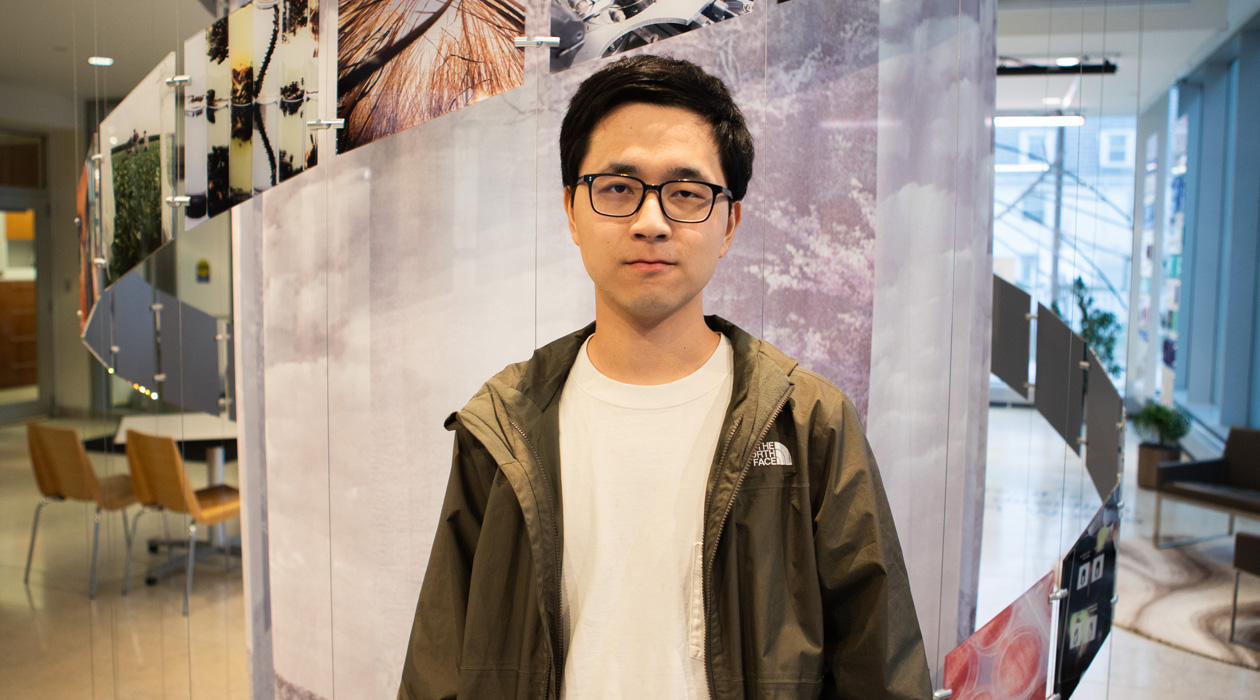
"I want to help create these toolkits and translate them into real crops, moving innovations from bench to field." / Isaac Mitchell

Share
For some undergraduate students, a summer research experience is a chance to confirm their interest in laboratory work. Yingjie Lei, a junior in plant biotechnology at the University of Illinois Urbana-Champaign, was looking for the freedom to focus on what he already knows is his calling.
“As a kid I imagined becoming a firefighter or police officer,” Lei said. “But in high school I discovered how much I enjoyed scientific inquiry.” Still in high school, he acted swiftly to explore his newfound passion: “I joined Professor Jian Huang’s lab at Soochow University near my home . . . several side projects explored plant biology. I was immediately drawn to the plant work and spent the next three years contributing to it—an experience that set me firmly on the path to a career in plant biology.”
Plants have continued to be the central focus of his scientific interest.
“Plants fascinate me—they harvest sunlight directly and sustain the world’s food and bioenergy systems,” Lei said. “Beyond that big-picture impact, I’m drawn to their elegant biology: without a nervous system, plants integrate hormonal signals, circadian rhythms, and environmental cues to adapt and thrive.”
Lei also embraced biotechnology early; in 2019, he began participating in the team-based International Genetically Engineered Machine competition, an international program that focuses on synthetic biology research. He has been involved in iGEM each year since, helping to lead teams to several awards and providing mentorship to other team members.
His strong interest in both plant science and biotechnology led Lei to the University of Illinois Urbana-Champaign. The supportive and collaborative research community he found on campus corroborated his choice. When he joined the laboratory of Professor of Plant Biology Amy Marshall- Colón (CAMBERS/PFS) as a freshman, he knew he had found the right fit.
“Dr. Marshall-Colón’s lab uniquely blended systems and synthetic biology with real crop applications, and it welcomed undergraduates as genuine contributors,” Lei said. “The group’s integration of computational design with wet-lab validation matched how I like to work—moving from in silico promoter design to vector construction and plant assays. Her mentorship, vision, and the lab’s collaborative, supportive environment were decisive factors in my choice.”
In the spring of his sophomore year, Lei applied for the Carl R. Woese Institute for Genomic Biology Mark Tracy Undergraduate Translational Research Fellowship. The award, made possible by a gift from biotechnological leader Mark Tracy, provided support for undergraduate students to complete a summer of fulltime work on a translational research project.
Lei was awarded a Tracy Fellowship for the summer of 2025 for his proposal to explore a novel method of introducing gene constructs to biofuel crop plants. Many traditional methods do not work well with sorghum and other promising crops; Lei’s project focused on carbon dots, which can deliver genetic materials to cells and also help to promote gene activity.
Using carbon dots, he was able to successfully transform sorghum seeds and confirm the activity of his experimental gene construct in the resulting seedlings. He began work on a gene construct whose activity will be more readily increased by the carbon dot protocol.
“The most satisfying part of my summer was watching ideas become data,” Lei said. “I built a carbon‑dot–mediated gene delivery pipeline in sorghum and seeing clear GFP bands on the Western blot, the first proof the approach worked transiently, was a standout moment.”
As always in scientific research, not everything in Lei’s project ran smoothly. The carbon-dot method did not produce stable gene expression in the longer term. He regrouped, performed troubleshooting, dug into alternative approaches, and ended the summer with a set of promising new directions. His enthusiasm for his chosen career path and its potential societal impact remains as strong as ever.
“I’m most excited about a career in plant synthetic biology,” he said, “treating gene networks like engineerable circuits to build crops that are more efficient and resilient. As our understanding of plant physiology and gene regulation deepens, we can . . . enhance traits such as drought tolerance, nutrient-use efficiency, and carbon sequestration.”
Lei’s summer experience turned bittersweet. Marshall- Colón died at the end of July, a tragic loss for her friends and family, her laboratory group, the academic world, and the broader community. Lei is grateful for the mentorship he received from her and spoke about his personal experience with her legacy of positive impact.
“I would like to express my sincere gratitude to Dr. Amy Marshall-Colón, a pioneering woman plant biologist, for her invaluable guidance and support,” he said. “She provided me with thoughtful advice throughout the grant application process and during my research . . . Her courage and unwavering dedication to science continue to inspire me deeply.”