


Researchers enable microorganisms to build molecules with light
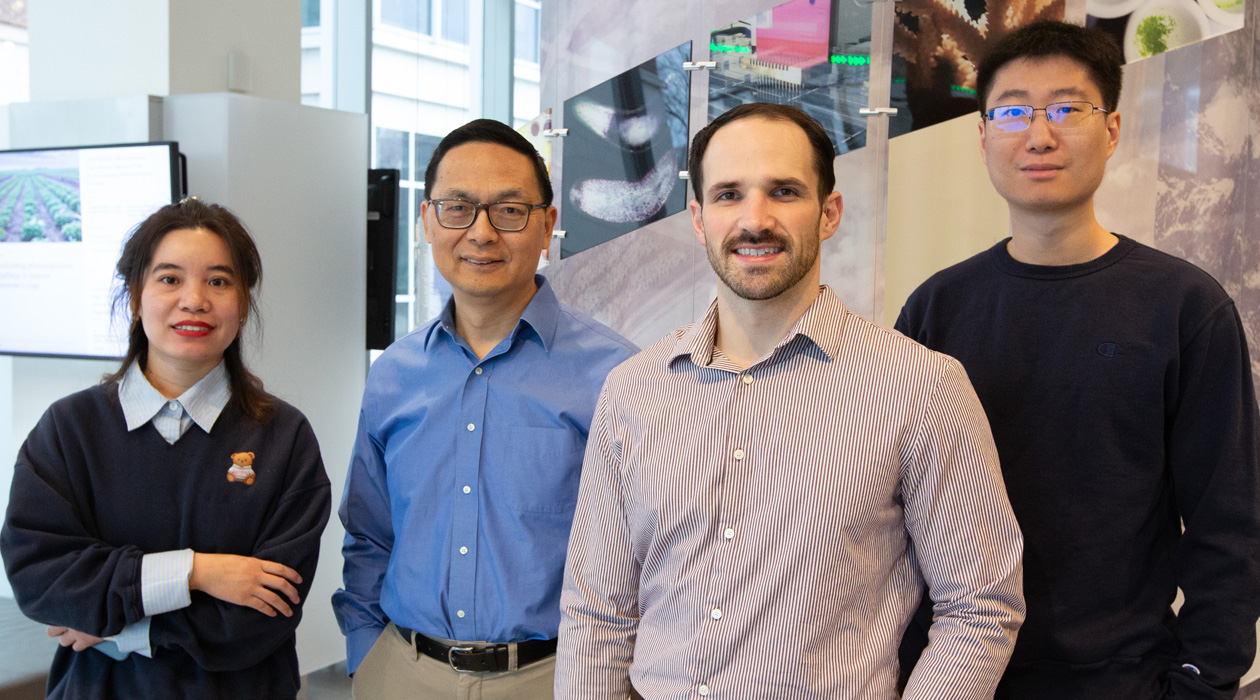
The research team included (from left) Postdoctoral Researcher Yujie Yuan, Professor of Chemical and Biomolecular Engineering Huimin Zhao, PhD student Wesley Harrison, Postdoctoral Researcher Zhengyi Zhang, and Postdoctoral Researcher Maolin Li (not pictured). / Isaac Mitchell

Share
Researchers are continually looking for new ways to hack the cellular machinery of microbes like yeast and bacteria to make products that are useful for humans and society. In a new proof-of-concept study, a team from the Carl R. Woese Institute for Genomic Biology showed they can expand the biosynthetic capabilities of these microbes by using light to help access new types of chemical transformations.
The paper, published in Nature Catalysis, demonstrates how the bacteria Escherichia coli can be engineered to produce these new molecules in vivo, using light-driven enzymatic reactions. This framework sets the foundation for future development in the emerging field of photobiocatalysis.
“Photobiocatalysis is basically light-activated catalysis by enzymes. Without light, the target enzyme cannot catalyze a reaction. When light is added, the target enzyme will be activated,” said Huimin Zhao (BSD leader/CAMBERS/CGD/MMG), Steven L. Miller Chair of Chemical and Biomolecular Engineering. “We have published many papers showing that it is possible to combine photocatalysis with enzyme catalysis to create a new class of photoenzymes. These artificial photoenzymes can catalyze selective reactions that cannot be achieved by natural enzymes and are also very difficult, or sometimes even not possible, with chemical catalysis.”
Biomanufacturing allows for the sustainable production of pharmaceuticals, herbicides, and other natural and industrial products. These processes rely on microorganisms that are naturally good at synthesizing molecules, using proteins called enzymes to promote chemical reactions to occur. Enzymatic catalysis is successful due to the selective nature of enzymes which have strong preferences for specific shapes and sizes of molecules they transform. However, because the types of reactions that enzymes can catalyze are much fewer than those by chemical catalysts, the number and classes of chemicals and materials that can be produced through biomanufacturing are limited compared to traditional chemical manufacturing.
The recently created field of photobiocatalysis aims to broaden the capabilities of biomanufacturing. While the vision is promising, there is a huge amount of experimental work to be done: most of the known photoenzymatic reactions can’t be incorporated into cellular metabolism. Previous work in Zhao’s group proved successful for in vitro applications but must be adapted for in vivo contexts to be useful for biomanufacturing purposes.
Zhao said, “Our strategy is to incorporate those photoenzymes in cellular metabolism so that we can use whole cells to convert glucose, which is a very cheap feedstock, to higher value products.”
Led by postdoctoral researcher and first author of the paper Yujie Yuan, the research team focused on building a biosynthetic platform for specific types of chemical transformations called hydroalkylations, hydroaminations, and hydroarylations. Using synthetic biology tools, they first engineered E. coli to co-produce all of the required components for these reactions, including a class of molecules called free radicals that are needed for the light-catalyzed reactions. Importantly, they developed a fully integrated platform that didn’t require external input of materials.
“We don't need to feed in any radical precursors, and the E. coli can produce the photoenzymes, radical precursors, and the substrates in the whole cells together,” Yuan said.
After optimizing the platform, Yuan and her colleagues tested different radical precursors to assess their compatibility with the platform.
“We evaluated six different photoenzymatic reactions, and we found that our platform can be compatible with these reactions,” Yuan said. “We also tested the scale-up of four different photoenzymatic reactions in the bioreactor.”
But while these results are promising, there are still improvements needed in order to translate this biotechnology beyond the research lab. One problem Zhao’s group is continuing to work on is increasing the low titers—the amounts of desired products made—when this process is done on larger scales in bioreactors.
“For the photoenzymatic reactions, the reaction conditions are restricted by the process. Light and also anaerobic conditions are needed. It is a major challenge to determine the conditions in the bioreactor,” Yuan said.
Because there are no existing bioreactors specific for light-driven biosynthesis, it is difficult to optimize these processes without a means to collect data about light levels in the reactor. The team is investigating ways to address this problem, including contacting companies to see if it is possible to design a custom bioreactor for these purposes.
Another next step for this research is using the photobiosynthetic platform to synthesize high value products like FDA-approved drugs or herbicides. But overall, the study is an important milestone for the field of photobiocatalysis, representing the first example of integrating photoenzymatic reactions into cellular metabolism. This offers a promising avenue for expanding the number and classes of molecules that microbes can sustainably manufacture.
“This is a proof-of-concept. It demonstrates it is possible to incorporate engineered enzymes with new to nature reactivity into cellular metabolism and produce compounds that cannot be produced by biological approaches or even chemical approaches, at least in the past,” Zhao said.
The publication, “Harnessing Photoenzymatic Reactions for Unnatural Biosynthesis in Microorganisms” can be found at https://doi.org/10.1038/s41929-025-01470-y and was funded by the US Department of Energy Center for Advanced Bioenergy and Bioproducts Innovation.