


IGB Profile: Core Facilities
"I think [this work] takes understanding what someone wants to do and why they want to do it, and then trying to design a setup that will work for them. Being flexible is part of it. Part of it is doing the design, and part of it is being willing to take risks." —Glenn Fried, Director of Core Facilities

Share
A foundational step in the scientific process is observation. The more we learn about the natural world, the further scientists have to go to make novel observations—to see what has never been seen before.
The Core Facilities group at the Carl R. Woese Institute for Genomic Biology helps make this type of scientific exploration and subsequent experimentation possible. IGB Core Facilities offers centralized, high-end research equipment to researchers within and beyond the Illinois campus community. The value of its contributions were especially visible in a plant science study published last December, the first to use a microscope to watch the microscopic pores on a leaf surface open and close while documenting its real-time changes in carbon dioxide intake.
Plant biology professor Andrew Leakey (CAMBERS leader/PFS), who led the study, attributed a large part of its technological innovation to his laboratory’s close collaboration the Core Facilities, particularly Core Facilities Director Glenn Fried. Fried’s dedication to creatively adapting research methods, particularly imaging methods, to the needs of each new project, is a guiding principle for Core Facilities work.
“The most important thing to know is that we're very happy to help people do special projects,” Fried said. “Core Facilities is not just a list of instruments that we currently have . . . if you want a specific kind of imaging data, we'll figure it out.”
Under Fried's leadership, the Core Facilities has grown from its establishment with the opening of the IGB in 2007 to include 18 different microscopes, including a Minflux setup for super-resolution microscopy; a nuclear magnetic resonance spectrometer for detailed chemical analyses; and infrastructure for customizable sample preparation and image analysis. Emerging technologies have been reflected in new offered services, including 3D printing and upgrades of existing equipment.
The Core Facilities’ growth over time is necessary to keep pace with the mainstream research needs of a large and busy research institute, especially as part of Illinois’ active and collaborative campus environment.
“We had 130 roughly new people come to the Core this last year, and most of them were looking for support and access using established and standard microscopy techniques," Fried said. “We can help them by providing access to tools and training or tools we have, microscopes we have.”
But each year also brings a project or two with more specialized imaging or analytical needs, and Fried’s group goes above and beyond to find ways to support them. Over the years, the Core Facilities team has pushed the boundaries of what their microscopes can do, innovating new sample preparation methods, adapting microscope constructions and settings, and procuring new equipment to create new pathways for discovery. The group has contributed to publications on the imaged 3D structure of an intact heart, the surface details of ancient pollen grains, and the fluid dynamics within a flow cell made out of real rock.
"In some cases, we don't have the tools we need to do the project,” Fried said. “In that case, we started looking at ways to acquire the tools. Sometimes that means we need to buy a new microscope. Sometimes it means we need to build a microscope. Sometimes it means that we need to add on to our microscope. We will work with any of those options, depending on which we think is the most helpful.”
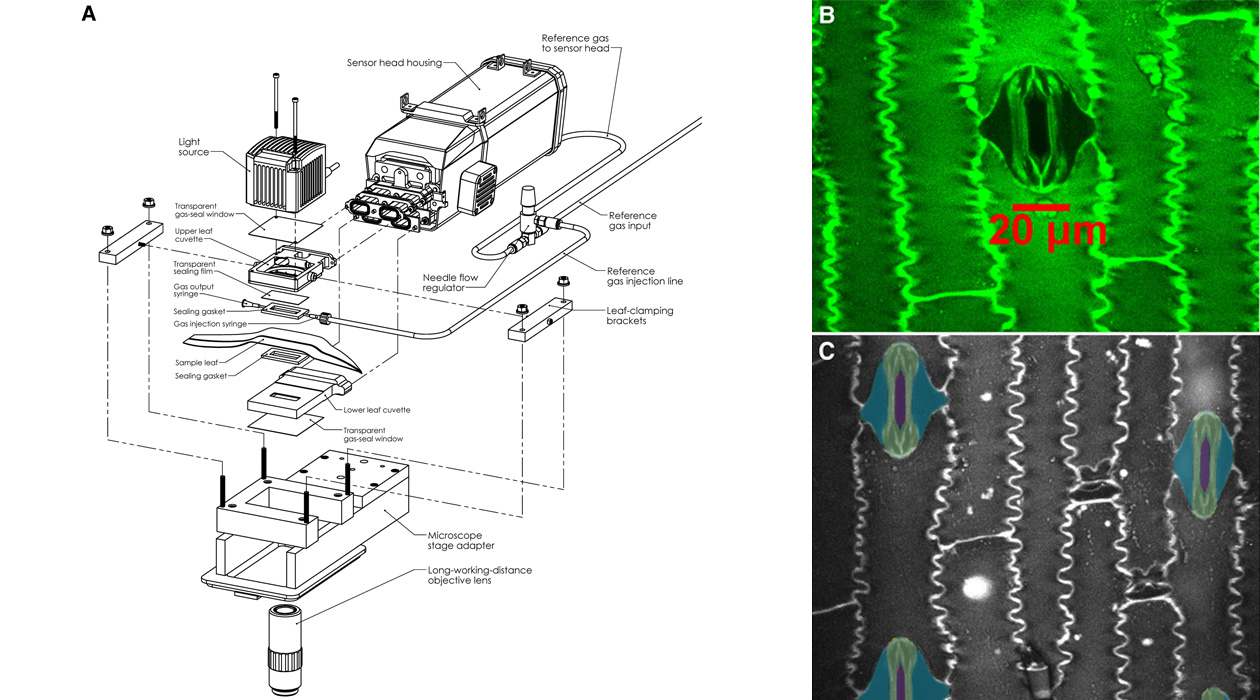
The most recent such effort, the development with Leakey’s research group of the “Stomata In-Sight" system, showcases the Core Facilities’ strengths. For the system to work, the team had to find a way to implement real-time microscopy of the movements of living cells on the surface of a leaf, in an enclosed chamber that also housed sensors able to detect tiny changes in ambient carbon dioxide and water vapor.
“We put a long working distance objective on the microscope and then we built a stage adaptor; [we] drew up plans and took them to the shop and made support systems so that the stage would support” the detectors needed, Fried said, describing how Core Facilities staff and lab members worked together. “it's a pretty big deal because that paper represents a whole new way to measure things that have never been measured before. Andrew Leakey has positioned himself as the leader in observing stomata open and close. No one else does that, and that's pretty special.”
At the end of the day, what drives the Core Facilities team is the pursuit of better and broader ranging science through a flexible approach to research methods.
"I try to build a culture in the Core that when someone comes in and says, ‘we have a problem,’ we'll say, ‘we'll help you.’” Fried said. “And then we ask what the problem is.”