


A century of photonics research shapes the future of healthcare diagnostics
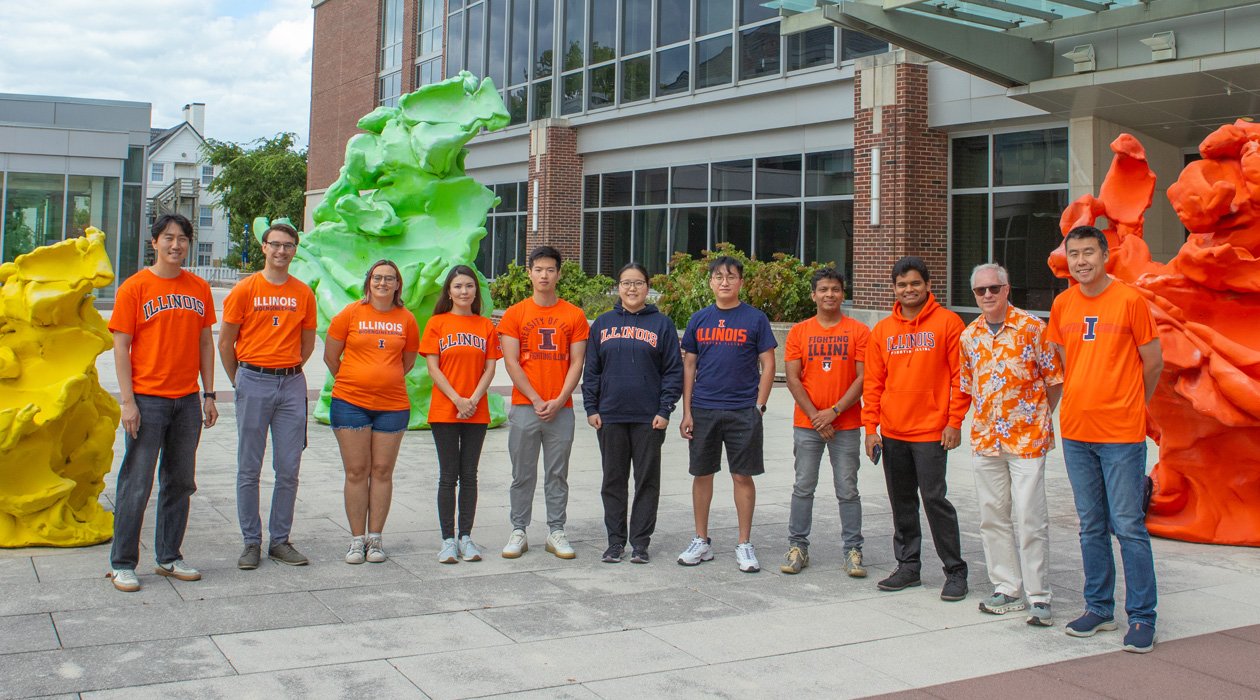
The authors highlighted their collaborative team effort by sporting their Illini Orange and Blue. From left to right: Hankeun Lee, Joseph Tibbs, Amanda Bacon, Takhmina Ayupova, Leyang Liu, Anqi Tan, Wang-Chien Chen, Saurabh Umrao, Seemesh Bhaskar, Brian Cunningham, Xing Wang / Isaac Mitchell

Share
Diagnostic testing is essential in modern healthcare settings. By sensing biological molecules called biomarkers, clinicians can gain insights into what is happening in the body, invisible to the eye. Recently, a collaborative team from the Carl R. Woese Institute for Genomic Biology published a comprehensive review on photonic crystal grating resonance, or PCGR, a promising technology for improving diagnostic biosensors and early disease detection.
The review article, published in the journal Chemical Reviews, provides a comprehensive overview of PCGR-based biosensors and their widespread applications—from pathogen detection and wearable diagnostics to environmental monitoring and toxin biosensing. It also dives into the past century of research that built the foundation for today’s technology and future advancements.
“It cites landmark works from 1907, 1947, 1956, and many more, connecting them to current breakthroughs in microRNA detection, lipid biosensing, circulating tumor DNA diagnostics, and beyond,” said Seemesh Bhaskar, first author of the paper and an IGB Postdoctoral Fellow in Professor of Electrical and Computer Engineering Brian Cunningham’s (CGD leader) research group. “To understand where we are going, it is essential to know where we have been. This review stands as a reminder that scientific foresight begins with historical awareness.”
The first grating photonic substrate was reported in 1902. Since then, these advanced nanomaterials have become much more sophisticated, with researchers designing and fabricating specialized substrates for different applications. Photonic grating crystals are particularly beneficial for diagnostic biosensing due to their ability to manipulate how light is absorbed and reflected on the nanoscale. This helps to amplify the biosensor’s fluorescence signal and uncover ultra-low levels of molecular biomarkers such as proteins, viruses, or nucleic acids.
“One of the real strengths of this review is not just its comprehensive content, figures, and references, but also its carefully curated tables,” said Saurabh Umrao, a postdoctoral researcher in Associate Professor of Bioengineering Xing Wang’s lab. The first table of the review, for example, outlines advancements in the field over the past 20 years. Drawing on insights from over 100 studies, it provides a comprehensive list of diagnostic technologies that use one-dimensional photonic crystals.
“In that sense, the review feels almost like an encyclopedia for the field, making it a valuable resource for both experts and newcomers,” Umrao said.
The field of diagnostics is highly broad and interdisciplinary, requiring knowledge from many areas including biology, chemistry, biomedical engineering, and materials science. A strength of this review is its holistic perspective that touches on each of these different areas, with an emphasis on not only sharing relevant information, but also providing critical analysis by experts.
When beginning the process of drafting the review, Bhaskar and Cunningham quickly realized that it was building into a much larger project than initially planned. This led them to recruit more people, and what was initially a four-person project, grew into a large team effort that played to everyone’s strengths.
Bhaskar said, “We thought the best approach was to incorporate people who have expertise in that domain. Anybody who looks at it will get a comprehensive picture, and that was only possible by having multiple people's experience.” Bhaskar, in particular, worked on the technical background of photonics and plasmonics and personally took an interest in historical perspectives, while Cunningham used his extensive knowledge for higher level analysis like addressing current challenges and future considerations for the field.
With background at the interface of biology and engineering, Umrao found it rewarding to write the diagnostics sections and explore emerging photonics-based technologies. Other members of the team contributed sections focused on substrate engineering or added chapters on machine learning.
“This collaborative approach is precisely what makes the review both comprehensive and authoritative, and I’m confident it will resonate with the community,” said Leyang Liu, a graduate student in Cunningham’s lab. Liu wrote a chapter on hybrid structures, focusing on plasmonic films, Bragg mirrors, and dielectric gratings. “It’s been a pleasure to contribute to this review, and the process has been energizing and genuinely enriching.”
As modern research has become increasingly complex and driven by discipline-specific work, the team hopes the review article can also inspire future interdisciplinary collaboration to develop new diagnostics. “Places like IGB are the best. You are put in a place where you can talk to interdisciplinary researchers. When this becomes part of life for scientists, many new ideas can come up,” Bhaskar said.
Another key aspect for advancing future PCGR-based diagnostic technologies is to addressing current pitfalls. Bhaskar and his colleagues did this by discussing topics like biosensor fabrication limitations and regulatory gaps. By identifying these issues, it can help to spark conversations that eventually lead to creative and innovative solutions.
Bhaskar said, “With a vibrant team of co-authors and collaborators, and with the support of our research centers and departments, we are excited about the continued journey of PCGR technologies and their potential to transform health diagnostics for all.”
The publication, “Photonic Crystal Grating Resonance and Interfaces for Health Diagnostic Technologies” can be found at https://doi.org/10.1021/acs.chemrev.4c00653 and was supported by the National Institutes of Health and National Science Foundation.