


IGB Profile: Han Keun Lee
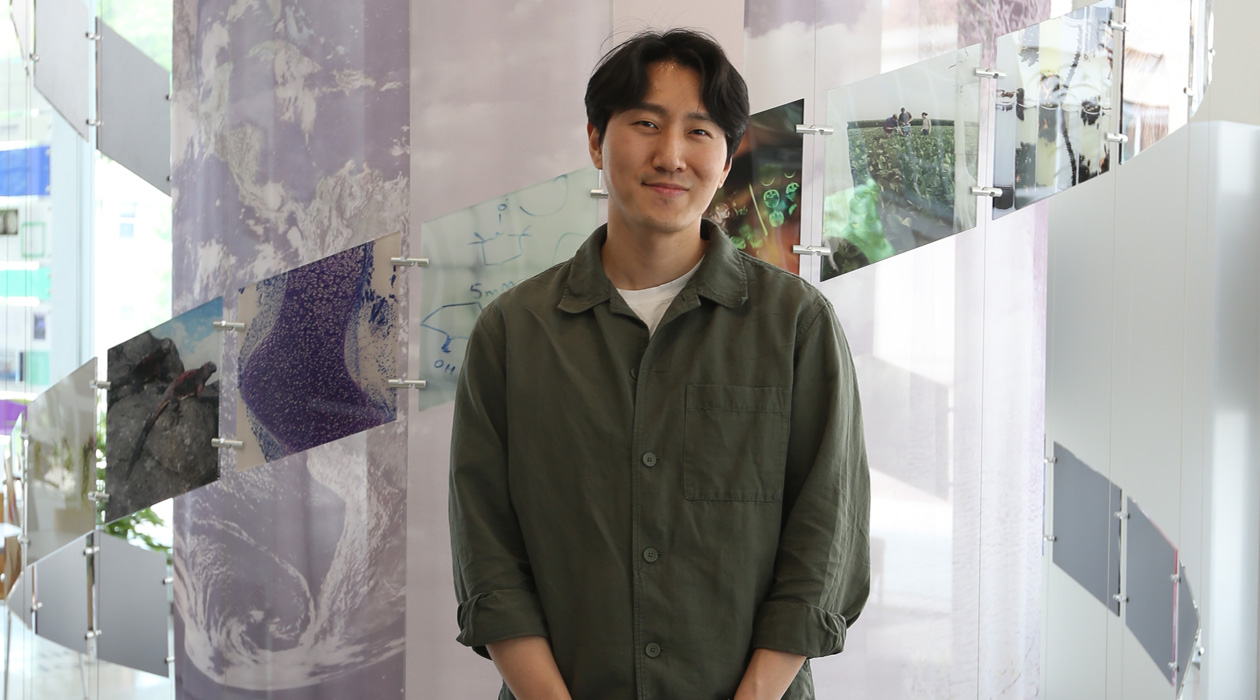
“Today is another day in paradise.” / Julia Pollack

Share
Han Keun Lee always knew he would become an engineer. Growing up in Korea, he was fascinated with making machines, inspired by his father who was an electrical engineer and researcher at LG.
“He used to bring his inventions home and show them to us,” Lee said.
Now a PhD student in electrical and computer engineering at the University of Illinois Urbana-Champaign, Lee works on his own inventions, developing new diagnostic methods to better detect infectious disease.
“It was very unexpected, actually,” Lee said, having never considered research as a career path when he was young. “I think that I was really fortunate to have great people around me who support me through it all.”
In 2006, Lee’s family moved from Korea to Ithaca, New York where he attended high school. He then continued his education in upstate New York at Binghamton University, where he earned his degree in electrical engineering and computer engineering, following in the footsteps of his father. As graduation neared, Lee serendipitously discovered his passion for research while waiting for his enlistment in the United States Army.
Lee planned to join the military through a special program that allowed international students to gain US citizenship through military service. He said, “I wanted to stay in the United States, and it was great opportunity. I think that only 100 people out of one state are selected per year, so I was lucky to be part of that.”
Because he would have time between finishing school and starting in the military, Lee needed something to bridge the gap. Around this time, a professor in his church community approached him, asking if he would like to try out some experiments. While hesitant at first, Lee ended up really enjoying working in a lab. He then joined Professor Seokheun Choi’s Bioelectronics and Microsystems Lab at Binghamton, where he developed paper-based batteries that used cyanobacteria to generate electricity.
“Once I was in the lab, and I started working on this project, I just felt like this is it,” Lee said. He quickly found joy and fulfillment in the process of learning to use different tools, diving into new subjects, and applying textbook knowledge to solve problems. “Creating the technology was very fascinating for me.”
During his six-year tenure in the US Army, Lee was proud to serve in the military, but he had caught the bug for scientific research and couldn’t shake it. “Basically, the whole time in the military, I kept studying after work hours. I went to cafes and would sit down there just studying, typing, coding.”
Lee mainly spent this time developing apps and websites, continuing to improve his skills as he kept the goal of pursuing graduate school and research in the back of his mind. Towards the end of his military service, Lee applied to doctoral programs and contacted professors, including Illinois Professor Brian Cunningham (CGD Leader) who is an expert in developing biosensors for point-of-care diagnostics and personalized medicine applications.
“The diagnostics field is something that I was also interested in, and I just felt that I could actually contribute to it,” Lee said. After numerous enthusiastic conversations, he joined Cunningham’s Nanosensors research group in 2020 after finishing his army enlistment.
“When I joined this lab, I knew that I was good at coding and building things,” Lee said. Though he was ready to hit the ground running, he wasn’t sure where to start after his research hiatus. “But then all my classes were really great at helping. Even now, I continue to take courses even though I don’t really have to just because I’m very curious about things and want to broaden my knowledge to try to find out how I can apply technology from other fields into my research. So, I just feel fortunate that I'm here.”
Through his classes, combined with his knowledge in coding, Lee became particularly interested in incorporating machine learning into point-of-care diagnostics to improve biosensor detection and analysis. He recently published new methods in this area and is now beginning to wrap up his thesis research and look towards the future. Lee someday hopes to lead his own research group and continue to learn, innovate, and positively contribute to society.
“I just want to be able to make changes in the world,” Lee said. “I really love being a researcher and being able to create tangible things that can impact other people.”