


Shortcutting photorespiration: A pathway to improve tomorrow’s crops
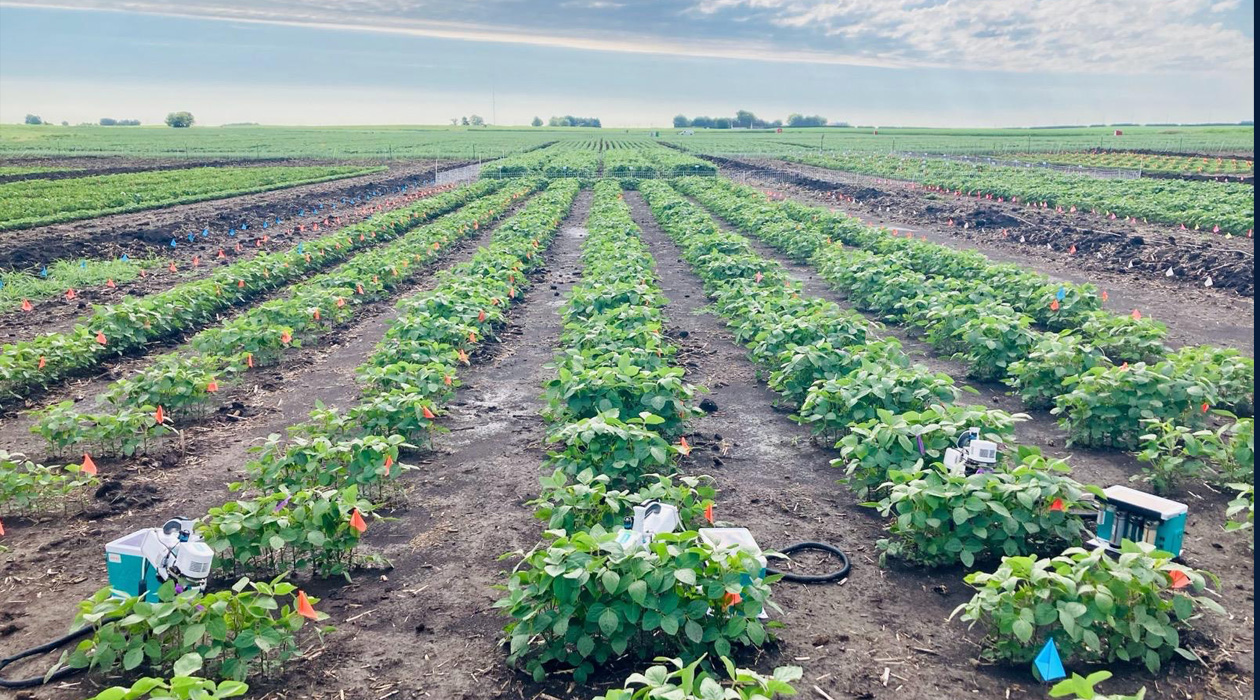
Photorespiration bypass soybean field trials at the University of Illinois Urbana-Champaign Energy Farm / Katherine Meacham-Hensold

Share
As global populations grow and temperatures rise, researchers are exploring ways to help crops withstand heatwaves by improving photosynthesis. In a Tansley Review published in New Phytologist, a team from the Realizing Increased Photosynthetic Efficiency (RIPE) project summarizes advances in engineering plants to bypass photorespiration—an energy-expensive process that limits crop productivity—and outlines challenges and next steps needed to translate this research to farmers’ fields.
“It takes a global community effort to make this technology available to growers,” said Katherine Meacham-Hensold, the scientific program manager at RIPE which is an international research project that is engineering crops to be more productive by improving photosynthesis. RIPE is supported by Gates Agricultural Innovations (Gates Ag One).
Photosynthesis is the natural process all plants use to convert energy from sunlight into food. The connection between photosynthesis and photorespiration lies in a key player in these interconnected processes: Rubisco. This enzyme—the world’s most abundant protein—is responsible for capturing carbon dioxide from the atmosphere to help make sugars for the plant. But Rubisco has a glaring weakness; about a third of the time, it captures and uses oxygen rather than carbon dioxide.
“Photorespiration is a large energy drain in most crops. If we bypass it, we can improve photosynthesis efficiency, which in turn promises increased crop yields,” said Jooyeon Jeong, a postdoctoral researcher in Professor Emeritus of Plant Biology and Crops Sciences Don Ort’s group.
When temperatures are higher, Rubisco captures oxygen even more often, further emphasizing the need to mitigate its inefficiencies. To address this, researchers around the world have engineered different methods to hack these metabolic pathways. By introducing new genes into plants, photorespiration can be partially circumvented, thereby favoring photosynthesis.
In previous work published by Ort’s group, it was shown that tobacco engineered to bypass photorespiration had up 20% more biomass, and potatoes had a 30% increase in tuber mass when grown under heatwave conditions. Ort notes that while these data are promising, there are still holes in understanding that need to be filled before this biotechnology can move from the research context to farmers around the world.
“Multiple labs have tried different pathways, and there's been a lot of success in labs and in model species and early field trials,” Meacham-Hensold said. “But there is a shared challenge linking yield increases precisely to the pathways that we've introduced and changed.”
In the review article, the team summarizes all the bypass shortcuts that have been developed and reports their benefits and drawbacks. When looking at all these together, it’s clear that there are inconsistencies. Even at the University of Illinois Urbana-Champaign, researchers observe contradicting data when photorespiration bypasses are applied in different studies or plant species.
These inconsistences can be attributed to a lack of critical data to understand what is happening on the biochemical level. While determining yield at the end of the season is relatively straightforward—like measuring a plant’s height or weighing a potato—it is incredibly challenging to measure the transient metabolomic fluxes.
“When we change the pathway, we're triggering different metabolite balances that are really difficult to measure in field, which is critical” Meacham-Hensold said. “You’re taking a leaf sample, flash freezing it, and then sending it back to the lab for analysis. So, it's just a snapshot.”
While these snapshots may reveal a small piece of the puzzle, it does not give enough of the full picture of the metabolomic fluxes occurring. This puzzle is further complicated by the unpredictably of the environment during field trials.
Co-author Amanda Cavanagh, a senior lecturer at the University of Essex, said, “It's really difficult to understand temperature dynamics in the field, because it's tricky to impose a temperature stress. Then if you are relying on naturally occurring heat waves you have to get out and try to take measurements at the right time to track it. So we don't really have good information on what kind of temperature thresholds for different species and at various crop growth stages would be the best for the bypass.”
Overall, the review article serves as a call to action for the field, emphasizing the need for widespread global collaboration to fill these gaps in metabolomic data and temperature dependence. Additionally, by running larger scale field trials across different locations and environments around the world, researchers can move a step closer to realizing the overarching goals of bypass crops.
“Our primary aim is to get these into the hands of subsistence farmers in geographic regions facing increased food security and increased heatwave events,” Meacham-Hensold said. RIPE in particular is focused on translating this work into soy and cowpea crops. “So, this paper is trying to bring together the gaps and the challenges to get from where we are currently to bringing a product with bypassed photorespiration to farmers.”
The publication, “Shortcutting photorespiration: avenues and challenges toward realizing higher-yielding photorespiratory bypass crops” can be found at https://doi.org/10.1111/nph.70724