


Tuning in to fluorescence to farm smarter: monitoring plant light use saves indoor farm energy costs
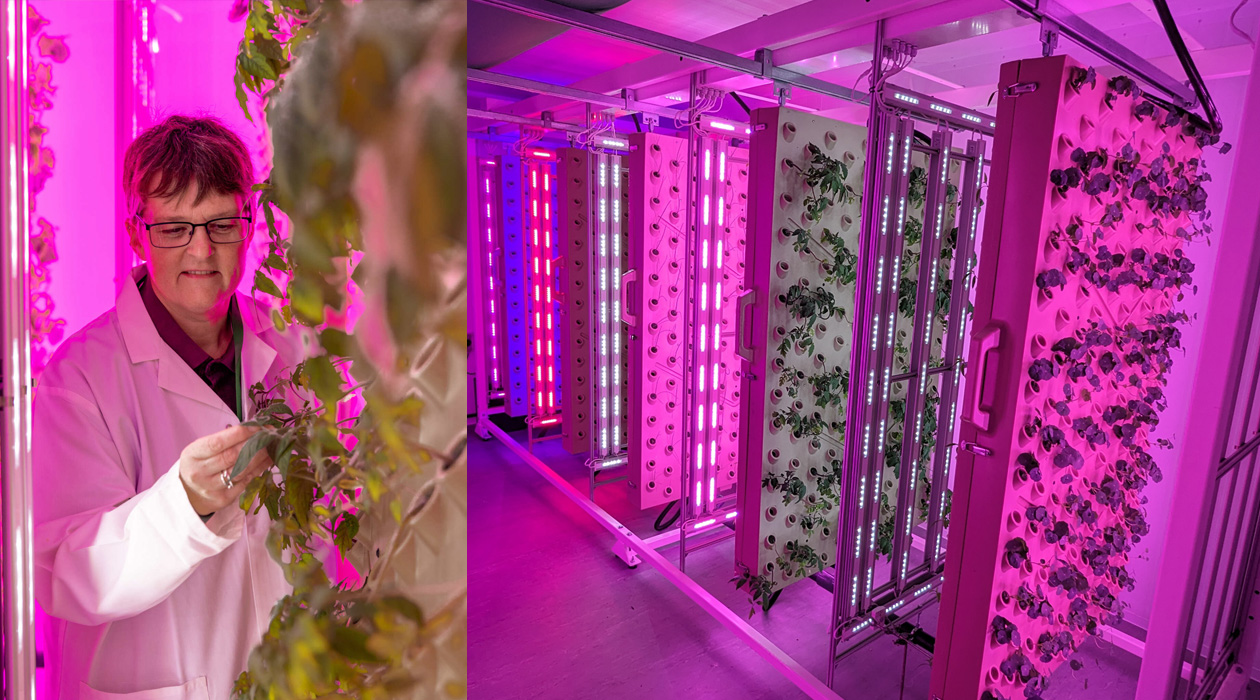
Tracy Lawson in the commercial-standard vertical farm in the University of Essex’s pioneering STEPS lab. / University of Essex

Share
Plant owners with a so-called green thumb often seem to have a more finely tuned sense of what their plants need than the rest of us. A new “smart lighting” system for indoor vertical farms grants this ability on a facility-wide scale, responsively meeting plants’ needs while reducing energy inefficiencies, clearing a path for indoor farms as an energy-efficient food security strategy.
The system was designed and tested in a study led by Professor of Plant Biology Tracy Lawson (CAMBERS/PFS), who conducted the research at the University of Essex and is now a member of the Carl R. Woese Institute for Genomic Biology at the University of Illinois Urbana-Champaign. The work, published in Smart Agricultural Technology , emerged from her goal to help establish the viability of vertical farming for large-scale food production.
"One of the key aspects of [vertical farming], of course, is the energy cost associated with using LED lighting,” Lawson said. “So that's where it all started, trying to save energy.”
Modern farming faces a myriad of challenges, including pest management and extreme weather, even as food production demands continue to rise with a growing world population. Vertical farms, housed in enclosed facilities with a smaller footprint and controlled irrigation and lighting, sidestep some of these challenges. They also greatly reduce water use and achieve near elimination of pesticide needs. However, even with high-efficiency LED lighting, the energy costs of vertical farms are a significant obstacle.
Lawson and her collaborators focused on the untapped potential of LED lighting for controlled environment agriculture. In addition to its lower energy demands, this type of lighting offers the same advantages in CEA as in home theaters—its intensity and color are almost infinitely adjustable. Despite this, the majority of existing vertical farm setups use lighting on simple on/off schedules. Building on her earlier studies examining the effects of dynamic light regimes (such as those characteristic of natural environments) Lawson and her team consistently observed a decline in photosynthetic efficiency toward the end of the photoperiod. These findings call into question the common use of simple square‑wave on/off lighting regimes in CEA. Plant scientists and growers alike lack information about what lighting schedules crops might prefer.
Lawson's team realized they could solve this quandary by asking the plants what they needed. How is this possible? When plants are exposed to light, the green chlorophyll in their leaves absorbs light and use it for photosynthesis. However, any light that is not used can damage the plants if not dissipated as heat or re-admitted from the leaves as chlorophyll fluorescence. Chlorophyll fluorescence is a common tool in plant physiology for understanding plant light use and whether a plant is getting more light than it can use in the moment.
“I've used chlorophyll florescence as a tool to measure photosynthesis,” Lawson said. "I thought, we could build a system where we measure photosynthetic efficiency and use this as a way for the plant ‘say’ in real time what it really wants.”
The researchers grew basil, which does well indoors, as their test crop for such a lighting system. They directly measured photosynthetic efficiency of the basil leaves, using a chlorophyll fluorescence monitoring system, and used artificial intelligence to adjust the lighting based on the signals directly emitted by the plant, enabling the plants to adjust their light intensity. If the plants weren’t able to use enough of the light, the lights turned down, saving energy and preventing leaf damage.
The study showed that after reaching a peak of light intensity six hours in, the lighting schedule that responded to plant needs gradually waned over the last 12 hours of light.
“Why does this decrease? A lot of ideas have been put forward, and a thought is that once the plant builds up enough carbohydrates, fixes enough carbon, it's a way to then save energy by not using what it doesn't actually need,” Lawson said. “There’s a suggestion that it's sort of a feedback signal—'I’m full!’”
With the lighting feedback system in place in the vertical farm, the crop yield was increased by about 13% and energy costs were simultaneously reduced by about 6%, exactly the type of improvement that helps put vertical farming within reach. The system is also straightforward enough to be implemented as soon as growers can invest in it.
“I think [the feedback system] is relatively simple to include in a vertical farm now,” Lawson said. “It also has great potential to be used, possibly with other tools, to build up lighting regimes and patterns for different crops. Therefore, specific lighting regimes could be predicted and tailored for the CEA industry, adjusting light without the need for continuous monitoring.”
Going forward, Lawson would like to explore more indoor farming conditions and plant species, seeing how the pattern of basil’s light consumption might generalize. In addition, she is working on exploring and optimizing other aspects of indoor crop production, including the color of the lighting.
“What are the ideal spectra for certain plants?” Lawson asked. “Using light intensity and spectral adjustments, we can manipulate secondary metabolites just before harvest; increase the amounts of anthocyanins, which are antioxidants associated with health benefits; we can trigger rocket leaves to change shape, go purple in 24 h; all with altering the light spectrum . . . I'm also interested in how we can change the lighting conditions and lock in freshness and nutrients. There are lots of things we can do by manipulating the lighting environment.”
The research was supported by the Leverhulme Trust, the Biotechnology and Biological Sciences Research Council, and Enabling Innovation: Research to Application funding to the University of Essex.