


New partnership aims to expand public engagement opportunities in genomics
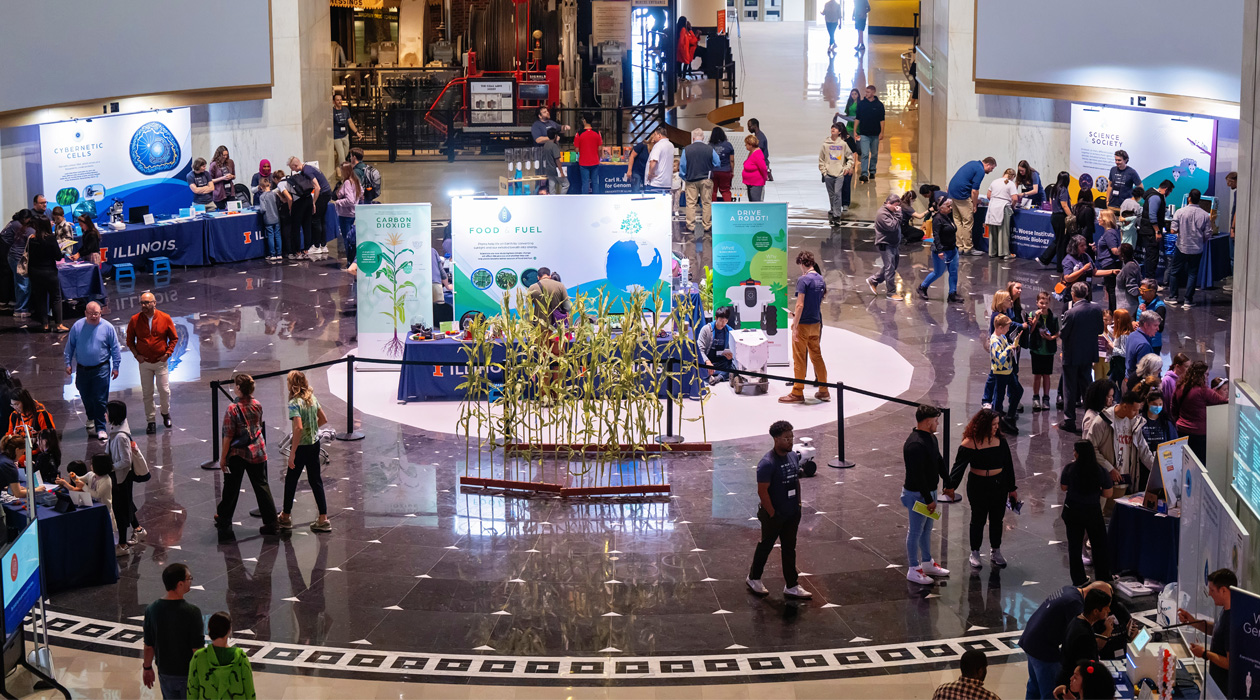
IGB's first World of Genomics at Griffin MSI, "Discover Everyday DNA," took place in October of 2024 and saw over 5,000 visitors attending the 6 interactive stations. / Heidi Peters

Share
Griffin Museum of Science and Industry and the Carl R. Woese Institute for Genomic Biology are extending their collaboration to bring genomics to the public.
What is DNA? How do genes shape the growth of living things? How can gene editing help us cure disease or produce more food? Genomics, the study of the structure and function of an organism’s complete set of genetic material, has an ever-growing impact on areas such as health, technological innovation, conservation, and agriculture, yet many members of the public do not have easy access to resources to understand and evaluate new developments. As this area of science continues to accelerate, communities need more opportunities to engage with these topics. The good news is that genomics is also a fascinating way to look at the living world and see something new.
This phenomenon is what brought together Griffin Museum of Science and Industry and the University of Illinois’ Carl R. Woese Institute for Genomic Biology two years ago. In fall 2024, Griffin MSI and IGB collaborated to offer the World of Genomics, a multi-day event hosted in the Museum’s main rotunda and featuring interactive learning stations staffed by IGB scientists. As one of IGB’s flagship outreach programs, the World of Genomics includes content related to research areas within the institute, spanning human health, agriculture, robotics, microscopy, DNA, societal impact, drug discovery, and ecology. Now, the two institutions are extending this partnership into a 5-year series of events and programming to bring the full breadth of genomics to the public.
The highlight of the collaboration will be three more World of Genomics events, hosted by Griffin MSI with content provided by IGB. The 2026 event will be held October 11-12. Learning stations will be staffed jointly by IGB scientists and members of Griffin MSI’s educational volunteer corps. Each World of Genomics event in the series will feature a different theme of genomic research, covering biotechnology advances, health and wellness innovation, and agricultural and environmental breakthroughs.
“This partnership is allowing us to reach an audience that is already interested in the sciences, and they're getting to learn something that even goes beyond what they were expecting when they visited,” said Assistant Director of Outreach Daniel Urban, who will lead the event on behalf of the IGB. “The space itself is also a beautiful setting, and the way the rotunda is centered, it allows you to interact with everyone that comes through the museum.”
Beyond this flagship event series, the IGB will also contribute to several existing Griffin MSI programs, bringing hands-on genomics activities and guest experts to the museum’s Junior Science Cafe series, Kickoff to Summer Picnic, and annual museum-wide career showcase. This will add a dimension of cutting-edge science to the museum’s work to provide STEM career resources to middle and high school students.
“We are excited to partner with Griffin MSI to bring IGB science, innovation, and outreach to Chicago residents and visitors,” said IGB Interim Director Lisa Ainsworth. "One of the goals of our outreach team is to create accessible and relevant pathways for the public to engage with and learn about IGB research. Fantastic events like the World of Genomics truly embody our mission to bring science to society."
Altogether, these offerings over the coming years are the product of the alignment of the mission and values of both institutions, to move forward a societal-level dialogue about science and what it can do for society.
"What excites me most about this partnership is the access it creates. It gives our guests the opportunity to interact with working scientists and engage with current research,” said Griffin MSI Head Scientist Dr. Patricia Ward. “When people can talk directly with the people doing the work, curiosity stops being abstract and really starts taking hold."