


Illinois-Led Team Selected for DOE Genesis Mission Award
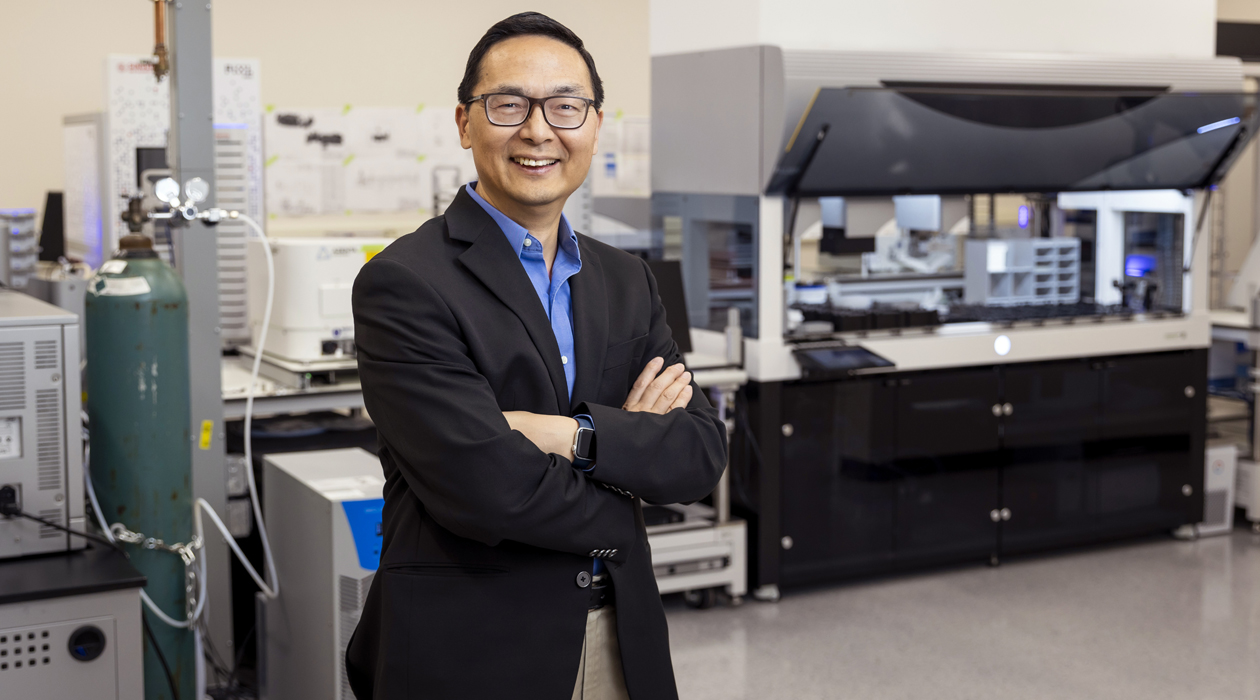
A team led by U. of I. chemical and biomolecular engineering professor Huimin Zhao was selected as a Genesis Mission Awardee by the Department of Energy. / Michelle Hassel

Share
A multidisciplinary team led by U. of I. chemical and biomolecular engineering professor Huimin Zhao (BSD leader/CAMBERS/CGD/MMG) has received a Phase I award through the U.S. Department of Energy’s Genesis Mission to develop the world’s first foundation models specifically designed for metabolic engineering.
Metabolic engineering enables microorganisms to produce value-added products such as renewable chemicals, fuels and materials. However, identifying optimal biological designs requires navigating a vast number of possible genetic and metabolic combinations. Existing machine learning approaches are often developed for narrowly defined tasks and depend on limited datasets, making it difficult to apply them broadly.
“Biological design presents an enormous challenge because of the complexity of genes, enzymes, metabolic pathways and environmental interactions,” Zhao said. “Our goal is to create artificial intelligence foundation models that can learn from diverse biological data and help scientists predict and design new biological functions much more efficiently than is possible today.”
The Genesis Mission is a historic national initiative led by the U.S. Department of Energy, which is building the world’s most powerful integrated science discovery platform. By uniting government, industry, academia and philanthropy, it is accelerating breakthroughs in energy, scientific discovery and national security through a new platform that combines AI, supercomputing, quantum systems and advanced scientific instruments.
Zhao is joined by co-investigators Hector Garcia Martin of Lawrence Berkeley National Laboratory and Arvind Ramanathan of Argonne National Laboratory. Together, the team will develop metabolic engineering foundation models, or MEFMs, a new class of AI tools designed to transform how scientists engineer biological systems for domestic manufacturing. The team joined with others from across the nation at the Genesis Mission Summit in Washington, D.C. on July 22.
“This project is an exciting next step in the era of AI-enabled scientific discovery and will drive breakthroughs in energy, biotechnology and national competitiveness for years to come,” said Susan Martinis, senior vice chancellor for research and innovation at Illinois. “Professor Zhao’s remarkable vision will transform metabolic engineering and we are thrilled that the team has been selected to participate in the first cohort of Genesis Mission projects.”
The proposed MEFMs will be trained using diverse biological datasets, including genomic sequences, metabolic networks, protein structures and multi-omics data. The models are expected to learn transferable representations of biological systems that can support a wide range of applications, from pathway optimization to strain engineering.
The project builds on nearly a decade of work funded by the DOE’s Center for Advanced Bioenergy and Bioproducts Innovation at Illinois, expanding on the TorchCell framework developed by Zhao. The team will also develop a next-generation genome large language model that builds on the GenSLM platform pioneered at Argonne and integrate advanced AI capabilities with extensive experimental infrastructure.
The award was made through the Genesis Mission’s Phase I Request for Applications. The goal of the Phase I RFA awards is to identify promising pathways toward transformative scientific capabilities and establish a foundation for future investment and scale. Project teams will design and demonstrate research workflows that integrate AI with scientific investigation while rigorously evaluating whether those approaches can accelerate discovery, improve predictive capabilities, enhance experimentation or generate new scientific insights.
If successful, the MEFMs could significantly accelerate the design-build-test-learn cycle that drives metabolic engineering, enabling predictive design of metabolic pathways, enzyme functions and microbial production systems across multiple organisms.
“Our vision is to make metabolic engineering far more predictive and scalable,” Zhao said. “This capability could dramatically shorten development timelines for domestic biomanufacturing and help unlock new solutions for energy, materials and industrial biotechnology.”
The collaboration among leading researchers at the University of Illinois Urbana-Champaign, Lawrence Berkeley National Laboratory and Argonne National Laboratory brings together expertise in artificial intelligence, synthetic biology, laboratory automation and large-scale scientific computing to advance the next generation of scientific discovery.