


New publication charts a path to democratized molecular innovation
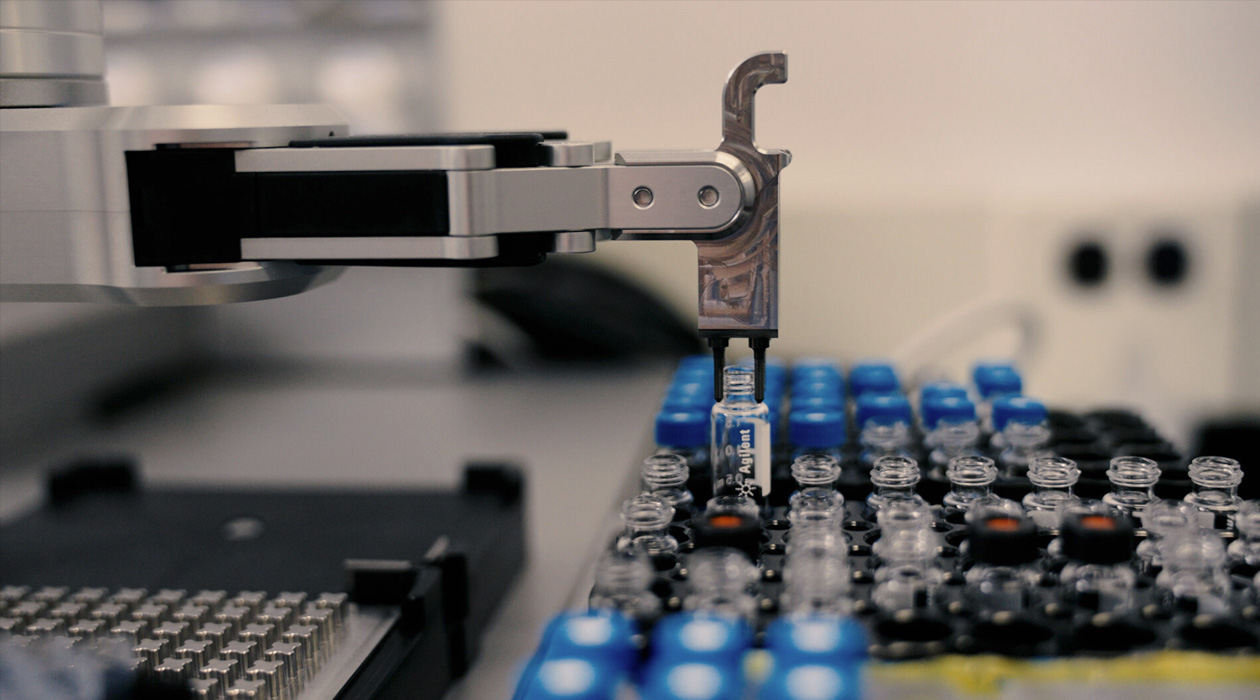
A robot positions "bloccs" for assembly via automated, iterative carbon-carbon bond formation. Molecule Maker Lab

Share
A paper published in the journal Science lays out a roadmap for broadening access to the process of discovering molecular tools that can benefit society, including medicines, materials, and a wide range of everyday consumer products. In parallel, the Molecule Maker Lab (MML) at the Beckman Institute, University of Illinois Urbana-Champaign, announced the formation of a global Task Force charged with prospectively developing safeguards to minimize the risks and maximize the benefits of democratizing molecular innovation.
In “Bonding Carbons Iteratively,” author Martin D. Burke (MMG), the May and Ving Lee Professor for Chemical Innovation at Illinois and founding Director of the Molecule Maker Lab (MML) at the Beckman Institute, describes a modular approach for making molecules called “blocc chemistry.” This method builds small molecules via iterative assembly of prefabricated building blocks, or “bloccs.” Unlike traditional chemical synthesis — which for nearly two centuries has relied on highly specialized, largely inaccessible human expertise — blocc chemistry allows carbon-carbon bonds, the backbone connections in nearly all organic molecules, to be assembled iteratively and automatically. This feature opens the door to robotic synthesis, AI-guided molecular discovery, and participation by nonspecialists, including students and citizen scientists.
“Blocc chemistry enables automation of organic synthesis, rapid generation of modular datasets for training AI models, and broadened access to molecular innovation,” said Burke. Early demonstrations of the approach have already contributed to AI-guided discovery of top-in-class organic laser emitters, durable organic solar cell materials, and other functional molecules.
Burke also emphasized that broadened accessibility needs to be coupled with shared responsibility. As he writes in the paper, “it is important to establish safeguards and best practices to ensure that small-molecule discovery is leveraged safely and responsibly,” pointing to biosecurity models such as the International Biosecurity and Biosafety Initiative for Science as a starting point for what governance of democratized molecular innovation could look like — including centralized monitoring of automated synthesis, algorithmic flagging of potentially dangerous compounds, and independent auditing of governance practices.
To translate that call into action, the MML is assembling an international Task Force of global thought leaders — spanning chemistry, artificial intelligence, medicine, industry, science education, students, and community members — to prospectively shape safeguards that can guide and govern this technology as it scales.
“We wanted to be way out in front of this,” said Burke. “Democratized molecular innovation is coming, and the world needs to get ready for it. The caliber of people already stepping forward to join this Task Force shows just how seriously the field is taking this responsibility.”
The Task Force is expected to convene its first discussions this month, with a consensus report anticipated in early 2027.
***
About the Molecule Maker Lab (MML)
The Molecule Maker Lab is working to make blocc chemistry accessible to anyone in the search for new molecules that benefit society. This opens meaningful possibilities — think medicines for unmet medical needs, technologies for sustainable energy, and progress on some of the world's most pressing challenges.
Acknowledgements
The author acknowledges colleagues for helpful discussions and support by the US National Institute of Health (R35GM118185) and the Molecule Maker Lab Institute, an AI Research Institutes program supported by the U.S. National Science Foundation (grant no. 2019897 and 2505932). The author is a cofounder and shareholder for Excelsior Sciences, a company that has licensed technologies related to blocc chemistry from the University of Illinois.