


IGB Profile: Tracy Parish
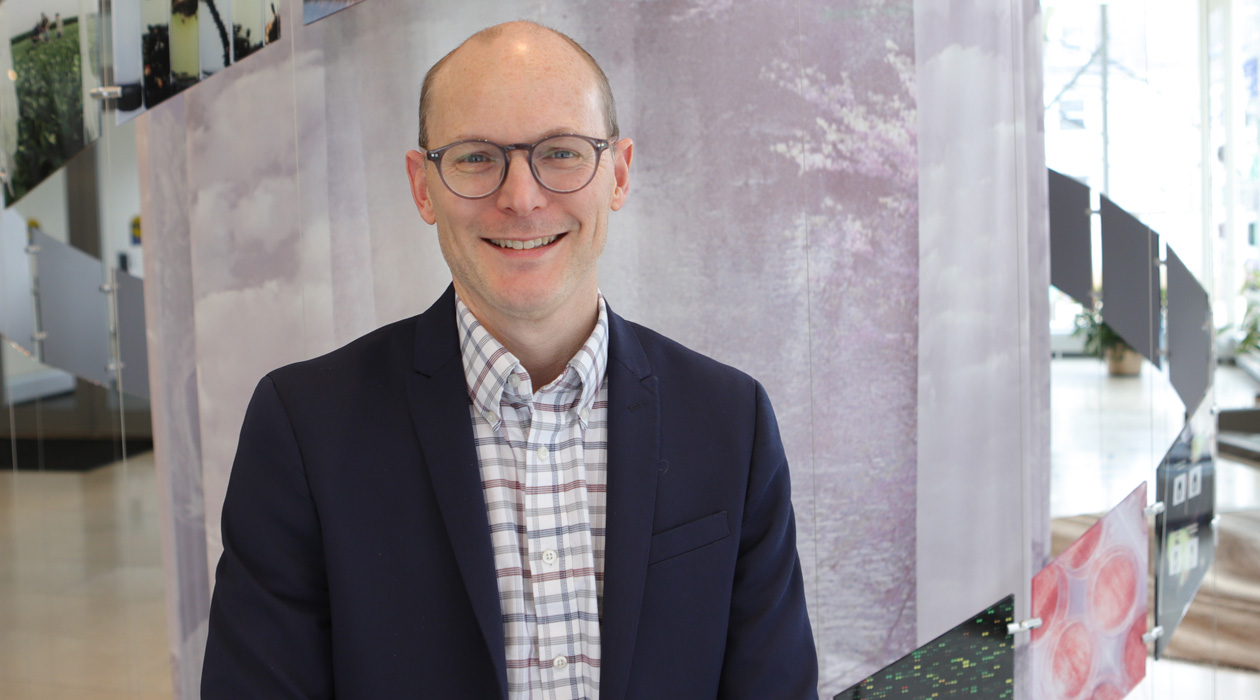
Tracy Parish is the IGB's Director of External Relations and Strategic Partnerships / Julia Pollack

Share
Tracy Parish has a knack for performance, whether as a trumpet player in the Champaign-Urbana Symphony Orchestra, an extra in The Dark Knight, or as the director of external relations and strategic partnerships at the Carl R. Woese Institute for Genomic Biology.
“When you're a performer, you have to build rapport with the audience, right?” Parish said. “What I do is performance. I have to communicate information, but I also have to do it in a way that feels positive to the people I'm talking to . . . so they want to talk to me again.”
As IGB faculty members work to address societal challenges with their genomic research, Parish puts the institute’s motto “where science meets society” into action, playing a critical role in helping to move their innovations out of the laboratory.
“The role itself is really focused on connecting the research themes with a number of different types of partners,” he said. Since joining the IGB in 2022, Parish has worked to build and maintain relationships with potential partners, and he helps faculty members to do the same.
“I meet with the faculty, learn about what they're working on, and try to understand what they are looking for,” Parish said. Depending on their goals, he may connect a faculty member to funding opportunities through philanthropic foundations and government agencies or look to industry to seek out a path towards commercialization.
“I go to a lot of scientific meetings, venture capital conferences, and industry conferences to network, and I connect people that are interested in our technologies with the faculty to help them build those kinds of relationships,” Parish said.
In 2025, for example, the Advanced Research Projects Agency for Health awarded $28 million to a large, multi-institutional team, thanks in part to an industrial partnership facilitated by Parish. After bringing Ginkgo Bioworks to campus, the Boston-based company joined forces with IGB researchers to develop the ARPA-H proposal, called Microbe/phage Investigation for Generalized Health TherapY. MIGHTY aims to harness phages—the natural predators of bacteria—as precision tools to shape the human microbiome and promote health.
Prior to joining the IGB, Parish held numerous positions at Illinois—in public engagement, student affairs, career services, and external relations. But diving into science and research, like the MIGHTY project, was a new challenge.
“I have to do a lot of homework,” Parish said. “You know, when I first started here, I remember thinking, I don't understand half of this. I had to spend so much time learning, reading and listening, trying to wrap my head around what people were talking about.”
Originally from southeastern Ohio, Parish moved to Champaign-Urbana to pursue his doctor of musical arts degree at Illinois, after obtaining his bachelor’s degree in music education and performance from Ohio University. After his graduate studies, Parish started his career as a music faculty member at Illinois Central College.
“I was grading papers, at music conferences, and doing performances all over the place . . . but it just was such a grind,” Parish said. “Because I have a background in the arts, that involved a lot of public engagement, fundraising, audience building, and communication. So that translated into doing public engagement for the College of Fine and Applied Arts here [at Illinois].”
While Parish’s career at Illinois has moved him away from the arts and into the world of scientific research, he is still actively involved in music. As a longtime professional musician in the Champaign-Urbana Symphony Orchestra, Parish plays the trumpet throughout their annual season—about 10 shows from October to April.
Parish also puts his background and training as an educator into practice by contributing to IGB’s professional development efforts. Every summer, his office runs the IGB’s Early Innovator Program; EIP is a 10-week entrepreneurship program designed to teach participating graduate student and postdoctoral researchers the skills necessary to become innovative leaders in their fields.
“I think learning about all the cool stuff that people are doing here at the IGB is probably the most fun part [of the job],” Parish said. “If faculty have ideas for technologies that they want to develop, whether it's an idea for something they're working on the lab or they have a commercial opportunity, they should come talk to us.”