


Incremental progress on a stubborn medical mystery: new studies yield insight on the signs and causes of hypermobile Ehlers-Danlos Syndrome

Share
Some genetic disorders are known for a clear connection between the gene product effected and the suite of symptoms produced. But genes do not work in isolation, and many other conditions can be bafflingly complex, as when an affected gene product impacts the function of many tissues throughout the body. Ehlers-Danlos syndrome, a collection of genetic disorders of the connective tissue, is particularly challenging for those who live with it because of its varied and poorly understood effects.
Three recent studies led by Christina Laukaitis (EIRH/RBTE), a clinical associate professor of biomedical and translational sciences at the Carle Illinois College of Medicine, add to our understanding of a particular form of Ehlers-Danlos Syndrome. Laukaitis and collaborators synthesized multiple types of data, including patient demography, range and severity of symptoms, and physiological data as part of an effort to clarify the occurrence and disease progression of hypermobile EDS.
“These three publications significantly expand our knowledge about the causes and implications of joint hypermobility,” Laukaitis said.
EDS itself is rare, but hypermobile EDS constitutes about 90% of those cases. It is characterized by unstable and hypermobile joints, as well as associated chronic pain. Although hEDS, like other forms of the syndrome, is genetic—it appears with much greater frequency in those with a close relative who is also affected—the multiple genes underlying its development have not been identified. This makes hEDS difficult to diagnose; without a causal explanation of symptoms that associated genetic changes might provide, it is also more difficult to innovate treatments.
In a study described in PLOS One, Laukaitis and collaborators at the University of Arizona, St. Jude Research Hospital in Memphis, and the Carle Health Stephens Family Clinical Research Institute in Urbana, Illinois addressed this knowledge gap. The research team surveyed patients with hEDS, those with another disease called hypermobility spectrum disorder, and non-hypermobile individuals.
Including individuals representing a range of symptom severity provided new potential insight into the development of hEDS. The research revealed that hypermobile individuals without chronic pain tended to be younger and also had physical differences from the non-hypermobile control group, suggesting that they might represent an earlier point in disease progression.
“Exploring cross-category relationships between symptoms in people with hypermobile EDS” was an important goal of the study, Laukaitis said. “In addition to describing the significant multi-system impairment people with EDS face, its major new finding is that people with hypermobility have symptoms, even though they might not report pain.”
A second study published in Sleep and Breathing and co-led by Laukaitis and Clinical Associate Professor of Neurology and Neurosurgery Charles Davies examined the relationship between hEDS and sleep apnea.
Obstructive sleep apnea is a disorder in which soft tissues in the back of the mouth and throat relax and block the airway during sleep. Individuals with hEDS are known to be at a higher risk for sleep apnea; researchers believe this may be because of the weaker and more flexible connective tissue associated with the disorder. The recent study examined whether this difference in the cause of sleep apnea may be associated with differences in the effectiveness of treatment with a continuous positive airway pressure device.
“The work on sleep apnea makes the surprising discovery that, while compliance with treatment is excellent in hypermobile people with sleep apnea, their symptoms of sleepiness do not improve as much as in non-hypermobile people,” Laukaitis said. “This makes it vital that we understand the multi-factorial causes of fatigue in this population.”
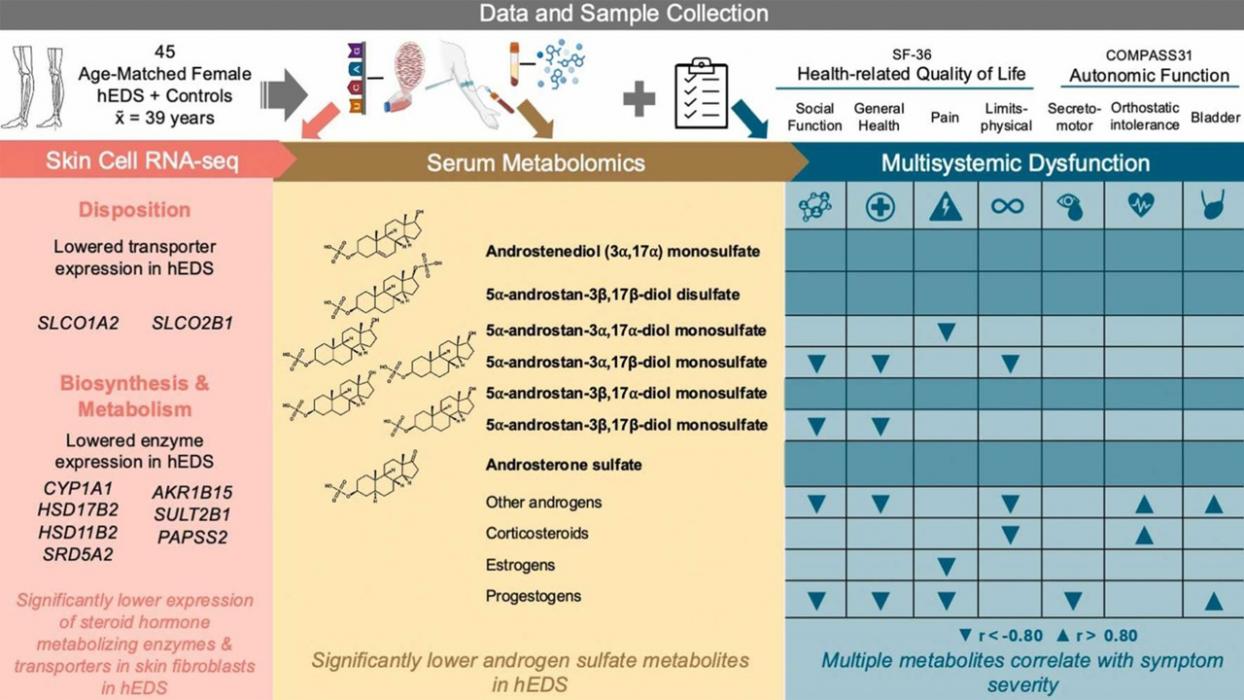
A third study examined hEDS from yet another angle, exploring possible correlations between hormonal differences and symptom severity in women with hEDS. The study, which Laukaitis conducted in collaboration with postdoctoral researcher Sarrah Hannon and Associate Professor of Genetics and Developmental Pediatrics Jennifer Andrews at the University of Arizona, was published in the Journal of Steroid Biochemistry and Molecular Biology.
“[The study] makes a novel and exciting observation that androgen levels differ in people with hEDS,” Laukaitis said. "Here we directly identify relationships between hormone levels and hypermobility, validating the clinical observation and opening a new area of study.”
Building on this particular study and the entire suite of work on hEDS, Laukaitis and her colleagues hope to develop a more definitive diagnostic test for hEDS. The new insights into the connections between signs and symptoms of the disease may also point to novel and more effective treatments.
The work in these publications was made possible by funding from the Maltz Foundation, the Ehlers-Danlos Society, and an anonymous donor to EDS research at Carle Health. Laukaitis also expressed the research teams’ gratitude to the care providers and participants involved in the work.
“We would like to acknowledge the >80 people who told us about our symptoms and provided biosamples (blood, urine, and skin) for the hormone ‘OMICS and PLoS One studies,” she said. "We also are grateful for our collaborators in pulmonary medicine at Carle and Carle research who were eager to interrogate their clinical data about sleep disorders.”