


New IGB theme seeks to bridge gap between large-scale population genomics and predictive ecology
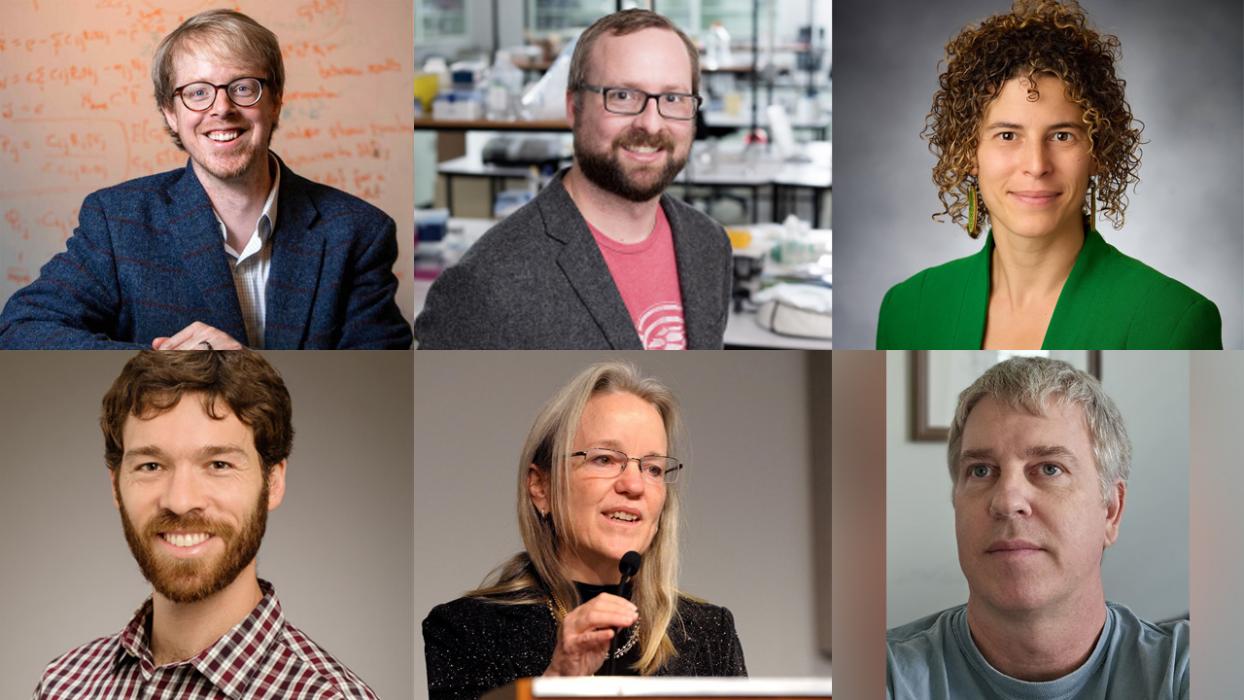
GECO faculty members and affiliates, top left to bottom right: Theme leader: James O’Dwyer (Plant Biology); Mark Davis (Illinois Natural History Survey); Rose Marks (Plant Biology); Ilan Shomorony (Electrical and Computer Engineering); Tandy Warnow (Siebel School of Computing and Data Science); and Mathew Yoder (Illinois Natural History Survey)

Share
The Carl R. Woese Institute for Genomic Biology is announcing a new research theme, Genomics for Ecological Communities (GECO), which will be led by James O’Dwyer (GECO leader/CAIM), the associate head and a professor of plant biology at the University of Illinois Urbana-Champaign.
“The core idea of our theme is that genomic data can transform how we understand and predict processes in community ecology, and how we can apply this understanding in conservation biology,” O’Dwyer said.
The new theme will use population genomics to address challenges involved in modeling complex ecological systems, predicting future ecosystem dynamics and mitigating biodiversity loss.
“We often don’t have the resources, time, or appropriate methods to effectively capture change in communities. Integrating genomics with community ecology allows us to ask fundamental questions that we haven’t be able to tackle before,” said Grace Magavern, a graduate student in plant biology.
Many different factors that impact ecological systems vary across time, geographic region and different groups of organisms. Due to the natural complexity of these systems, ecological theory has often struggled to reliably connect mathematical models and predictions with real-world ecology. Population genomics, however, has the potential to resolve these issues. The field of population genomics examines how the genetic makeup of a group of organisms from the same species changes over time.
In comparison, community genomics examines the collective genetic material of multiple different species coexisting in a shared community. Prior research from O’Dwyer and others demonstrated that genomic data gathered across multiple species within a community contains valuable, predictive information for community dynamics that studies on a single species alone can’t provide.
Imagine a forest. “Forests aren’t just one kind of tree, they are communities. Communities like Champaign-Urbana for example, thrive when many different parts play together, this is true of the natural world as well,” said Matthew Yoder (GECO), a research scientist and biodiversity informatician at the Illinois Natural History Survey.
“At GECO we’re studying what makes natural communities successful, and how they change or possibly fail. We’re doing this by looking at real forests and their DNA, taking this information and creating models to predict how they might change,” Yoder said.
Damla Cinoglu, a postdoctoral researcher in the O’Dwyer lab, is working to understand forest community dynamics. “My work involves pairing forest census data with newly collected genomic data across diverse tree species in the U.S., including recent field campaigns in Illinois and Utah. Using this data, I will expand the model’s mechanistic scope and parameterize it to predict short-term community dynamics,” Cinoglu said. “In parallel, I am helping design and establish a community-level genomic demography database to curate and share these multi-species datasets.”
Combining expertise from plant biology, natural history, electrical and computer engineering and data science disciplines, the researchers plan to curate existing population genome data, while also launching campaigns to collect new datasets, and applying theoretical modeling to both to predict future scenarios.
“I’m excited to apply new techniques and ideas. I think the combination of expertise on the team is really synergistic and could lead to some novel findings. It’s fun to work with people across disciplines,” said Rose Marks (GECO/PFS), a professor of plant biology.
By working across disciplines, the researchers foster a mutualistic relationship, much like those found in ecological communities, where members can learn and benefit from one another. For example, the collaboration between GECO and the Illinois Natural History Survey, or INHS, will help both grow stronger together.
“Coming from the INHS where we have world-class collections, one of my long-term goals is to strengthen their impact and role in projects like GECO,” Yoder said. “Once we begin to understand what really matters in the field, lab, and during analysis, then we can think about connecting the dots back to critical long-term resources like our INHS collections.”
Beyond utilizing plant biology and natural history resources, the data science and machine learning techniques will enable the researchers to develop predictive models that can more accurately forecast how ecosystems change, respond to invasive species or lose biodiversity.
“My main goals are to help with methodological aspects to improve accuracy and interpretability of the analyses that are done,” said Tandy Warnow (GECO/IGOH), the Grainger Distinguished Chair in Engineering and a professor in the Siebel School of Computing and Data Science.
Developing a predictive framework will lead to fundamental biological insights and ultimately address urgent societal needs to understand and confront future biodiversity change. Joseph Liu, a graduate student in the Program for Ecology, Evolution, and Conservation and a member of the O’Dwyer lab explained that he will be using simulated ecological communities to test how their genomics vary under different parameters.
“Ultimately, my goal for this work is to generate a greater understanding of how ecosystems have changed and will change, as well as support conservation efforts to maintain communities in the face of rapid environmental shifts,” Liu said.
GECO faculty members and affiliates:
Theme leader: James O’Dwyer (Plant Biology)
Mark Davis (Illinois Natural History Survey)
Rose Marks (Plant Biology)
Ilan Shomorony (Electrical and Computer Engineering)
Tandy Warnow (Siebel School of Computing and Data Science)
Mathew Yoder (Illinois Natural History Survey)