

Riley Taitingfong, PhD (Chamoru)
- Biography
-
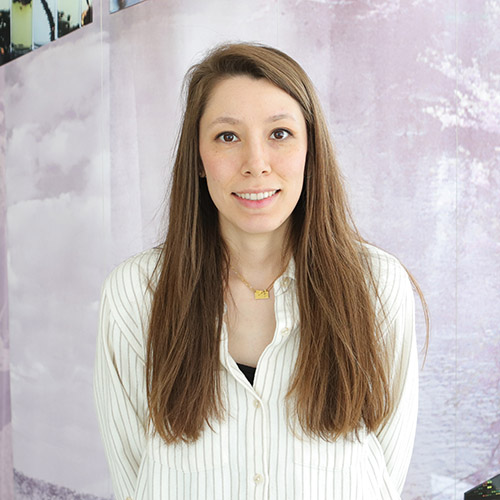
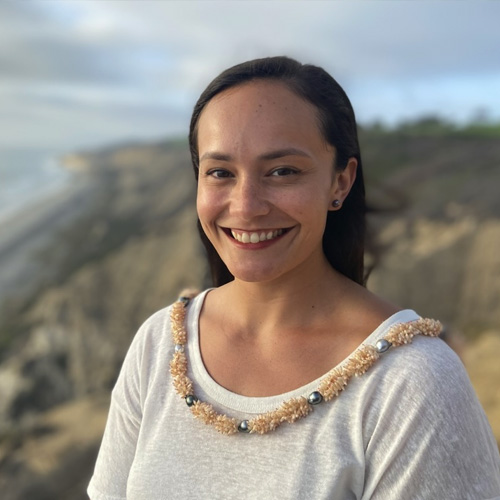
Dr. Riley Taitingfong (she/her) is a Chamoru researcher and educator working on issues of Indigenous sovereignty, environmental justice, and emerging technologies. She is currently a postdoc at the University of Arizona’s Native Nations Institute, where she co-leads several international collaborations focused on advancing Indigenous Data Sovereignty. When she’s not working, Riley enjoys birding, diving, paddling, and spending time with her family.
- Video - Editing Islands: Indigenous governance of gene drives in the Pacific
-
- Interview
-
Joshua Diaz
Okay so, Riley, can you tell me a little bit about yourself?
Riley Taitingfong
Sure. So, håfa adai. My name is Riley Taitingfong. I just traveled here from San Diego, where I currently live. I am a postdoc for University of Arizona, the Native Nations Institute there. I just started that in December. And yeah, I am of CHamoru and European descent. CHamorus are the Indigenous peoples of the Marianas Islands in Oceania and Micronesia. My family is from Guam, or Guåhan. And so yeah, I live in San Diego now, which is one of our biggest diasporic CHamoru communities. So, it’s very nice to be there and have my very large extended family, have big community, all kinds of CHamoru stuff going on year-round. And yes, I do research with the Native Nations Institute. And when I’m not doing that, I like to go birding, I like anything that gets me out to the ocean. I’ve been doing outrigger paddling with Kai Elua club in San Diego lately. So yeah.
Joshua Diaz
I understand, like, being on the ocean, how nice it must be.
Riley Taitingfong
Oh, my gosh, yeah. It’s like medicine. And yeah, I don’t feel good when I don’t have access to the ocean. So, I definitely make a lot of time for that.
Joshua Diaz
Yeah, I’m used to all of, like, the rivers and lakes around, like where my uncle grew up, and everything, like visiting them on the ranch areas and stuff. So, at your position now, how did you first get involved in your research that led to you being there?
Riley Taitingfong
Oh, sure. Yeah. So, you know, I first got interested in research [at] my undergraduate institution. So, I went to University of Washington (UW). My undergrad mentor was Ralina Joseph in the Communication Department. And she was the first professor that I met at UW and that I took classes with that kind of planted the seed in my mind about graduate school. She, with her work that she does really, she really inspired me to, like, get curious about things and ask questions about things and ask critical questions about things. And so yeah, I got interested in research through working with her, and she encouraged me to apply for PhDs. I didn’t really know what that meant at the time. She gave me a lot of practical advice about going after the PhD at institutions that could provide financial support, which was huge. And yeah, so she supported me through the process. And I was accepted at UC San Diego (UCSD) in their Department of Communication. And while I was at UC San Diego, I was really interested in doing community-engaged work kind of in biomedicine and the sciences. And so, a lot of my research early on was looking at the challenges of adapting sort of community based participatory research to scientific disciplines and technology development and things like that. And at the time, at UCSD, there was this huge influx of, you know, funding and this growth of infrastructure to support the development of new genetic engineering technologies. And there was a big conversation in those spaces around how do we engage communities and making decisions about whether we use some of these technologies in the natural world, outside a laboratory setting. And so that’s how I got interested in what my dissertation research was looking at, which is gene drive technologies and Indigenous governance of those technologies. And so, I spent many years in that space working on that. And I graduated in June 2021, with my PhD from UC San Diego, and I’ve been in a couple of postdoc positions.
The postdoc position I’m in now at NNI [Native Nations Institute] is a really awesome fit. I’m loving that the kind of core of what we’re doing is Indigenous sovereignty. And that’s different than other kinds of intellectual communities I’ve been in to this point. So, I think transitioning and finding this position was really came out of not only my interest in Indigenous sovereignty, in technology and data governance, but also in trying to find kind of more value-aligned places at different institutions where I could do that work.
Joshua Diaz
Very nice. So, you kind of answered the second question, which what is what is your current role as being a researcher?
Riley Taitingfong
Oh yeah, so at the Native Nations Institute, I’m working as a postdoc with funding from the Luce Foundation. And I’m working with Professor Stephanie Carroll, Maui Hudson out of Waikato, Jane Anderson at NYU, and we’re really looking at how you actually kind of practice Indigenous data sovereignty in different institutions and repositories. And so, a big part of my work now is building tools to implement the care principles for Indigenous data sovereignty. So, we’re kind of early phase doing work to understand like, if you’re a repository that maybe houses Indigenous data, or other kinds of institutions that do, where do you start when you want to do this kind of work or improve relationships with communities whose data you have? So, I’m, like, right now mostly on this kind of big learning curve to get introduced and familiarized with Indigenous data sovereignty movement and the tools that do exist. So, like the care principles or local contexts from Maui and Jane’s collaborations. So, so yeah, working in that space. And other than that, I do a little bit of teaching. And, yeah, it’s pretty sweet.
Joshua Diaz
So, out of everything you’ve done, what has been your favorite part, either about data collection, or doing actual research being in the lab, community. What has been your favorite part?
Riley Taitingfong
I’d have to say, being able to work in communities that feel more value aligned. You know, like I was saying earlier, kind of, in the past experiences I’ve had have been like, trying to translate the value of Indigenous expertise, or trying to kind of define Indigenous self-determination, and kind of make it legible in different spaces, which is really important work and comes with its own set of challenges. And so, I think recently, being able to kind of realign myself in communities of people that have these long histories doing organizing and activism and research work that is all about Indigenous sovereignty is like, a whole new world of possibility. And there’s so much to learn. So, I feel like I get to actually experience this like, abundance kind of mindset that I like to have as a value and like a guiding ethic, right of like, there’s so much that we can learn from and there’s so much we can do in collaboration. And I’m finding that in new ways that I didn’t before, in higher [education] or in, you know, academic research. So, yeah, I’m stoked on that.
Joshua Diaz
I definitely resonate with that, just based off of, because right now, of course, you know, it’s grant application. So, it’s like, the literature of everything and seeing how much isn’t done on my topic, but how much Indigenous communities do on the topic is very interesting to me, and then having to translate to certain audiences that what Indigenous communities did is just as valuable as what the peer reviewed, you know, academic journals did.
Riley Taitingfong
Right, just because our knowledges aren’t, you know, living in these journals behind paywalls doesn’t mean that they’re not valuable.
Joshua Diaz
Exactly. Just because I didn’t have to pay $35, like, doesn’t mean that it’s not [funded? 8:38] knowledge. So now, like, do you have any advice for young Indigenous people interested in science or science-related fields?
Riley Taitingfong
Yeah, definitely. So, I would say, first, follow both your curiosity and your cultural protocol, in kind of navigating your journey into science or academia. So, you know, really being in touch with what makes you feel interested, asking questions all the time, and pursuing those topics that are, you know, make you kind of come alive. And at the same time doing that in ways that align with your values and your cultural protocol. And so, I think it’s really important to be critical about the intellectual communities that you’re entering into, the institutions that you’re working at. What are their histories, you know, what are their relations with Indigenous peoples and maybe with your community? And understanding how you can do work that isn’t going to sort of compromise your value system. I think that’s really important. And I’d also say to just go places that make you feel whole, you know. Like, maybe you need the water, maybe you need community, maybe you need to have access to other practices that, you know, ground you. And I think going into any kind of higher [education] system or program, and having to go through these, like rigorous milestones can be really rewarding for sure, but challenging. And so always having space that you can like come back to yourself or your community and your grounding practices is very important. It’s a big reason that I decided to do a PhD in San Diego was because I have a ton of family there who helped, you know, kept me fed and loved on and because I had the ocean and you know, so many Chamorros.
Joshua Diaz
Yeah, it’s interesting. So, I went to a predominantly first-generation, immigrant university [for] my undergrad. I went to Fresno State. And so being there, you know, being Indigenous, it wasn’t a crazy thing. You know, everyone was like, “oh, yeah, I’m from this region. I’m from that region.” You know, “I’m from this state,” and all of it made sense. And then being transferred to the Midwest, let alone Illinois, a removal state, it’s like all of a sudden, you’re just dwindled to like, the group of us that come from all these different backgrounds. And you have to build your own community here. But it’s, it’s definitely interesting doing that. I did not expect that transition. But it’s one that has been good. But it’s interesting, nonetheless.
Riley Taitingfong
Yeah. And I’m so glad that you have people you can build with too. I think that’s part of the thing is, like, if you go somewhere and you’re not as represented in certain ways, like, do you have the resources you need? Do you have the people that you need to build what you need so that you can have those things? And, you know, so I’m glad to hear that you have that. And I’m excited to hear more about what y’all are doing to do that.
Joshua Diaz
So, you were talking about how, when conducting research you need, it’s important to keep in line your values and your cultural protocols. So as an Indigenous scholar, how does your methodology differ from non-Indigenous researchers?
Riley Taitingfong
Yeah, that’s a good question and something I think I feel a responsibility to kind of always be coming back to as part of my practice. I would say, as a Pacific Islander too, like, it really means trying to come to my research with a more expansive mindset, right? Looking at things as more connected than sometimes these like dominant framings in research can be. So for example, my dissertation research was looking at proposals to test new genetic engineering technologies on islands. And in sort of diving into that work, the discourse is very dominated by these sort of concepts of isolation, of looking at islands as sort of natural laboratories. And that’s like a whole different framework from what I believe, and many Pacific Islander communities believe, which is that islands are inherently connected, not disconnected or isolated by the ocean, right? And so, I think translating that into like, a deeper set of values and practices is like, how do we understand the relationships and the ways that we’re connected, right, even though the institution can do things to kind of make us feel separated or shape these scarcity mindsets, and kind of attempt competitive practices, right? And how can we just do research in a good way, and by that, I mean, being in good relations with the peoples and, you know, the places and more-than-human relatives that our research affects, right? And so, I think it is a constant question of being in responsibility both to like my home islands while I’m in diaspora and being in responsibility to the Indigenous peoples on whose lands I’m living in diaspora. So, so yeah, I think the short answer is it’s just taking seriously these responsibilities to, you know, embody my value system and my research and also build relationships through the research that can make positive change and grow our movements, you know, as Indigenous peoples together across communities too.
Joshua Diaz
So, other than building the relationships from conducting this research, what other benefits do you see from indigenizing your field, for example?
Riley Taitingfong
Yeah, I mean, I think the relationships are a big part of it. I think being able to kind of speak more truth, or do more truth-telling within our respective institutional settings is another benefit too. I mean, I think there’s so many ways that the stories we’re told about higher education or about research, just wash out the more unsavory parts of history, right? I know, there’s been conversations here in this movement for land acknowledgments about, you know, actually reckoning with the forcible displacement that is part of that history as a land-grant institution, right? And similarly at UC San Diego. So, I think we’re in an important moment right now where there’s a lot of like, talk and hand-waving about indigenizing and acknowledging these things. But being able to tie those more deeply to like material outcomes and practices is really important. So, I think that’s important for like, higher [education] overall is like, how can we move beyond the sort of window dressing to actually mobilizing resources that will materially, you know, make change for Indigenous communities? For my fields, specifically, I just, I think that there’s so much expertise that, you know, is stewarded by different Indigenous communities. And when I think of like doing good community engaged science, I think there’s so much opportunity to learn from and with people who have relationships to the ecosystems that people are looking to impact with, for instance, use genetic engineering technologies. So, you know, I’ve been discouraged in moments because I think the way community engagement in some of those spaces is happening is more of an exercise in PR and marketing and kind of like, “let’s educate these lay people so that they’ll agree to the use of these technologies,” when I think we have this great opportunity that I am encouraged by alternatively, that’s like, what if we actually do some mutual learning? What if we recognize and pursue much more expansive ideas about where expertise lives? Like, I think we’ll be so much better equipped to, you know, approach these really complex environmental challenges when we actually work with people who have such historied knowledge in these spaces.
Joshua Diaz
No, I understand. It’s interesting with my research how the stats only capture a fraction of what’s really going on, you know? And so for these institutions to not understand that community knowledge is just as, if not more important, than what you can produce on a slide or on a PDF. So, it’s interesting, I’m glad that that there’s more people paying attention to it now. But it’s, it’s interesting. I don’t know if you relate, but the community knowledge I had before coming, you know, how I knew my cultural values, everything like that coming in, and to see it as like a new novelty kind of thing is where you’re like, you got to do a double take. Like, it’s new, you know what I mean? So that’s kind of what I’ve been going through is just that, “oh, this is this is new for you,” right?
Riley Taitingfong
Yeah, definitely. Yeah. And I think it’s nice to have opportunities to be able to bring that knowledge into these spaces, and it is a practice to be taken seriously. And, you know, there are certain things that we also have to protect from the ways they may quickly get exploited in some of these spaces. So, I hope we can stay in conversation about how you’re navigating that because I think that can be really complicated as well. Yeah.
Joshua Diaz
All right. Well with that being said, that was all of our questions for the Center for Indigenous Science. Thank you for doing all of this. I very much appreciate it, and I know Ripan and Jenny do too.
Riley Taitingfong
Si Yu’os ma’åse’. Thank you very much. Appreciate it.